

Implausible, by Chris Morrison (Free Speech Press, 2026)
Movements obsessed with the imminent end of the world have recurred throughout history. They all share the conviction that Armageddon will be caused by the sins of humanity, and that only self-flagellation will propitiate the angry gods. They’re usually fixated with coercing others into the same mindset.
In the past these movements were religious in nature. God, or any god, they claimed was enraged by evil human beings who therefore needed punishing. We, however, live in a secular age. The present orthodoxy has been recast in a bizarre contemporary conflation of pseudoscience and religious fervour to create a unique variant on ancient and medieval mentalities. “Orthodoxy means not thinking — not needing to think. Orthodoxy is unconsciousness.” (George Orwell, 1984.)
Chris Morrison’s Implausible is a short book (100 pages) which these days, when a gnat’s attention span is about the most any author gets, is a good idea. The cover has some wonderful headlines from recent years. My favourite is the Guardian’s ‘Joanna Lumley says wartime-rationing could help solve climate crisis’ (October 26th 2021). What’s next? Climate Crisis Precautions wardens berating residents with a revived “Put That Light Out!” and “Turn That Boiler Off!”?
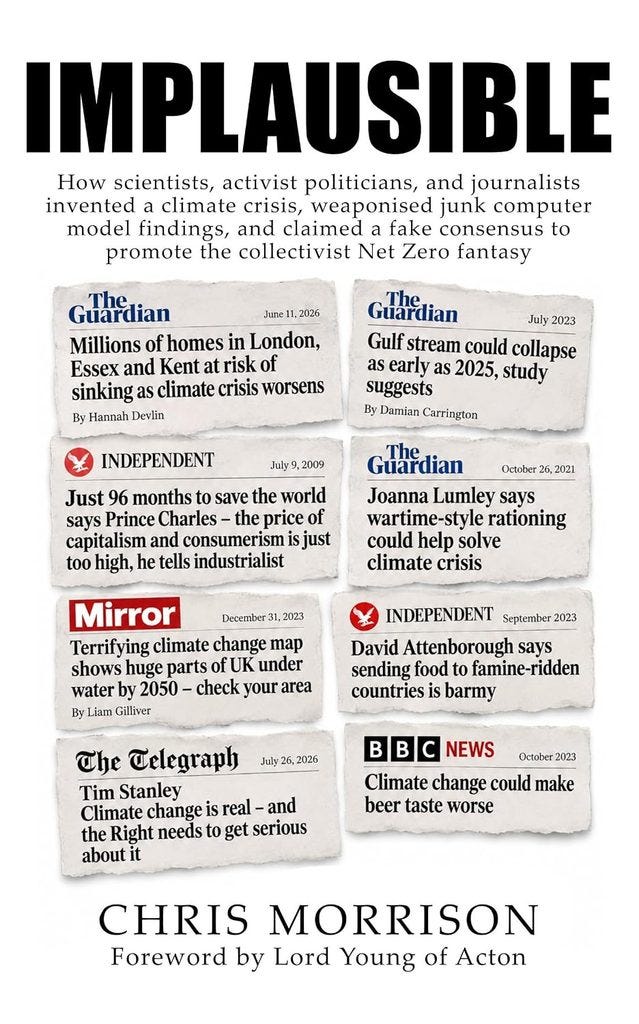
Apart from the prelims and end matter, Implausible has five chapters on “Hydrocarbons”, “Climate Science”, “UK Met Office”, “Net Zero” and “Climate Clots and Comedians” (the latter including such luminaries as George Monbiot and his litany of date-locked apocalyptic predictions that have never come to pass). The book is, if you will, an exposé of a phenomenon Charles Mackay described in 1841:
Every age has its peculiar folly; some scheme, project, or phantasy into which it plunges, spurred on by the love of gain, the necessity of excitement or the mere force of imitation. Failing in these, it has some madness, to which it is goaded by political or religious causes, or both combined.
Extraordinary Popular Delusions and the Madness of Crowds (1841) (Chapter on Crusades)
In the Foreword, Toby Young says: “Reading it will make you angry — and you should be angry, very angry. But you’ll also be very entertained.” His take on Chris Morrison’s theme is that “the climate agenda is a thinly disguised power grab by the lanyard classes, determined to assert control over the unruly masses who are proving stubbornly reluctant to give up their sentimental attachment to freedom”.
The whole ‘climate crisis’ all made sense to me when I realised it’s about a very small number of people making a vast amount of money out of, and controlling, everyone else.
Toby’s words could easily be applied to how medieval aristocracies sought to control the peasantry, or how the Victorian landed, political and commercial elite kept the working classes on a tight leash. Plus ça change.
One of the problems with a book like this is that it’s difficult to imagine a screeching eco-protester or a self-righteous Green MP or councillor buying a copy, let alone reading it or being converted. In our polarised era it’s increasingly difficult to have a reasoned debate about anything.
Morrison kicks off with the bombshell that on April 7th 2026 the “United Nations-backed Intergovernmental Panel on Climate Change (IPCC) admitted that a set of computer model assumptions commonly known as RCP8.5 were ‘implausible’”. It thereby fired a missile right through the Armageddon stories fuelled by its “high emissions worst-case scenario” that we have been bombarded with by armies of credulous journalists and the Met Office among others for the last few decades. This is important because the whole ‘climate crisis’ cult was only ever going to falter if its own proponents start giving up on it.
Morrison bears down on the meretricious consequences of the RCP8.5 assumptions. “Easily convinced politicians have been taken in by invented claims, and Net Zero rules and regulations have flowed through the economy and society.” Result? Among other outrages, British consumers are now stumping up an extra £200 billion on their electricity bills.
Sir David Attenborough does not escape Morrison’s attention. In 2022 the national hero and holy relic warned that the Arctic was on course to be summer ice free by 2035. But it’s been stable for 20 years now, says Morrison, who points out that polar bears are currently on a roll and mysteriously not teetering into extinction.
To that we can add the mysterious failure of Antarctica to be ice-free by 2023 as well as the apparent downright ignorance of past fluctuations like the high of 1964 not matched again until 2014, or the low of 1966 matching a recent dip. This seems to be a common feature of today’s pseudoscience: an inclination to regard any recent deviation from the mean as unprecedented and of weapons-grade significance.
Like so many people of my age I can vividly recall the insistent predictions (including from my teachers) in the early 1970s that the oil was about to run out, the atmosphere was about to be unbreathable and overpopulation would all conspire to bring about a collapse of civilisation.
The funny thing is that pseudoscience is most likely to be peddled by people who claim to be scientists. Morrison homes in on the problem:
Over the last few years, the implausible pseudoscience of individual weather attribution has taken hold, driven in part by the need of lawfare activists to pin bad weather on industrial operations. This involves comparing two imaginary atmospheres with different levels of CO2 and producing a computer model finding that an individual weather event is X times more likely to be caused by humans.
Next a fusillade of press releases is sent out to credulous, copy-hungry journalists desperate to fill their bulletins. I can bear witness to that because a long time ago in another galaxy far, far away, I used to work for BBC radio news. Slow news days are always the most dangerous. The hacks reach out for the pile of press releases sent in by charities, political spin-doctors, publicity-hunting commercial concerns, and – of course – ‘scientists’ of every conceivable hue desperate for prominence in their fields.
The next thing you know is that something which might never have been a story has been propelled into people’s homes, often terrorising children, and taken on a life of its own. The whole edifice of scientific publication has been consumed by a movement to suppress anything which diverges from the Holy Writ of the impending end of the world. Citing several chilling examples, Morrison observes:
There is certainly a ‘consensus’ in much mainstream climate science publishing – a consensus of fear that unless the agreed narrative is followed, the chances of publication tend towards zero.
The message might be shifting, something that Morrison mentions. On Friday October 23rd 2026, Radio 4’s Six O’Clock News covered Storm Austen and the damage it had wrought, as well as the prospect of two more storms to come in the following days. I listened with interest, waiting for the Usual Suspects, the BBC’s climate and environment correspondents Justin Rowlatt and Matt McGrath (the latter the recipient of a €100,000 award from the pro-green technology Banco Bilbao Vizcaya Argentaria apparently) to be wheeled out.
After all, these days there isn’t a rain shower or breeze we aren’t told was wildly worse than it would have been in the Good Old Days thanks to human-induced climate change. However, climate change went without mention in the bulletin and human responsibility for all our weather woes was ignored too. It was almost like listening to a programme from over 20 years ago.
Nonetheless, my hopes were dashed when a BBC Radio 4 Today presenter announced on October 26th 2026, “we do know however that the weather is getting more extreme”, continuing to peddle the eternal fiction that once upon a time the weather was stable, benign and predictable and only now has it taken a turn for the worse. Morrison cites the 17th-century weather observer Richard Shann and his enthusiasm for climate alarmism (I covered other examples from this period in Daily Sceptic in 2023). Fings ain’t what they used to be, goes the refrain. They never are, are they?
“Climate stability has never existed,” says CM, but “climate science has degenerated into a discussion based on beliefs”:
Political correctness is destroying many academic institutions which are turning into junk echo chambers peddling whatever crazy nostrums bring in the cash and garner mainstream attention.
This has coincided with a proliferation of academic institutions populated by intellectual 12 year-olds each desperate to blaze their way across the firmament.
Then there’s the Met Office, with its “bizarre methodologies and unchallenged hysterical weather claims” used to spread “the necessary climate alarm to promote Net Zero”.
Perhaps one of Morrison’s most convincing points also ought to be obvious:
Science is never ‘settled’ – what was occurring was a deliberate trashing of the scientific process for obvious command-and-control political motives. A vast amount of dark money was helping to gaslight entire populations to the extent that individuals were triggered into climate hysteria if anyone dared to dispute the settled doomsday narrative.
This is all fascinating stuff, and it’s delivered in a fast-paced and highly readable text. But is Implausible going to change anything? I’m no scientist, though I’ve long been concerned by the extent to which what I thought was the true scientific method has been submerged under a tidal wave of fake science and scientists who tell you things they ‘believe’, which instantaneously disqualifies them from being scientists.
My understanding was that in science you produce a hypothesis and then do everything possible to demolish it – as Mr Spock said (borrowing from Sherlock Holmes), “Once you have eliminated the impossible then whatever remains, however improbable, must be the truth.” Instead, much climate science has been turned into a religion, characterised by dogmatic pronouncements that are declared to be infallible and unchallengeable truths rather than being tested to destruction (as Morrison points out, reminding us that these days dissenters are more likely to be criminalised).
There is nothing more divorced from true science. It’s been compounded by the BBC’s decision that “any dissent from [official climate orthodoxy] could be dismissed as too insignificant to be worthy of notice” (Morrison quoting the climate sceptic Christopher Booker). Morrison rightly equates that with the world of dictators.
No surprise then that Morrison likens climate catastrophism to other falsehoods that have proliferated across the contemporary Western world. Not least is the hypocrisy of those so keen to indulge the fancy that hydrocarbons must be done away with, unaware of what that would mean for their self-indulgent lives. Richard Hammond put this very well in an interview with the Telegraph recently:
How many people do you see sellotaping themselves to bridges to complain about cars, when they’re wearing clothes made from oil-based products? We need to be better informed.
To this one can add, among others, Morrison’s “the scandal that dares not risk being mentioned in the mainstream media” which is the destruction of balsa wood reserves in the Amazon rainforest. Why? Wind turbines need balsa wood cores because of its lightness, strength and load distribution in sandwich composites. I explored this further. There’s a move to substitute PET and PVC foams, but these are made with plastics manufactured from oil and require fossil fuels to provide the extreme heat needed for manufacturing.
That’s the paradox and it’s a central plank of Implausible. While a wind turbine generates electricity throughout its operational lifespan, creating its ultra-strong, lightweight blade structure demands vast quantities of oil-derived materials. And then there are the benefits of elevated CO2 levels (which varied between two and five times more than today when vast numbers of dinosaurs ate forests for lunch), such as more and larger trees.
Even if Morrison is wrong and the climate-panickers are right, it’s beyond belief that billions of people could be sentenced for generations to doing without, all for the sake of trying to crank down average temperatures a degree or two by slapping concrete/balsa/PVC wind farms all over the place and manufacturing vast quantities of non-recyclable solar panels and batteries.
Do they really think the people of the 22nd century will thank the 21st for leaving them lumbered with all that debris? Especially if the desired effect never happens because even if it does (and it’s a big if) all the so-called planet-saving eco ‘stuff’ churned out from wind-turbine columns to EV batteries will by then have been slung into landfill sites which will probably have to spread to the Moon.
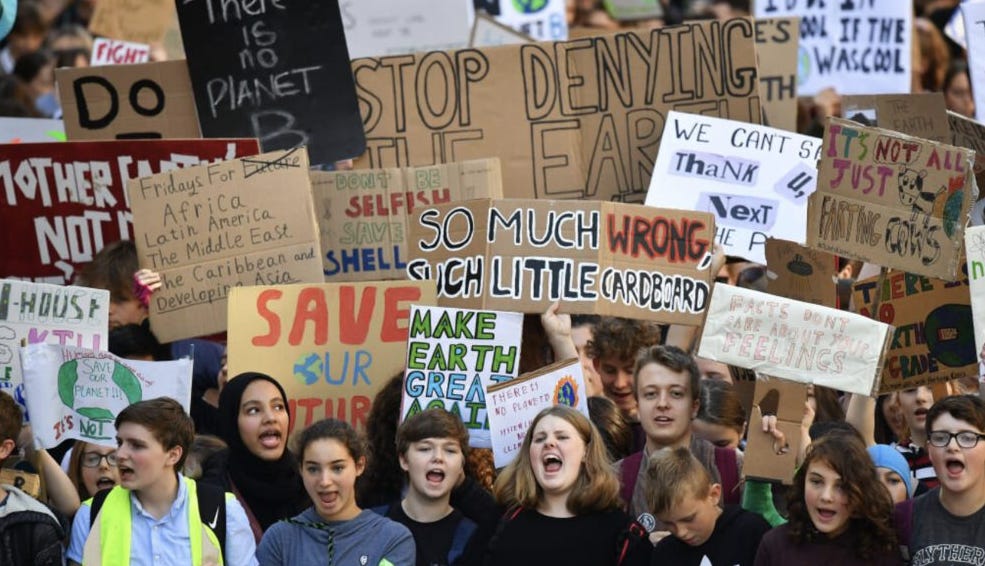
But that does epitomise the challenge for Implausible, despite the vast amount of detail Morrison has harnessed (only a micro fraction of which I have referred to here). So many people have absorbed the fanciful apocalyptic narrative and the need to adopt the modern equivalent of rain dances and self-flagellation that it peppers their everyday speech and behaviour.
Climate catastrophism has become a trope, a posture, the ‘right’ thing to talk about at parties, the excuse for everything. Now millions of people take it as a given that any deviation from the weather mean is invariably the fault of humans and that by quoting from climate catastrophism liturgy and indulging in futile gestures like buying heat pumps (‘we felt it was the right thing to do’ they trill as they hand over four time the cost of a boiler and replumb the house) the impending end of the world will be extinguished by a gale of virtue-signalling.
Changing minds, even getting people to question anything, is a tall order. Implausible is a necessary book, if only because as a polemic it’s a suitable counterfoil to the polemics produced in yet another an age of insanity, so I wish it well, but it’s an uphill task.
Morrison leaves the reader with two explanations:
Rank stupidity bred of decades of dumbed-down and politically biased education, or another concerted attempt by international hard-Left forces determined to destroy and remake society according to their own perverted ideological whims?
With predictions that AI will wipe out humanity within 10 years, and now Wes Streeting telling Britain to be ready for war in 1,000 days, thereby creating a nationwide shortage of tinned ravioli and wind-up radios, perhaps even the most fanatical proponents of climate catastrophism will find something else to fret themselves into a meltdown over and forget the weather. Maybe it’s all only ever been about terrifying everyone out of their wits to keep them under control.
Then, dreadful trumpet, sound the general doom!
Romeo and Juliet
Guy de la Bédoyère is a historian and writer with numerous books to his credit, most concerned with the ancient world though his latest is The Confessions of Samuel Pepys (Abacus 2025).