

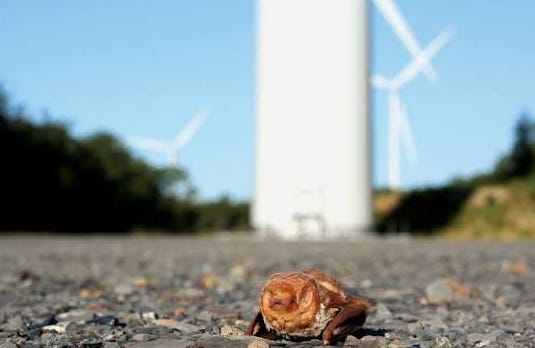
Shocking evidence has emerged to suggest that American bat fatalities following collisions with wind turbine blades have reached a level compared to the devastating depredations of white-nose syndrome. Over the last 20 years this fungal disease is likely to have killed around 12 million bats and in some places led to a 90% wipeout of local populations. A new survey from the US Geological Society suggests that bat deaths caused by wind turbines over the last 40 years have reached nearly 19 million, and the annual rate of 1.5 million is increasing every year.
This is the massive ecological scandal that dares not raise its voice in mainstream media and politics. At most the slaughter is just seen as the cost of doing virtuous business in the interests of promoting the Net Zero fantasy. As we have reported in the Daily Sceptic, blind eyes are also turned to the 500,000 balsa trees illegally logged in the Amazon rainforest every year to supply the lightweight but strong cores for turbine blades. Also somewhat under-discussed is the doppler effect created by giant revolving blades and the unwelcome distortions they can create for both miliary and civilian radar.
If wind turbine energy was fracking for gas, it would have been banned years ago.
The latest report has been compiled by a group of scientists at the federally-funded US Geological Survey and it casts new and disturbing light on the increasingly obvious bat genocide problem connected with wind farms. Of course, the terrible American figures are relevant across the world where wind farms have spread in many ways like a plague.
The scientists start by noting what is already known that blades crunch large numbers of bats, but state that the “scope and severity of these fatalities have remained largely unknown because monitoring has been piecemeal and focused on site-level compliance”. They continue:
Bats provide essential and economic valuable ecosystems services, yet scientists have questioned for more than two decades whether their populations can withstand the impacts of disease, habitat change and anthropogenic disturbances. The two greatest sources of mass fatalities in North America come from collisions with wind turbines and white-nose syndrome.
White-nose syndrome has caused catastrophic declines in several US bat populations and recovery could take many decades. It is considered one of the most serious wildlife events in recent years in the US. Declines in populations of species such as the northern long-eared bat, the little brown bat and the tri-coloured bat are feared to have hit over 90%. In Europe and other areas of the world where the disease has been widespread for centuries, the death tolls are much less dramatic, with naturally selected and immunised bats better able to survive infection. In time such natural help may be on the way for bats in America. Alas, there is no similar hope for getting used to being battered by countless wind blades strewn over their hunting grounds and natural habitats.
The alarming new findings from the US Geological Society are much worse than previous estimates and they are sending shivers through bat conservation circles. Dr Ed Arnett, the Chief Executive Officer for the Wildlife Society, commented that the bat fatalities “are far more alarming than we thought”. Dr Arnett had previously studied bat fatalities at wind facilities for eight years and said the new research “corroborates his own work from more than a decade ago on bat fatality numbers”.
It is the size of the kill that is truly shocking. The paper identifies “substantially higher species-specific totals than previously estimated”. Almost seven million hoary bats, nearly six million eastern red bats and over three million silver-haired bats have been lost since 1981. There are no reliable numbers for bat population in the US, but if similar deaths were reported in Canada, it would be likely that these species would be heading for local extinction. Like the raptors that are also being decimated in some regions by wind turbines, bats have a low reproduction rate with just one offspring a year.
Slaughter on this scale could take decades for the bats to recover. And that assumes the obvious threat from wind turbine blades can be stopped.
The researchers analysed 499 wind farm monitoring reports from 1981 to 2024 across the contiguous United States, adjusting the numbers of dead bats found to account for those missed during searches. They then used statistical analysis of 10 species to take account of factors such as turbine characteristics and locations to extrapolate overall fatalities in the period. From this they give an estimate of 18.7 million losses over the research period. The current annual loss is 1.5 million, and this number appears to be increasing every year as more wind turbines come on stream.
It is noted that previous extrapolations over 10 years ago identified the deaths of hundreds of thousands of bats, but “the science has not advanced to offer more precision since then”. The cynical might comment here that there is not a great deal of demand – and hence grant cash – for this type of work in the mainstream. Promoting their new findings, the researchers suggest that robustly estimating the magnitude of fatalities can help answer questions regarding “species impacts and population viability”.
There are other major concerns about the loss of bats in the US. Bats play a hugely important part in ecosystems, particularly through insect control. They consume agricultural pests and insects that affect natural habitats such as forests as well as human health. It has long been accepted that bats save US farmers many billions of dollars through this natural insect suppression. As with almost all so-called ‘green’ projects, the harder you look the more the costs, both financial and ecological, mount.
Chris Morrison is the Daily Sceptic’s Environment Editor. Follow him on X. His new book IMPLAUSIBLE: How scientists, activist politicians and journalists invented a climate crisis, weaponised junk computer model findings and claimed a fake consensus to promote the collectivist Net Zero fantasy is out now on Amazon and only £3.99 for the download and £8.99 for the paperback – five-star customer rated.
