

Britain has as little as two days of gas stored up, raising fears of a potential crisis as supplies from the Middle East dry up.
The UK’s gas reserves have shrunk from 18,000 GWh worth last year to 6,700 GWh – enough for just 1.5 days of demand, according to new data published by transmission operator National Gas.
A similar amount is stored in tanks as liquefied natural gas. Europe, by contrast, has built up reserves of several weeks-worth of gas.
The crunch in supplies has resulted in traders charging the UK a premium for gas, exploiting its need to outbid rivals in other countries. It means the UK is now paying the highest wholesale gas prices in Europe.
Meanwhile, Goldman Sachs released a note on Friday evening warning that the size of the Middle East oil supply shock was “17 times larger than the peak April 2022 hit to Russia production”, following the invasion of Ukraine.
“We now think that oil prices would likely exceed $100 next week if no signs of solutions emerge by then,” the bank said.
“We now also think it’s likely that oil prices, especially for refined products, would exceed the 2008 and 2022 peaks, if Strait of Hormuz flows were to remain depressed throughout March.”
It comes as Prof Mohamed El-Erian of the University of Pennsylvania warned that households across the UK will be “hit from multiple sides” by price rises caused by the escalating conflict in the Middle East.
He told BBC Radio 4’s Today programme: “Once again, we see the UK more vulnerable to external shocks than otherwise that in turn is going to translate into higher mortgage rates. So the average person will get hit from multiple sizes, unfortunately.”
“The average person is going to face higher energy prices, but also higher mortgage rates and slowly but surely, noticeable increases in a broad range of goods and services because of supply chain disruptions.”
Natasha Fielding, head of gas pricing at Argus Media, a leading publisher of commodity data, said: “The price of gas in the UK has increased by more than almost anywhere in Europe. The UK gas hub price is now above the Dutch TTF [the main European gas hub] all the way from now until the end of May. Before this week, the UK was priced below the EU.”
She said this was partly driven by the UK having “little gas storage and so is more exposed to price spikes” adding: “We can’t rely on withdrawing more from storage, so we have to get that gas from abroad.”
It comes as the UK effectively lives hand-to-mouth, relying on a constant flow of tankers laden with American liquefied natural gas (LNG), plus piped gas from Norway, to keep the lights on and homes warm.
The UK used to have up to 12-days worth of gas in storage but successive government ministers pulled funding for the system and it collapsed. A raft of short-term storage facilities around the UK were mothballed in the last decade.
National Gas data showed that gas stores were at 18% of their former capacity on Friday, while LNG stores were just over half full.
A National Gas spokesman said the UK got most of its gas from Norway and its own North Sea, adding: “The UK benefits from a wide range of gas supply sources. These provide the flexibility needed to balance supply and demand.”
However, a report sent to ministers by National Gas signalled its concern over the lack of gas storage, as output from the North Sea starts to sharply decline.
In the report, Jon Butterworth, National Gas Chief Executive, warned Ed Miliband, the Energy Secretary, that keeping the UK’s lights on would need three new gas storage facilities or six giant barges equipped to process LNG and pump the resulting gas into UK pipes.
Mr Butterworth said ministers should “recognise the critical role gas continues to play in maintaining a stable and reliable energy system – particularly during periods of cold weather and low renewable generation”.
Full story here.
Let’s try and put all of this into perspective.
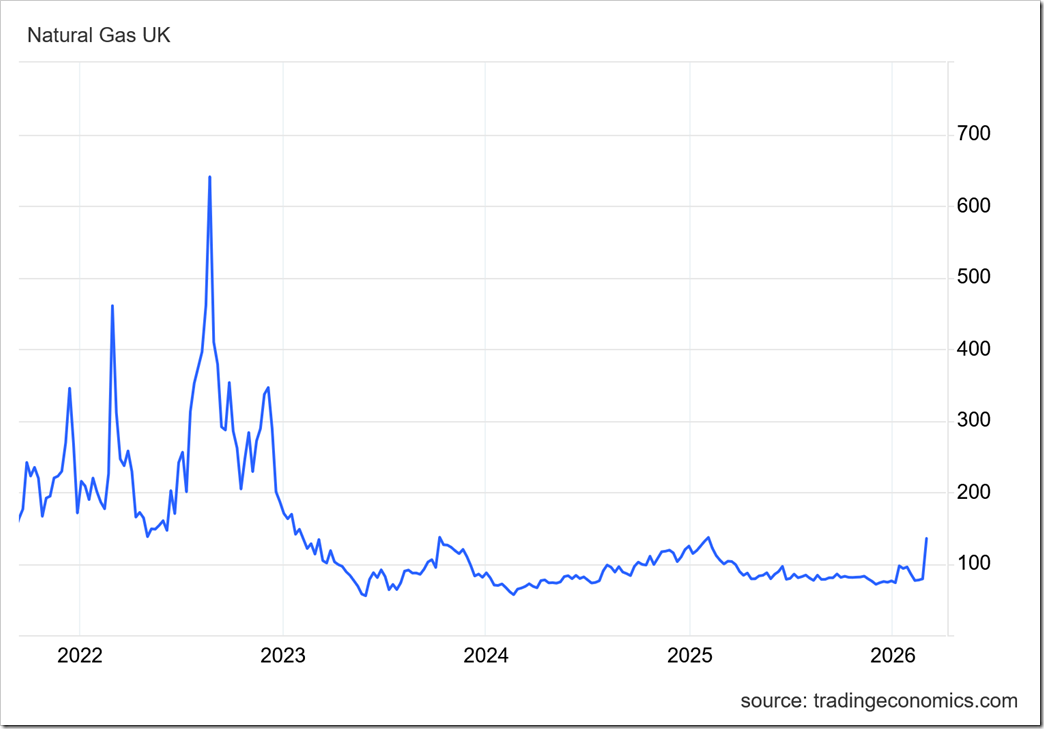
In the last couple of weeks, UK Natural Gas Futures have gone from around 70p/therm to 135p/therm.
Although this is a large percentage jump, we had equally high prices just a year ago. There is no comparison at all with the price spikes in 2022:
https://tradingeconomics.com/commodity/uk-natural-gas
As we saw during the Ukraine crisis, spikes in energy market tend to be extremely short-lived. Gas prices then spiked at 632p/therm in August 2022, but halved within a month.
The recent increase of about 60p/therm equates to £20.48/MWh. In 2024, the UK consumed 688 TWh of natural gas, so in theory if we pay that much extra for all of our supply, it would cost an extra £14 billion a year.
However, we produce about half our gas and LNG imports only account for 16% of supply. (The share of LNG rises to a quarter during winter).
In terms of electricity supply, we only use a quarter of total gas supply for power generation. Leaving aside the vagaries of electricity market pricing, the gas price spike should only add about £3.5 billion to electricity prices.
Bear in mind that this year we are adding £15.9 billion to electricity bills in order to pay subsidies to wind farms, solar farms and biomass power stations.
If we want to keep electricity prices from rising, there is a simple answer – suspend the Emission Trading Scheme immediately and indefinitely.
This article originally appeared on Paul Homewood’s Not a Lot of People Know That blog.
