

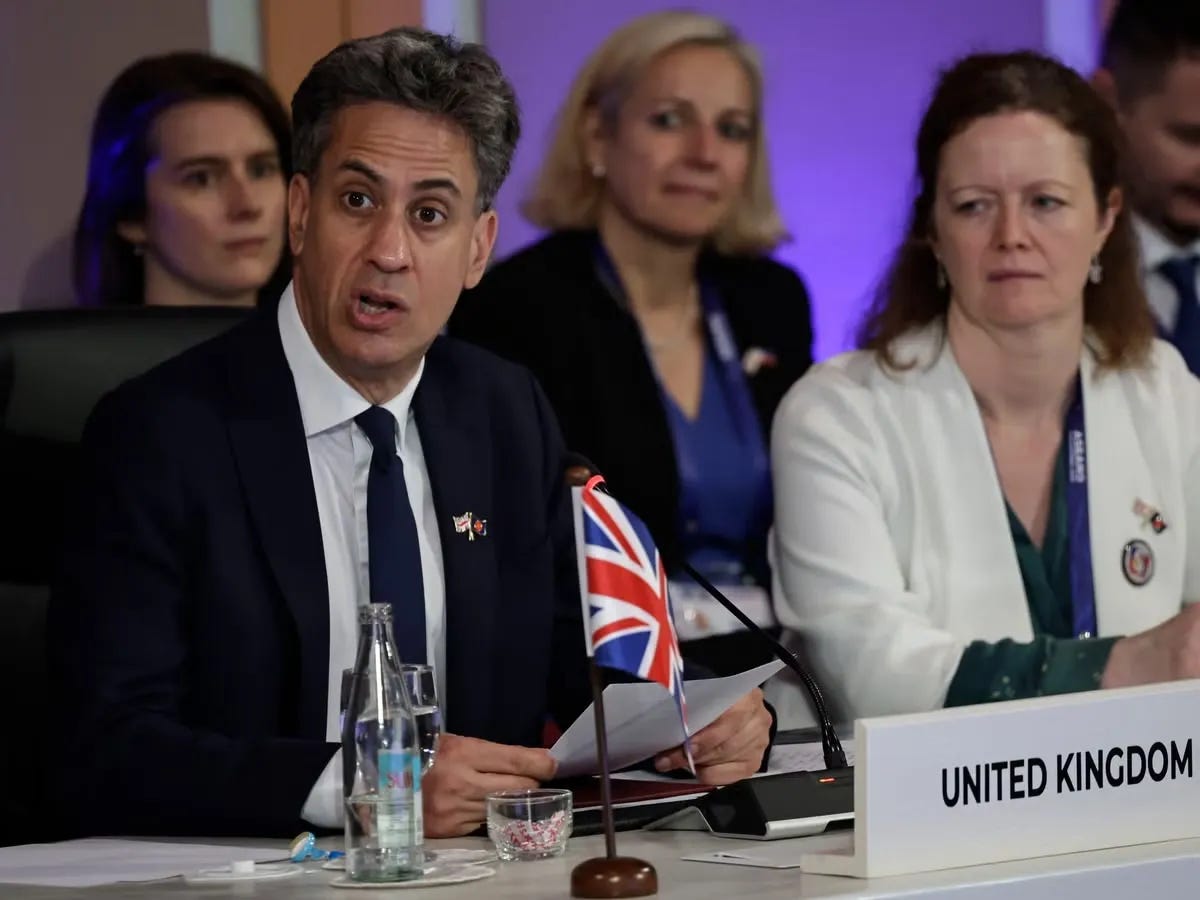
Ed Miliband has spent his career as one of the world’s most committed climate zealots, and he now finds himself installed as Foreign Secretary in Andy Burnham’s new government, personally taking up the United Kingdom’s seat as Governor of the World Bank. The Foreign, Commonwealth and Development Office announced this week that the former Energy Secretary would personally occupy the United Kingdom’s seat as Governor of the World Bank, a job normally left to a junior minister, so that the “climate crisis” and overseas development sit at the very heart of British foreign policy. “International development is not an add-on to British foreign policy – it is central to it,” Miliband declared. “By taking on the role of UK governor to the World Bank, I want to send an unambiguous signal that this Government is serious about its global leadership on development and climate.”
He arrives there determined to push the Bank back toward the climate agenda it has just spent a year being forced to retreat from under the Trumpian energy agenda of “drill baby drill” and “energy dominance”. It sets Miliband, and the Burnham Government behind him, on a collision course with the Trump administration’s deliberate campaign to strip the ‘globalist’ climate agenda out of the very institutions Miliband now intends to use as his platform.
The Trumpian energy counter-revolution
Since Donald Trump’s return to office, his administration has waged a sustained campaign to wrest the great multilateral institutions back from the ‘globalist’ climate agenda that captured them over the past two decades. Washington threatened outright withdrawal from the International Energy Agency unless it abandoned the Net Zero fantasies embedded in its 2021 “Net Zero by 2050” roadmap; the IEA duly reintroduced its Current Policies Scenario, quietly shelving two decades of advocacy dressed up as forecasting.
Treasury Secretary Scott Bessent has led the same campaign more bluntly still with respect to the Bretton Woods twin institutions (the World Bank and the International Monetary Fund). The Treasury Secretary told the IMF and World Bank that fossil fuels remain critical for developing nations and, reading between the lines, that the eco-zealots’ stranglehold on global finance had to end. Last October, Bessent told the World Bank directly to refocus on affordable energy, poverty reduction and country self-reliance; by this April he was warning the IMF that “mission creep” into climate, gender and social issues had left it disconnected from its core mandate.

