


Conspiracy nuts have had a field day over the delayed release of work compiled by the British Intelligence Services warning of possible eco-collapse, mass extinctions, food shortages, conflicts and mass migration. In fact, the flimsy 14-page report is little more than a cutting job from the Guardian. Twenty-six mostly usual suspect sources are named, and highlights of the most extreme scenarios are cherry-picked in yet another Net Zero Blob effort to create population panic. Who knows how much taxpayer money was wasted on this compilation – AI could have done the job in under a minute. The obvious reason for the delay in publication was that someone intelligent in the Intelligence Services said something along the lines: ‘We can’t publish this BS, we will look complete idiots.’
The claim is that the original report was blocked at the top of the British government for being too negative. This is obvious nonsense. No claim of eco-system collapse and devastating climate change would ever be considered too extreme by almost the entire British political class, at least if past evidence is anything to go on. It appears that the report was compiled by the Joint Intelligence Committee, which coordinates the work of MI5 and MI6. It only saw the light of day with publication by the Government’s environment department following a Freedom of Information request from the Times newspaper. Green author and activist Rupert Read was suitably affronted by what was seen as a cover up.
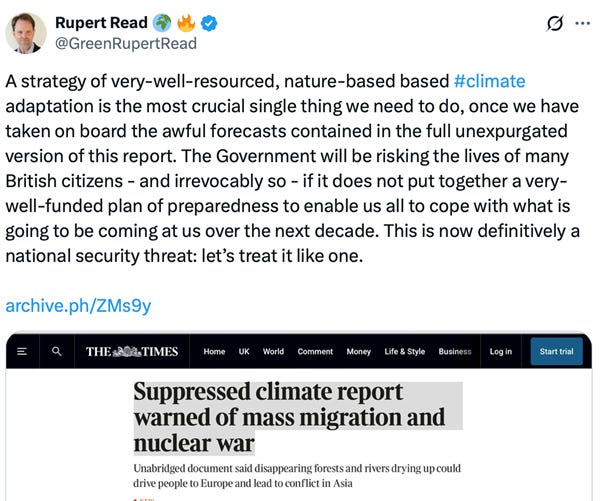
The report is strewn with fake scares that have been widely debunked over the years. The surprise is to see some of them still being published by bodies with reputations to lose. It would be interesting hear Rupert Read debate some of these contentious matters, but, alas, along with Caroline Lucas, George Monbiot and Clive Lewis MP, he signed a 2018 letter to the Guardian stating that he would no longer lend his “credibility” by talking to those who question the opinions around human-caused climate change.
It is claimed in the report that the rate of extinction is tens to hundreds of times higher than the average over the past 10 million years, and this is said to “suggest a sixth mass extinction may be underway”. These types of claims require copious computer modelled estimates and assumptions, but they have a problem in connecting with observed reality. In a paper recently published by the Royal Society, it was found that extinction rates for animals and plants have “generally declined in the last 100 years”. Past extinctions are said to “strongly suggest” that climate change is not an important threat to biodiversity. The paper’s conclusions about extinctions are not new, and there is not a scintilla of scientific proof that the planet is in, or facing, a sixth mass extinction of animal and plant life.

