

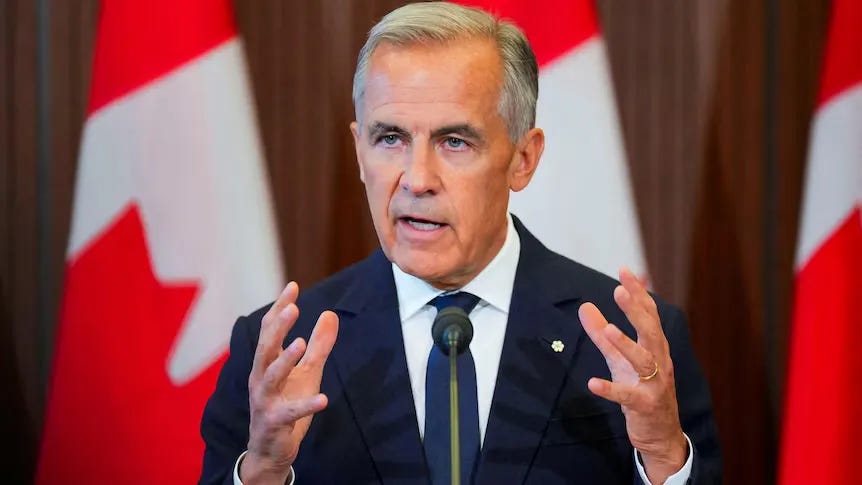
The collapse of US-Canada trade talks last week, and Prime Minister Mark Carney’s declaration that “you’re at war when you get attacked,” has turned a tariff dispute into a political toxin that now sits inside the one relationship still holding North American energy security together. Fifty-percent US tariffs have taken effect on billions of dollars of Canadian goods; Ottawa has promised dollar-for-dollar retaliation from September 8th. Crude oil, natural gas and potash were, for the moment, carved out of the American levies, but that exemption cannot be thought permanent. The uncertainty, the public flirtation with using oil as a retaliatory instrument and Carney’s larger strategic posture toward Washington already threaten the physical barrels and the political trust on which the 2025 National Security Strategy depends.
The contrast with what seemed possible only a year earlier could not be more dramatic. The August 2025 Anchorage meeting between Donald Trump and Vladimir Putin, however inconclusive on Ukraine, opened a window onto a potentially different energy order: one in which sanctions-driven distortions might have eased and Russian Arctic and Siberian resources might have again attracted Western capital. Combined with the January 2026 capture of Nicolás Maduro and Washington’s subsequent assertion of control over the rules of Venezuelan oil production, that vision promised hemispheric abundance rather than managed scarcity. Carney’s brinkmanship now risks putting a dagger through it – and doing so at the expense of Alberta first.
The Anchorage window and the promise of abundance
On August 15th 2025, at Joint Base Elmendorf-Richardson in Alaska, the presidents of the world’s largest and third-largest oil producers met for the first time since the outbreak of the Ukraine war. No ceasefire was signed, although the maximalist demand by EU hawks for an immediate ceasefire was dropped as a non-starter. Trump said there was “no deal until there’s a deal”. Putin later conceded that “there were indeed no agreements reached in Anchorage”. Yet the meeting itself, after years of isolation, revived talk of economic cooperation in the Arctic, LNG technology, icebreakers and even possible restarts of ventures such as Sakhalin-1. Russian officials spoke of region-to-region contacts between the Russian Far East and the US West Coast; side conversations touched Novatek technology for Alaskan gas.
That window mattered because the post-2022 sanctions regime boomeranged on its progenitors. Measures intended to turn the Russian rouble into rubble instead accelerated Europe’s de-industrialisation, sent discounted Russian barrels through Indian and Chinese refiners into European markets at a premium and encouraged experiments in non-dollar settlement. A genuine US-Russia thaw would have reversed those distortions, reopened Siberian unconventional plays to American fracking expertise and reduced the incentive for BRICS energy trade to migrate away from the dollar. Developing countries, long subject to decarbonisation demands while the West consumed the fossil fuels that built its wealth, would have gained cheaper energy and a less politicised development path. The ‘spirit of Anchorage’ never became a treaty. By mid-2026 it had largely dissipated. But the mere possibility of ending the sanctions-driven split in global oil trade – and of pairing US technology with Russian Arctic and Siberian geology – was part of a larger architecture of energy abundance. The other half of that architecture was sitting in the Orinoco Belt.

