

This is the seventh in a series of 13 articles challenging climate change orthodoxy commissioned by Professor Gwythian Prins. We will be publishing the articles at a rate of one a week (read the first article here, the second here, the third here, the fourth here, the fifth here and the sixth here). The hope is that they can be collected into a book for Sixth Formers and university students.
Anyone born after 1980 belongs to the first generation raised under the shadow of scientific ‘neo-catastrophism’. In that pivotal year, a landmark paper by Nobel laureate Luis Alvarez and his team shattered the paradigm of geological gradualism. Alvarez demonstrated that a massive asteroid impact — rather than incremental evolutionary shifts — abruptly annihilated the dinosaurs. By illuminating the role of sudden disasters in Earth’s history, the study sparked a scientific revolution, ushering in an era of catastrophic thinking that reshaped both academic research and popular culture.
After four decades of doomsday modelling dominating public and scientific spheres, the academic tide is finally turning. Today, a growing number of scientists are pushing back against overhyped worst case scenarios. In their place, researchers are adopting measured, evidence-based perspectives that emphasise human resilience and adaptability over climate collapse, global catastrophes and annihilation.
During the initial wave of neo-catastrophism, researchers proposing the most extreme hypotheses were routinely rewarded with high media visibility, surging citation rates and abundant funding. Today, this incentive structure has largely run its course; a saturated media landscape has sharply diminished the returns on alarmism. Conversely, dismantling hyper-catastrophic models has emerged as an equally powerful catalyst for scientific advancement. Falsifying a dominant doomsday narrative is now proving to be just as professionally rewarding and scientifically impactful as establishing one.
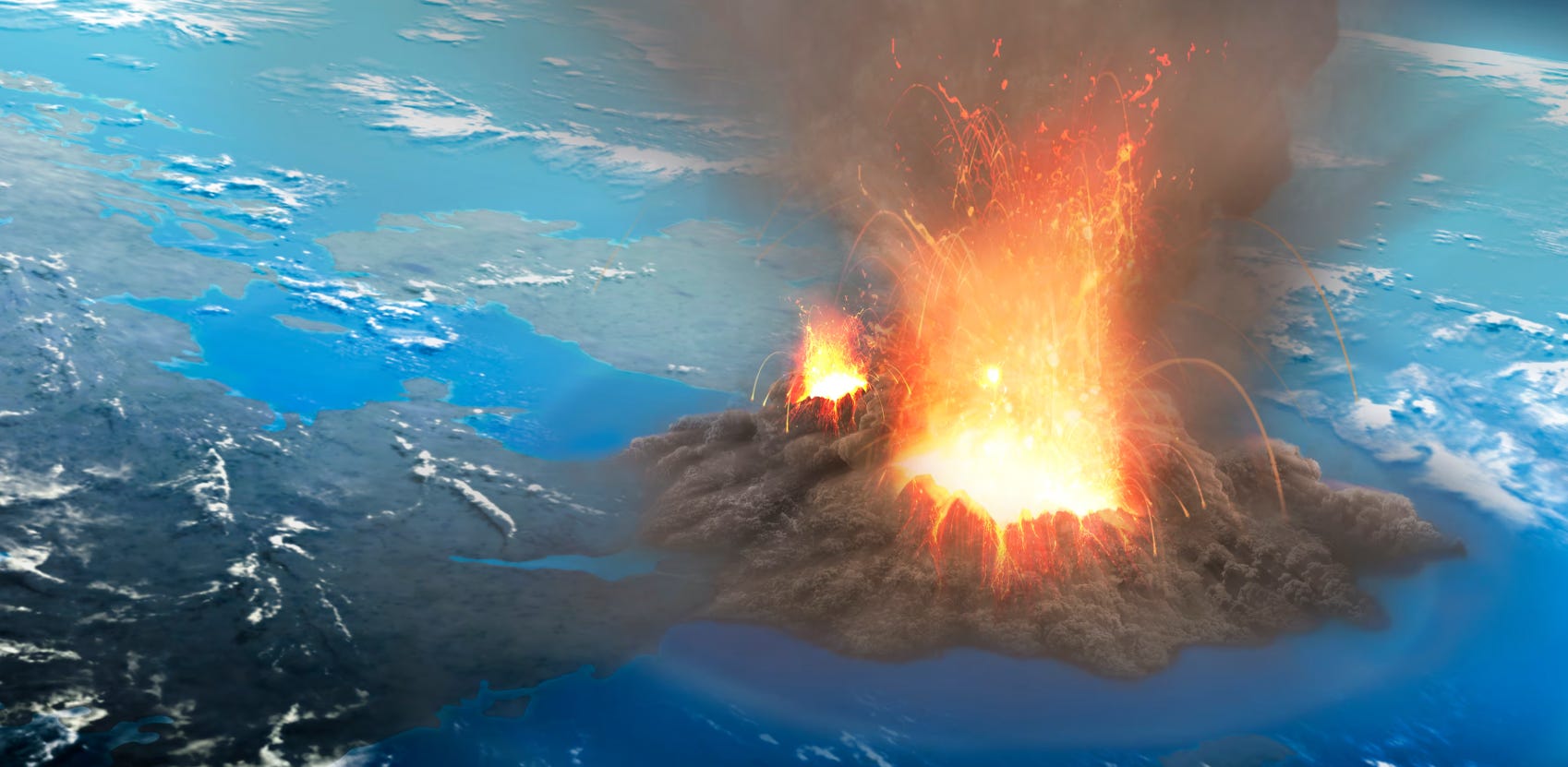
Volcanic risk research is leading this reality check. For more than 30 years, the scientific consensus held that the eruption of Sumatra’s Toba volcano around 74,000 years ago triggered a ‘volcanic winter’ that plunged the planet into a deep freeze, pushing early humans to the brink of extinction. In the last few years, however, archaeological and paleo-environmental findings and new data have thoroughly refuted this near-extinction theory.
New discoveries show that groups of early humans survived immediately after the Toba event, even in India and Sumatra, which were covered by thick deposits of volcanic ash. A study by Chinese scientists assembled archaeological data has demonstrated the continuity of human activity before and after the Toba event, confirming the survival of hominids after the eruption. This evidence refutes the so-called ‘population bottleneck’ hypotheses and the long-held theory of human near-extinction.
Despite mounting empirical counter-evidence, apocalyptic frameworks endure within the scientific community. Existential risk modellers routinely inflate volcanic hazards, claiming that the probability of a civilisation-ending eruption in the next 100 years is 100 times greater than large-scale asteroid and comet impacts combined. This striking divergence suggests that contemporary computer models overestimate the civilisation-ending risk of volcanic eruptions by at least an order of magnitude.
Apocalyptic theorising surrounding the Toba eruption was forged by early, catastrophe-driven climate modelling. Where others saw temporary volcanic cooling, some researchers theorised that a massive shroud of stratospheric sulphur aerosols acted as the catalyst for an impending ice age. They argued that a swift 3-5°C plunge in global temperatures forced a perilous climate tipping point, spreading perennial snow and sea ice across northern latitudes. The resulting ice-albedo effect trapped Earth in a millennium-long deep freeze. This framework evolved into a reciprocal ‘climate-volcanism feedback’ theory, which argued that a changing climate may have helped to triggered the Toba eruption, which then acted as the ultimate anchor locking in global glaciation.
Recently, these apocalyptic models have faced successful challenges. Last year, researchers at the Max Planck Institute of Geoanthropology reported that high-resolution sediment layers in India revealed an unexpected aftermath to Toba. Instead of freezing, the region experienced a ‘volcanic summer’, becoming significantly hotter and more arid for several years. The fact that super-eruptions can trigger intense regional warming took scientists by surprise — though it is far less surprising that the mainstream media largely ignored the findings.
Leading volcanologists have also challenged the nightmare scenario of a sun-blotting, frozen planet. Although many still claim that historical volcanic eruptions triggered severe global climate shocks and human near-extinction, climate models often exaggerate these effects. New research suggests post-eruption global cooling is unlikely to exceed 1.5°C, even for the most powerful blasts conceivable. In a 2024 study published in the Journal of Climate, a team from NASA GISS and Columbia University demonstrated that traditional climate models heavily overestimate volcanic cooling. They argued that microphysical aerosol constraints limit the capacity of even the most colossal eruptions to alter global temperatures to the extent previously assumed.
A review of genetic data reveals no evidence of a human population bottleneck around 74,000 years ago. Combining these findings with paleo-environmental research findings, geoscientists have effectively dismantled the Toba near-extinction hypothesis. The evidence proves that the eruption did not plunge East Africa into a six-year volcanic winter, did not choke the gene pool of early African humans and never brought the human species to the edge of extinction.
Most older climate models rely on flawed linear assumptions: they assume that multiplying the size of an eruption by 10 makes the sky 10 times more opaque for 10 times longer. In reality, when immense amounts of sulphur dioxide enter the stratosphere, the chemical particles do not spread evenly. Instead, they collide and coalesce into larger, heavier particles that fall out of the atmosphere much faster. Furthermore, instead of backscattering solar radiation, these coarser aerosols absorb and trap outgoing longwave thermal radiation rising from Earth. This creates a greenhouse-like effect in the stratosphere, warming the air layers below. Consequently, a massive volcanic event triggers complex atmospheric chain reactions that can create regional ‘volcanic summers’, particularly in tropical zones like India.
Thus far, no volcanologists have rejected these findings. However, atmospheric scientists note that these microphysical simulations require extensive empirical cross-examination before replacing older models entirely. Critics point out that the study relies heavily on assumptions about how quickly particles clump together. Until researchers can physically measure ancient fallout, this scaling remains a model-based hypothesis rather than a confirmed fact.
Additionally, some geologists and archaeologists note that relying on global mean temperatures masks regional variability. A 1.5°C drop in global average temperature sounds small, but temperature changes are never distributed evenly; certain regions could still face severe, localised cooling.
Whether these new hypotheses will entirely replace the old models remains an open question requiring further verification. It is too early to draw categorical conclusions. However, the real breakthrough is that the volcanic doomsday consensus has been cracked wide open — leaving a new generation of scientists free to scrutinise new data without being forced into worst-case thinking.
Benny Peiser is a social anthropologist. He co-founded the Global Warming Policy Foundation with Nigel Lawson. In recognition of his work on neo-catastrophism, the International Astronomical Union named a 10km-wide asteroid — Minor Planet (7107) Peiser — in his honour.
Or the universe could have been formed in a Big Bang that produced all the energy at once in a massive explosion of incandescent plasma. As the explosion expanded at the speed of light the volume of the universe would expand and the density of the energy would fall correspondingly.
Eventually the plasma would cool to incandescent gas and congregate into gas clouds and eventually into solid matter. This solid matter might form solar systems that continuously cooled until liquid water and eventually simple life forms could survive. After a few billion years one of these life forms might develop speech and organized societies.
What are the odds that this life form would also invent inductive reasoning, ideology and other unprovable hypotheses (aka lies).