

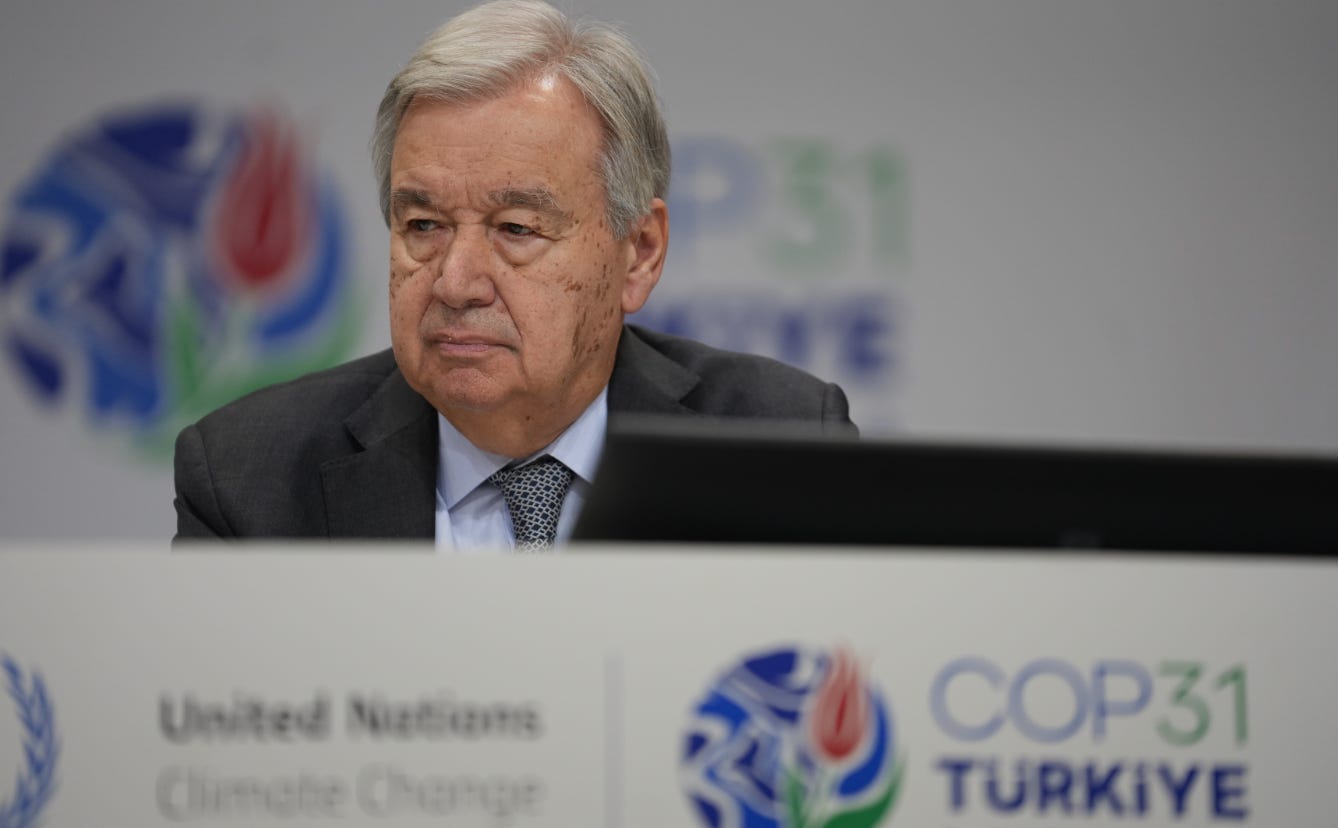
COP31 has collapsed. After two weeks of talks and two days of overtime, the longest climate conference on record broke up in Antalya on Sunday without adopting its main cover decision. This is the first time that has happened since Copenhagen in 2009. The legacy press is clutching its pearls on cue. The Independent has the summit descending into disarray, campaigners are calling the text a betrayal, and the Telegraph‘s account of the collapse tells readers it reveals an “uncomfortable truth”. I would call it a limited victory of reality over ideology because the ideology has plenty of life in it yet.
António Guterres, attending his last climate summit as UN Secretary-General, said he was deeply disappointed, and that whatever the negotiators lacked, the ‘science’ left no room for ambiguity. On November 11th he had already told the leaders in Antalya that the world needed a new Climate Justice Compact. With governments incapable of agreeing among themselves at COP31, he turned to the ‘climate justice’ brigade of young people, scientists, indigenous peoples and civil society (i.e., the usual well-funded environmental NGOs). He told them the climate crisis will not wait for governments to find common ground. Climate justice warriors of the world, unite! Marx would have recognised the line, though the working class in the then-advanced capitalist countries was happy to find that its daughters could afford silk stockings.
The wreckage in Antalya
The text finally tabled by the Australian and Turkish co-presidents did not mention fossil fuels at all. It nodded obliquely at the 2023 Dubai agreement, called for tripling adaptation finance with no baseline, backed carbon capture and proposed lifting electricity’s share of final energy use from about 23% to 35% by 2035. Explicit references to moving away from fossil fuels had been stripped out in the second week. The EU and its allies threw a tantrum at this gift to the demonised petrostates. Ireland’s Climate Minister, speaking for the EU, said the talks had been hijacked by the oil states. The small island state Tuvalu refused to accept the text. The British delegation, boasting the only G7 leader to have attended the conference, was profoundly disappointed. Saudi Arabia and Russia backed leaving reference to fossil fuels out. A week earlier the Arab Group, the Like-Minded Developing Countries and Russia had rejected an earlier draft for crossing their red lines. China and India disagreed with the final text but accepted it to keep things moving. The ones who rejected it were the Europeans, the British and the small island states.
None of this is a surprise to anyone who has followed these conferences. The COP process got its momentum and its international support for a global climate regime from the relentless push of the EU, its allies like Australia and Canada, and the US. In the collective West, the signal exception was the Trump administration in both terms. President Trump’s second term in particular seemed to have put a nail in the coffin of the climate globalist project of the past two decades.

