

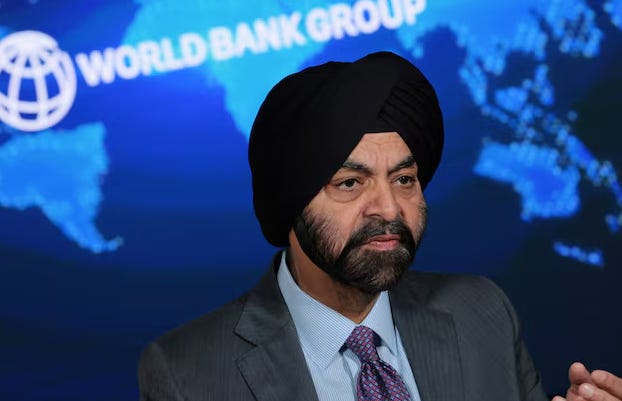
As the faithful gather in Antalya for COP31, the World Bank laid its offering on the altar last week: Governance for Climate and Development, the fifth annual digest of its Country Climate and Development Reports (CCDRs) now covering 103 economies. One might have expected a chastened institution. In April 2025 US Treasury Secretary Scott Bessent told the Bretton Woods twins (World Bank and IMF) that mission creep had knocked them off course, and on June 29th this year the Bank duly retired its target of steering 45% of its financing to climate. Yet its own climate page still boasts of $48 billion in “climate co-benefits” in the last fiscal year, 44% of its own-account financing. The target is dead. The mania – a form of climate-focused pathology – lives on.
The CCDR is the Bank’s “core diagnostic” for helping countries align their “climate ambitions” with their development priorities, and the Bank’s blog trails the new report as a journey from commitment to delivery. The phrasing smuggles in an equivalence that no finance minister in Lusaka or Abuja would recognise. Why would a poor country have climate ambitions at all, beyond ensuring that poverty does not stand between its citizens and the travails of bad weather? Is civilisation itself not born of the struggle against the depredations of nature? Is science, in the Baconian tradition, not power over a harsh nature, the taming of her furies for the comfort of man? The ambitions in question belong to the Net Zero ideologues of Brussels and Davos. The poor merely get to be the guinea pigs of climate modelling and Net Zero imperatives.
The cart before the horse
The report opens with the assertion, repeated across all five editions, that “climate and development are inseparable”. It then declares that climate change poses a substantial threat to economic development, with projected GDP losses of between 1% and 20% by 2050 “compared with a baseline without climate change”. This is an alternate universe. No country has ever been offered a baseline without weather. The counterfactual that matters to a development bank surely is the loss from the absence of growth, measured against a baseline of robust growth, whatever the climate does.
The Bank’s own text gives the game away. Its modelled losses are larger in poorer and hotter economies. Its headline adaptation case is Nigeria, where the projected GDP loss shrinks from 6.7% to about 1% once one assumes mechanisation, air conditioning, health interventions and flood-resilient investment. Heat stress, it notes, costs far less in high-income countries, where machines do the heavy lifting. Mauritius is declared at risk of water scarcity, yet 61% of the water its system captures is lost before it reaches a customer. That is a plumbing problem. Mechanisation, air conditioning and pipes that do not leak used to be called economic development. The Bank has rediscovered it and filed it under “climate adaptation”.

