

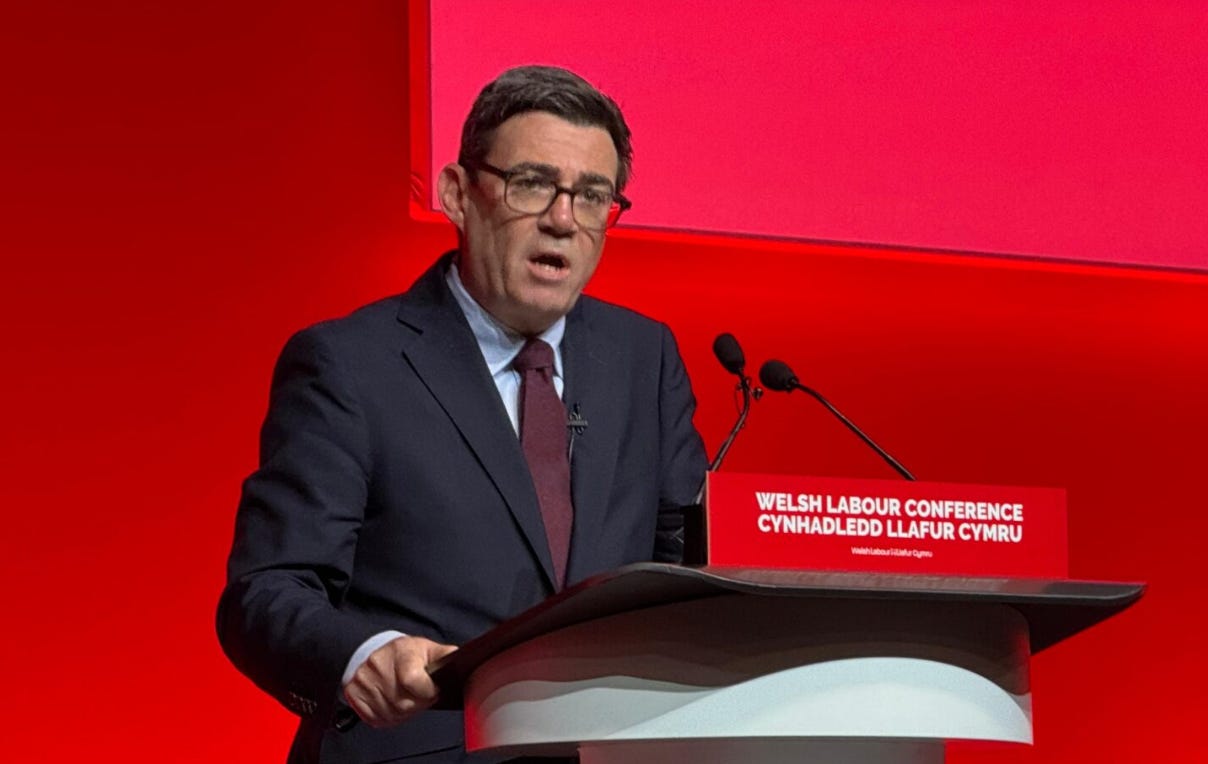
In welcome news from the Welsh Labour conference at the weekend, Andy Burnham has proclaimed the “reindustrialisation“ of Wales. Burnham, of course, is yet another prisoner of the climate belief system and beholden to the student body of Labour MPs, but in his address to conference he reveals a repressed yearning to make use of coal for mining and electricity generation, should he be free to make the right choices for Wales while in a position of responsibility, such as that of Prime Minister, for instance.
As Burnham reminded us in his address, “Welsh coal powered the Industrial Revolution”.
As recently as 2013, 40% of Britain’s electricity was generated by coal. For 130 years before that, coal was the base of our prosperity and the political fortunes of the Labour Party. Good socialists loved coal, iron and steel. Then all of a sudden, in the aftermath of the EU’s 2001 Large Combustion Plant Directive and the UK Carbon Price Support tax, coal became in modern Labour parlance, haram.
To the Labour Party of today and much of the public, coal is dirty, antediluvian, a danger to physical and moral health. Yet to some of us it is the most beautiful and natural thing in the world. Just as gold shines in the hand and is pleasing to look at, so a lump of coal sits in the palm quietly exuding power, with three times the volumetric energy of wood. A love of coal is the new ‘love that dare not speak its name’.
Richard Lyon’s The Energy Trap is an excellent book for non-specialist readers about the true cost of ‘renewables’ and the British energy crunch. But even Lyon is entirely coy on the topic of coal for electricity generation. To my email, Dominic Frisby replied briskly: “Coal is uninvestable in the UK.” Tap up a centrist granddad on this topic and you’ll probably hear anxieties about pea-souper fogs in London, something irrelevant to the modern debate as those London smogs were caused almost entirely by domestic burning.
Yet the UK Coal Authority, caretaker of our disused mines, cannot suppress a note of longing on its website: “So much of our three nations’ history has been shaped by the natural minerals under our soil. None more than coal, which provided heat, steam and power for hundreds and hundreds of years.”
Indigenous coal is a pillar of energy security in any sane country. Free of legislative shackles, coal would soon be cheaper than wind while providing double the benefits: power and baseload inertia. Coal is usually burnt near to where it is mined. It suffers no political chokepoints. In answer to the old Left-wing saw that imported oil leaves us exposed to nasty regimes is the rhetorical question, attributed originally to Chancellor Nigel Lawson: “How much coal goes through the Strait of Hormuz?”
British coal reserves are abundant in a way that only God’s generosity is abundant. According to Euracoal, there are 3.8 billion tonnes known of known reserves under our feet, while the full reserves might be as high as 186 billion tonnes. As with all gifts from God, however, there is a catch. Though hundreds of millions of tonnes of shallow coal are still available, the bulk of the reserves are deeper and significantly harder to extract.
Net Zero Watch has recently published Coal Power and National Security, a summary for policymakers of the case for coal by Andrew Montford. He advocates fluidised bed combustion (FBC) technology for a new generation of coal-fired power stations. FBC technology is cleaner and more versatile than the alternatives. It is more forgiving of a wider range of coal types and can even handle waste and biomass fuels. The new coal-fired power stations of the kind advocated by Montford will be relatively complex to build and initially more costly to run due to the loss of skills. However, research into mining automation and coal gasification is likely to improve the extraction of coal power at depth and therefore the energy return on energy invested (or ‘EROEI’) of coal.
Coking coal is essential to steel production and so to the production of our Milliwatt Messiah’s beloved windmill towers. Needless to say, Woodhouse colliery, an impressive project in West Cumbria to extract metallurgical coal from beneath the sea using automated vehicles, was blocked by everyone from local planners, to teenage hunger-strikers, to the Department of Energy and is currently abandoned. As in Burnham’s Welsh lament to Labour: “The mines closed, factories closed, steelworks silenced.”

Britain doesn’t have an energy strategy, it doesn’t have a grid strategy, it doesn’t have a workable ‘transition’ strategy. What we do have is a legislative brick wall into which we are heading. On the grid, out of frequency warnings are a regular occurrence. Our electricity interconnector use from Europe runs up to 20% whenever the wind blows, overhead line maintenance teams can’t carry out their work because controllers dare not switch off power lines, our gas-fired power stations are running to the end of their lives (something Ed Davey once understood as energy minister), and all this at a time when, to quote Penn State University, replacement gas turbines are “sold out” worldwide due to demand from data centres and because “only a limited number of foundries can produce the superalloys, coatings and single-crystal blades required”. But it’s all fine as Net Zero has already destroyed industrial demand in Britain. Meanwhile onshore fracking is banned (Davey again) while we rely on gas interconnectors from Europe just as European reserves are depleted. Nuclear has never been developed at the scale needed (Nick Clegg, this time).
Poverty, welfare dependency and even a lack of food due to fertiliser shortages arising from Net Zero policies are all a greater threat to health than any hypothetical ‘climate impacts’ or minor air pollution from modern coal power stations. Coalmining can be dangerous but it is a real job, capable of supporting a real community of the kind to which Burnham once belonged and lovingly recalls; “It’s what we did and it’s what Wales did too. We were the front line of Britain’s proud industrial history,”
Energy should just be a practical question: how to obtain the most reliable source at the most reasonable price. Unfortunately coal is now heavily politicised again, as it was politicised before in the 1970s. Now we are held to ransom, not by trade unions, but by a climate belief system originally conceived by the international justice visionary Maurice Strong of the UN. His aim was to whip up climate fears as a pretext for the distribution of wealth from rich countries, who would have to cut their carbon emissions, to poorer countries, who would not. The Kyoto protocol setting out Strong’s invidious scheme was voted down 95 to zero by the US Senate in 1997 but was still pushed through by the globalists and by the political leaders they knew how to flatter.
In reality global coal production has trebled since 1980 and was the fastest growing primary energy source from 2000-2022. Meanwhile the Government website blithely states that the world “transitions to Net Zero”. Fortunately, it is lying.
The re-introduction of coal will have to face down activism, backed tacitly by institutions and also by swathes of the public. Activists will believe themselves justified in disruptive violence, yet violence won’t be sustained without the sanctuary of public opinion that supports its aims. When attitudes change, the support vanishes.
We are likely to be forced back to coal as the fiscal crisis unfolds. Burnham should come out with pride and announce a return to exploitation of the “one-off endowment” (in Richard Lyon’s phrase) of captured solar energy under our feet: billions of tonnes of hard coal.
Chris Larkin is a pseudonym.