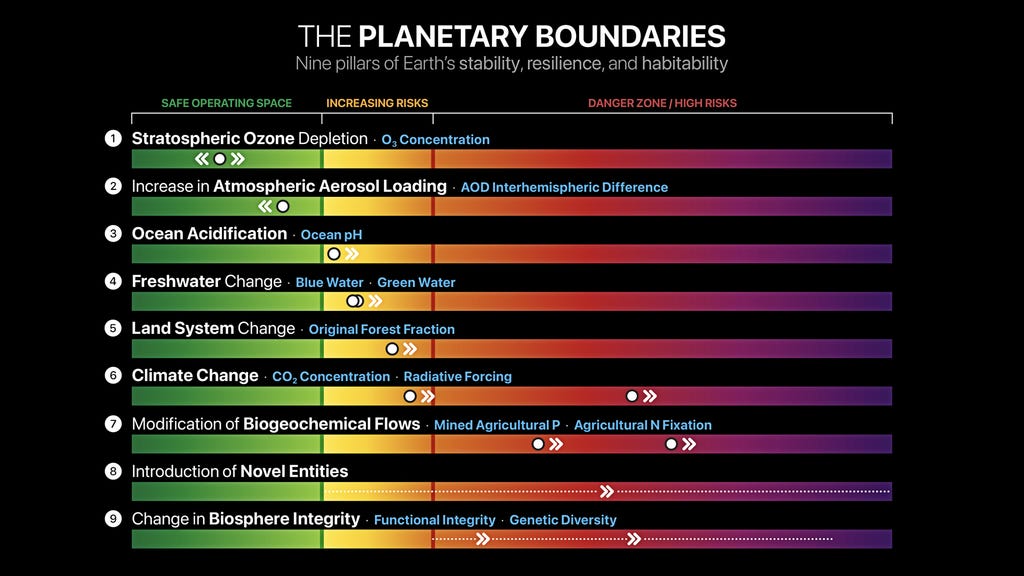
On September 21st, the Potsdam Institute for Climate Impact Research (PIK) released its 2026 Planetary Health Check, an annual report now authored, we are told, by more than 60 scientists. The Guardian duly reported, as it always does, the verdict with the gravity the occasion apparently demanded: the planetary life-support systems on which humanity depends have deteriorated to their worst levels ever recorded, and seven of nine “planetary boundaries” are now breached at their “highest ever levels of transgression”.
The seven transgressed boundaries, PIK tells us, are climate change, biosphere integrity, land-system change, freshwater change, biogeochemical flows, novel entities and ocean acidification. Only stratospheric ozone and atmospheric aerosol loading remain, for now, within bounds. Having delivered this verdict, PIK’s sixty co-authors extend the traditional mercy of the apocalyptic genre: salvation remains possible, if only humanity accelerates action to “return to the safe operating space” and thereby secures “shared future prosperity”. It is a formula as old as the genre itself — diagnose civilisational catastrophe, then offer just enough hope to keep the reader turning the page, or better still, funding the institute.
These cycles of doom repeat themselves regularly (remember the Club of Rome’s 1972 report Limits to Growth anyone?) The PIK report is simply the latest instalment. It deserves to be read carefully, not because its science is compelling, but because its rhetorical machinery — the appeal to consensus, the confusion of value judgement with measurement and the use of pseudo-scientific “tipping points” is now so deeply embedded in Western policy discourse that it has driven trillions of dollars in investment and regulation.
Nine boundaries, one big assumption
The “planetary boundaries” framework, first proposed in 2009, holds that nine interlinked Earth-system processes must remain within defined “safe limits” to preserve planetary stability. It is a seductive idea: a single dashboard, nine dials, and a simple readout of humanity’s report card. The trouble is that these ‘dials’ have no scientific content. As the Breakthrough Institute noted in its detailed review of the concept’s scientific foundations, the great majority of the nine boundaries — land-system change, biosphere integrity, nitrogen and phosphorus flows, freshwater use, aerosol loading and novel entities — have no identified global biophysical “tipping point” at all.