

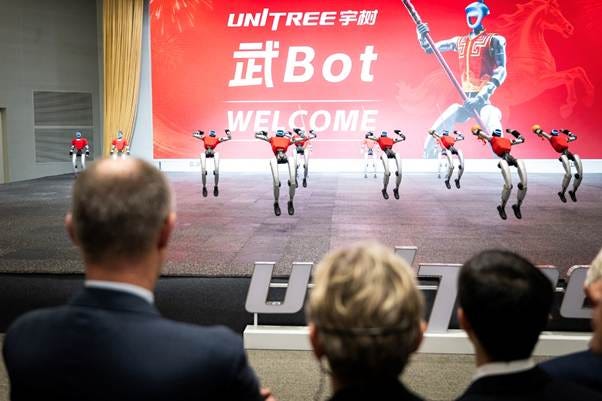
“I’ve seen things you people wouldn’t believe,” said German Chancellor Friedrich Merz on his return from China. No, wait, that was the ‘replicant’ android Roy Batty played by Rutger Hauer in Ridley Scott’s Blade Runner. In no less a tragic scene, however, Merz might just as well have been recounting his experience of galactic travel. He hadn’t seen attack ships on fire off the shoulder of Orion, but he had seen a synchronised robot combat-dance and the eastern industrial rival’s advanced manufacturing capabilities. “We are no longer productive enough,” he told other European policymakers ahead of his trip. “If you come from China, ladies and gentlemen, then you have an even clearer feeling that with work-life balance and a four-day week, prosperity in our country cannot be maintained in the long-run.” In another universe, and not one governed by implausible sci-fi premisses, it could now be Germany hosting impressive displays of robotic prowess.
The Energiewende – high-tech industries powered by Gaia’s Providence – was the less plausible science fiction plotline Germany chose for itself. It turns out that you can’t have nice things if making nice things becomes too expensive a process, and other makers of nice things have lower costs, such as labour and energy. And it turns out that if you don’t make nice things, then you can’t do nice things, such as maintain “work-life balance” and fund public services. For too long, and across Europe, the concepts of values and principles have been estranged from all that has made them possible. Armies of numpty wonks in London, Brussels, Paris, Berlin, Rome and beyond, never stopped to wonder, ‘What is the relationship between those cooling towers and our social-democratic, progressive, liberal outlook?’ Instead, they claimed that the next stage in human development required blowing them up.
What does it mean then, to blow up a coal-fired power station and to depend instead on intermittent sources of energy? Ethics – but only 35% of the time, in the case of wind? Principles – but only in daylight hours, peaking at midday and disappearing at night? A “work-life balance” determined by the weather, meaning that you can only have a life when you can’t work? Social democracy when the sun shines, but feudalism in the dark winter months?
The Chancellor’s message to the German people is that they need to work harder. However, the instruction to ordinary people to lower their expectations comes amid some long-awaited signs of realism. “China has significant production capacity, which is now also posing a problem for Europe in some respects, because this capacity far exceeds market demand,” he explained on his return. This much has been known since the late 2000s, when China was accused of destroying European solar thermal and PV cell manufacturers by dumping. In the early 2010s, German companies Q-Cells, SolarWorld, Solon SE, Conergy, Sovello, Sunfilm, Soltecture and Solar Millennium all went bankrupt. The Engergiewende ploughed on, regardless.

