

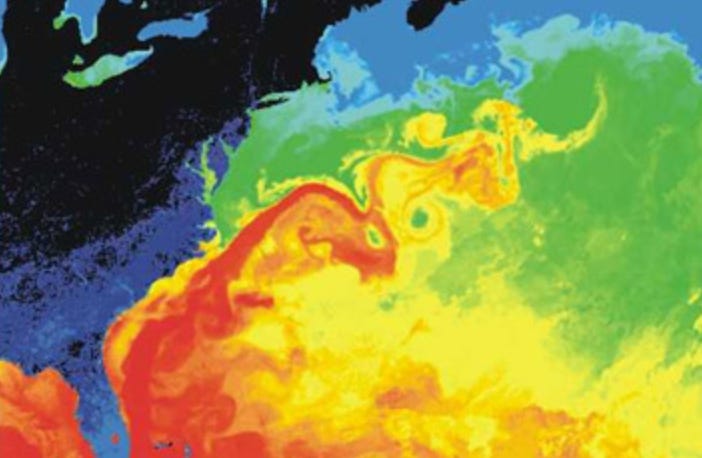
In July 2023, Georgina Rannard of the BBC ran a ‘scientists say’ story stating that the Gulf Stream system of warm ocean currents “could collapse as early as 2025”. It would be difficult to find a more tosh-filled tale of climate bunkum so perfectly constructed to fill the population with alarm and a willingness to accept the collectivist Net Zero fantasy. All the recent evidence, other than the findings of rigged computer models, is providing conclusive proof that the Gulf Stream is currently stable, although subject to higher-than-expected natural variations in what are often very short time intervals.
For 20 years the RAPID-MOCHA-WBTS Array has measured the movements along the Atlantic Ocean at 26°N. A number of submerged stations have collected large amounts of data on the currents that bring warm waters from the Gulf up to the Arctic and return them cooled, heavier and saltier back to the south. Alarmists and Net Zero fantasists have long argued that humans interfere with this process. In unison they wail (perhaps next year!) that a ‘tipping point’ could be reached where the currents reverse and bring ice age weather to countries in the northern hemisphere.
But findings from computer models that have produced countless The Day After Tomorrow headlines are being rendered increasingly worthless by the actual RAPID data. In fact, there has been a largely unannounced pause in any weakening of the Gulf Stream – also known as the Atlantic Meridional Overturning Circulation (AMOC) – since the early 2010s. Before that, and going right back to the start of measurements in 2004, the strength was generally relatively high, but there was a substantial weakening between 2009-2010. Such was the scale of this temporary weakening that the 20-year record has been skewed to show a 6% decadal decline. But RAPID has shown that sharp changes on a daily to inter-decadal period are the norm rather than exceptional. All of this is likely to be due to natural variation – what is often referred to as ‘noise’ – rather than any human cause.
Many of the fluctuations appear to be driven by changing air currents rather than deeper water formulations alone. These findings are starting to fundamentally change the way scientists understand the operation of the AMOC and mean that single or short-period snapshots are inadequate in measuring long-term strength. Needless to say, computer models are simply not up to the task of separating out any noise arising from the natural variability.

