

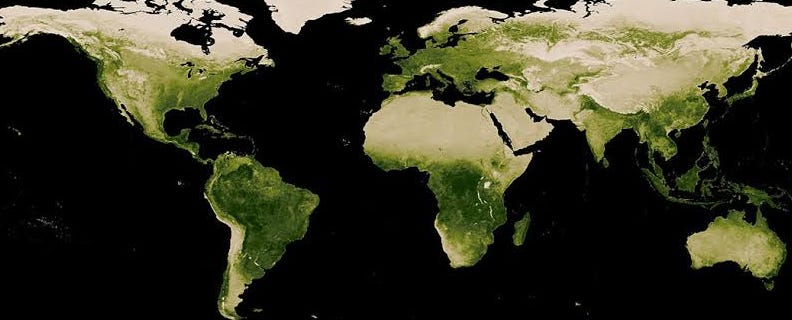
Global mean vegetation greening reached a record high last year, extending an already significant multi-decade upward trend, according to recent findings published in Nature. In fact, 2025 set a record for global vegetation greening with a steepening of the average trend. Top of the list with 77.6% showing extra greening was croplands, meaning more food is becoming available to boost global diets.
This greening story – a tale that gets more impressive every year – is largely absent from the mainstream media. It was certainly missing from a recent climate contribution from Sandwich-board Stanley (a.k.a. Tim Stanley of the Telegraph) who made an unsourced claim that one third of the agricultural production of Bangladesh “is feared to vanish by 2050”. Happily, there is no sign of that invented fear coming true since agricultural production has more than doubled in the country since the turn of the century. Notes Stanley: “The evidence is stacking up – we only have to look out of our windows,” a comment that suggests journalists hired to broadcast opinions and beliefs should steer well clear of science where data and facts are given a higher priority.
Back in the real increasingly verdant world, the Nature-published scientists note that herbaceous ecosystems such as grasslands and crop fields dominate the greening signal. 72.1% of grasslands showed greening while the overall satellite data reveal 68.% of the total vegetation area showed improvement, up from the previous record set last year of 67.7%. Greening ‘hotspots’ were observed in southern Africa, southern South America, northern Australia, Europe, central North America and northern China. Some ‘browning’ was observed in eastern Siberia, and this was attributed to anomalously cold growing-season temperatures.
Two different satellite measurements are commonly used to track global greening. The recently published study used Normalised Difference Vegetation Index (NDVI), which measures how green the land surface appears. Other studies use the Leaf Area Index (LAI), which estimates the total leaf area covering the ground, and therefore provides a measure of the amount of vegetation. Although they measure different aspects of plant growth, both datasets help point to a significant increase of more than 15% in global greening over the past 40 years, with around 70% of the increase attributed to carbon dioxide fertilisation.

