

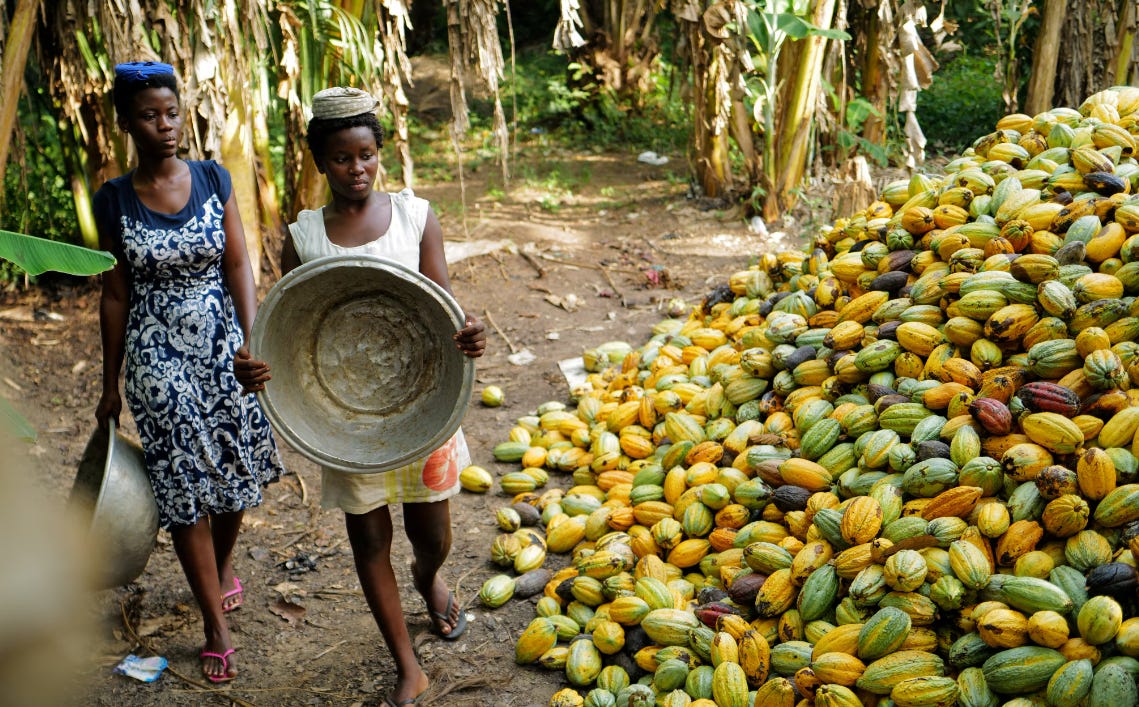
It all seemed to kick off in March 2024 with the BBC’s chief climate headbanger Justin Rowlatt noting that “climate change” was one of the reasons for chocolate Easter eggs getting more expensive. Experts are said to have claimed that “human-induced” climate change had made extreme heat “10 times more likely” in the main cocoa bean-growing areas of West Africa. The story has had excellent fearmongering legs with a couple of years of bad weather-related harvests sending the world price of cocoa soaring. As late as October last year, the New York Times was stating that higher cocoa prices pushed up by climate change had led to companies changing their chocolate confectionary concoctions. Alas, sadly missing in recent chocolate climate claptrap is that an improved recent harvest (no weather-adjusting humans thought to be involved) has led to a massive 75% slump in global cocoa prices from the peak reached in January last year.
Like coral, polar bears and Arctic ice, any narrative-disturbing news is ignored. The media barkers promoting the Net Zero fantasy simply move onto the next promising climate porn project that can be ramped up to Armageddon level. The Great Choccy Catastrophe is a classic of its kind, but it is just the latest in a long and increasingly tedious line of crying wolf climate tantrums.
Rowlatt laid the ground well with his 2024 story, noting that cocoa trees were particularly vulnerable to changes in climate since they only grow in a narrow band around the Equator. Severe drought conditions were said to have affected West African regions from February, including the Ivory Coast and Ghana. Green Blob-funded World Weather Attribution (WWA) chipped in with its 10 times computer-modelled pseudoscientific guess, complete with its political message that unless the world quickly reduced fossil fuel use, West Africa “will experience similar heatwaves about every two years”.
According to Ben Clarke: “Increased climate change driven by fossil fuel use is multiplying this natural challenge in many regions. It fuels more extreme conditions, devastates harvests, and makes food costs higher for all.” Clarke is described as an “expert” on extreme weather and works for the Green Blob-funded Grantham Institute at Imperial College. Home, also, it might be noted, of WWA.
Those of an inquiring mind might draw on history and science to observe that bad weather spells causing irregular harvests are simply natural events led by ocean and atmospheric processes that, in many ways, are still little understood. Unless of course you are saving the planet for your own warped societal motives by claiming control of the climate thermostat. Irregular harvests leading to market price movements are not uncommon in the cocoa growing business, as in many other agricultural operations. Two years of bad weather have been followed by better conditions, which, allied with sharp drops on the demand side, have led to a massive – curiously under-reported – fall in prices. From a peak level of around $12,900 a metric ton in January 2025, the price of cocoa beans has fallen by 75% to a recent level around $3,240 in March 2026. Nevertheless, structural problems remain for West African farmers with poor pest control and aging trees affecting production. In addition, manufacturers have been reducing the amount of cocoa in chocolate products.
Inserting made-up tales of human-caused climate change to explain the complex workings of the world’s cocoa and chocolate markets is little more than political posturing. It can be ignored and treated with the contempt it deserves. The fact that it muddles up the long-term climate change statistical construct with individual weather events says it all.
They get a lot of weather in the tropics, particularly in countries like Ivory Coast which accounts for up to 45% of world cocoa bean production. Dry periods alternate with wetter conditions, and there is some short-term variability in decadal temperatures. But according to World Bank climate figures, the average temperature since 1900 has risen just 1°C, while rainfall totals have remained remarkably stable. The average annual total since 1900 is around 1,354 mm. This is nearly identical to the 1,283 mm recorded in 2023, and similar to the 1,239 mm that fell in the supposedly drought conditions in 2024. Neighbouring Ghana is the world’s second largest cocoa producer and its 125 year precipitation average is 1,236 mm. This is a little higher than the 2024 ‘drought’ total of 1,181 mm, and a tad lower than the 1,278 mm in 2023.
The tropics have provided good pickings for climate and Net Zero agitators. Temperatures and rainfall can vary widely over individual years and decades. For instance, Ghana had record low rainfall in 1983 of 851 mm compared with a record high of 1,775 mm in 1968. As we have repeatedly seen over the last few years, any departure from the norm becomes the basis for a politicised junk science prediction that the climate is in crisis.
Chris Morrison is the Daily Sceptic’s Environment Editor. Follow him on X.

Climate grifters are a species of lunacy.
You wouldn’t know a cacaueiro (coco tree) if you fell over it.