

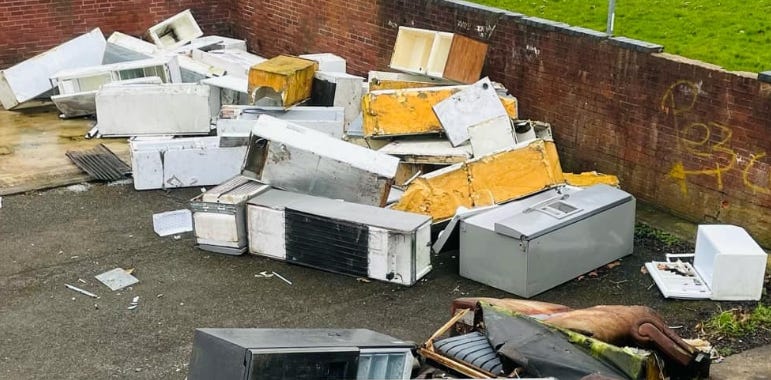
You may be one of those unfortunates whose fridge or freezer stopped working during the summer. Or you may have had a new kitchen installed. If so, your hopes of being free of your old appliance may have been dashed over the summer and into this month. Recycling centres nationwide have been refusing to accept fridges and freezers, with notices advising that the question of what to do with them is your own problem now. Recycling, once the main plank of the green dream, is in crisis.
At issue is a ‘backlog’ of processing after demand for disposal of cooling appliances began exceeding waste processors’ capacity. According to recycling industry compliance non-profit Ecogenesys, this backlog has two main causes. First, hot weather tends to increase the number of cooling appliances that consumers desire to replace. Second, and more significantly, a number of major recycling processors have gone out of business over the last year or so.
One of those processors was Unimetals, whose Newport site in Wales had a capacity to recycle one million appliances per year. The company went into liquidation last November. In February this year, a fire took out a newly constructed plant operated by European Metal Recycling at its Darlaston site, which had previously boasted a capacity to recycle a fridge “every 30 seconds”. And then in April, a plant in Thetford was also damaged by fire, causing Wiser Recycling’s capacity to process such waste to be lost. With all this capacity lost, England’s remaining processors were unable to meet demand, and the fridges started piling up at local waste recycling centres.
At the core of the problem is the substances that makes fridges work – the gases whose cooling effect is achieved by vapour compression and decompression, and the foam that insulates the appliance. In the past, fridges used ozone-depleting chlorofluorocarbon (CFCs) gases which were also common in the foams. Though CFC’s have been replaced by flammable hydrocarbons, environmental regulations require that waste processors can accommodate either species of coolant and foaming agent. Regulations and legislation governing the disposal of Waste Electrical and Electronic Equipment (WEEE) have grown increasingly strict in recent years, as have green rules more broadly.

