Greenland’s icecap is melting away thanks to global warming, at least that is what we are told. According to the EU’s European State of the Climate 2025 Report, the ice sheet lost 139 Gt last year. They say that is equivalent to about 1.5 times the amount of ice stored in all the glaciers in the European Alps, and raised global mean sea level by 0.4 mm. (A gigatonne is one billion tonnes.) Since 1972, losses have amounted to 5,747 Gt. The rate of ice loss has increased by around five times since the 1980s and is expected to continue increasing beyond the end of the century.
These amounts sound terrifying, which is of course the object of the exercise – at least until you realise that at present rates it would take Greenland 27,000 years to melt away.
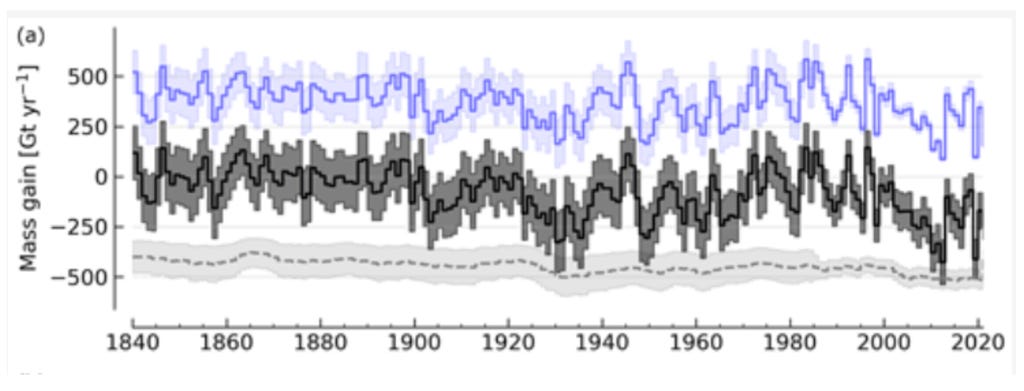
I am always suspicious when ‘scientists’ present trends since the 1970s, a time when the Earth had gone through three decades of cooling and there were genuine fears among both scientists and world leaders about the return of the Little Ice Age. I am even more suspicious when I discover that official data about the Greenland ice sheet is publicly available back to 1840.
In 2021, a peer-reviewed study calculated the annual changes in the ice sheet mass balance since 1840. (The heavy black line represents the net changes, which is of relevance to this discussion):