

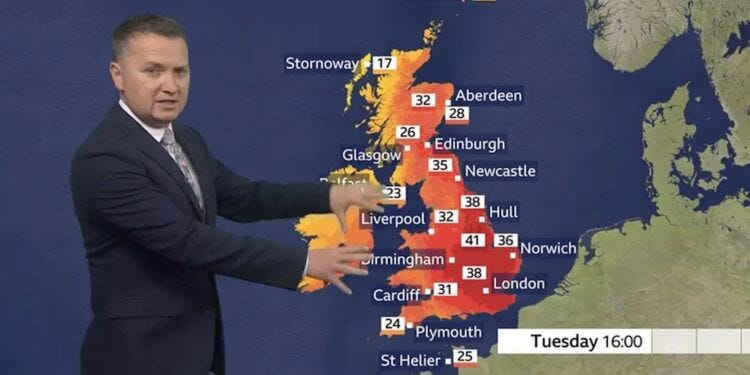
Climate scientists and media correspondents have been getting excited by record temperatures once again. On May 26th, Kew Gardens and Heathrow reported 35.1°C, a new UK record for May, followed by a June record of 37.7°C (June 26th) at Lingwood, Norfolk. The media’s fear narrative, which is climate change reporting, has gone into overdrive with weather graphics turned to hot red; the contrived alarm reinforces the faith of true believers in the global warming message. With such zealous reporting over supposed connections to global warming, little attempt is made to consider and evaluate other possible factors. Climate change seems to have stolen scientific curiosity. Such climate fever was also seen in 2022, when Coningsby in Lincolnshire recorded a value of 40.3°C on July 19th 2022.
Other media reports have noted record global sea surface temperatures for the month of June, given the onset of a major El Niño episode. Carlo Buontempo, director of the EU’s Copernicus Climate Change Service, commented that “With ocean temperatures at these levels and El Niño on the horizon, we are likely to see more temperature records fall in the coming months.” The UN Secretary General António Guterres stated with some alarm that “Earth is being pushed beyond its limits.” The Met Office has also reported that in 2026 England recorded the highest average mean temperature for June (at 17.1°C) in a record stretching back to 1884, while the UK as a whole was the second warmest (see also: Met Office – Marine Heatwave).
Following the record warm year of 2023, other likely causes for the record temperatures were discussed here, over and above the influence of the supposedly villainous greenhouse gases. Such factors include the growth of the urban environment, which also potentially impacts upon the accuracy of temperature readings where new buildings or roads encroach too close to the thermometer screen. The positive phase of the Atlantic Multi-decadal Oscillation and volcanic eruptions can also play a significant part in global temperature changes. Recent improvements to the cleanliness of fuels used in the Far East, Europe and America, and in global shipping, have also led to a noticeable change to cloud cover in the Northeast Pacific and North Atlantic. These factors helped to warm the planet.
A paper in Nature Communications, published in the autumn of last year (November 5th 2025), found that over a 20-year period from 2003 to 2022 the reflectivity of clouds decreased by about 5.6% (2.8% ± 1.2% per decade). The scientific press at the time noted that cleaner air may have accelerated warming. Computer modelling suggests the majority influence for this change has been the reduction in the content of sulphur dioxide and other aerosol precursors in fossil fuels. So-called bunker fuels, used by global shipping, have also been restricted globally by the International Maritime Organization (IMO) from March 1st 2020, with the sulphur content reduced to 0.5% from 3.5%. This further reduces sulphur releases to the atmosphere.
Sulphur pollutants act as condensation nuclei for cloud droplets to form, so given more pollution, clouds will increase their liquid water content with more numerous but smaller droplets. Clouds modified in this way reflect more sunlight, thus having a cooling effect on the planet. Estimates suggest that this effect cooled the lower atmosphere by half a degree Celsius. This was the case for decades. The removal of the sulphur content from fossil fuels has therefore led to thinner cloud cover and an increase in solar radiation reaching the surface, which warms the ocean and land surfaces.
The authors of the 2025 paper forecast that the decrease in cloud reflectivity, and additional warming to the Earth’s systems, will continue for the next few decades without action to tackle the problem. They also noted that most climate models examined failed to model the scale of the reduction in cloud reflectivity, which implies that the climate sensitivity to greenhouse gases in the models is in error. They comment that “Further research is needed to assess whether near-term climate scenarios should be revised to account for the weak cloud reflectivity reductions in the Earth System Models.” At least some of the warming observed in recent years is due to lower cloud reflectivity, which follows from use of cleaner fuels – and so not all warming is due to the effect of greenhouse gases.
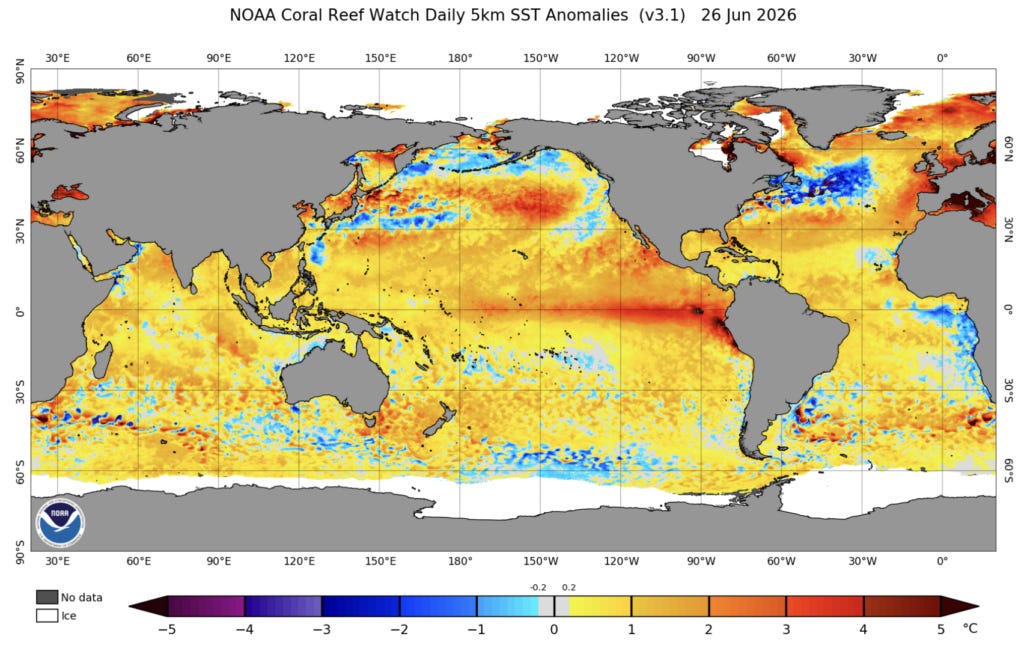
When we turn to consider the recent heatwave that affected Europe at the end of June, we see a marked temperature anomaly around the coast of Iberia, in Biscay and the Mediterranean Sea of three to five degrees Celsius (Figure 1). With cleaner air and thinner clouds, more solar radiation is able to warm the European seas and land, thus leading to record temperatures. And yet reporting on this in the popular press in recent weeks has been absent; it is all too easy for the press to encourage the popular imagination to follow the script of the climate industry without asking questions.
Andrew Sibley is a semi-retired chartered meteorologist with an MSc in Environmental Decision-Making and an MPhil in Theology.

So after decades chasing cleaner air, it now turns out that that has affected cloud cover and, lo and behold, Earth heats up. Is it time to bring back coal-fired homes and factories?