

This is the ninth in a series of 13 articles challenging climate change orthodoxy commissioned by Professor Gwythian Prins. We will be publishing the articles at a rate of one a week (read the first article here, the second here, the third here, the fourth here, the fifth here, the sixth here, the seventh here and the eighth here). The hope is that they can be collected into a book for Sixth Formers and university students.
When I entered politics roughly a quarter of a century ago, human-induced climate change was my primary reason for running in the 1999 European elections and, at that time, I considered it the greatest threat to humanity. I began my journey in the European Parliament Committee for Environment as an active climate legislator and attended most of the UN climate COP (Conference of the Parties) meetings as a member of the parliamentary delegation. I also served on a temporary Climate Change Committee in 2007, aiming to influence all possible climate and energy related issues.
My years as a lawmaker and a COP attendee have significantly shifted my perspective. Over this period, I’ve observed the environmental movement – and consequently the COPs, the Greens and the Commission – alter their stance on nearly all key climate policy instruments. I’ve witnessed numerous pendulum swings, with efforts to try to correct policies pursued with equal fervour as the original measures. Biofuels and the attitude towards biomass energy use are prime examples. The result has been a bipolar approach, swinging from one extreme to another, which has decisively weakened Europe’s investment environment.
After witnessing our grandiose, expensive, yet ineffective policies, I even feel compelled to ask: which endangers our security more, climate change or current climate policy? Naturally, I must justify such an audacious question. I owe an explanation for what happened during my career as a legislator. I’ve addressed this in my doctoral dissertation, ‘The Rise and Fall of the Kyoto Protocol – Climate Change as a Political Process’ (2014), where I detail the mistakes made in the name of climate policy — errors that have, unfortunately, often harmed the environment.
For many, the fight against climate change is synonymous with the Kyoto Protocol and its UN framework. In my thesis, I analysed its most relevant elements and ideological assumptions. The climate problem has been presumed to be more one-dimensional than it truly is, leading to excessive simplification. The protocol has constrained leaders with climate puritanism and a politics of limitation, ultimately resulting in a series of failures.
Firstly, it’s fair to say that the success of climate actions has been disturbed by massive and unpredictable globalisation. Between 1997 and 2002, nobody anticipated that China, India and parts of South America would absorb industrial production so forcefully from Europe and the US. The emission share of Kyoto-target countries was marginalised, falling from 63% at the protocol’s entry into force to just 13% under Kyoto II.
The Kyoto Protocol proved ineffective in positively influencing this development. In the case of industrialised nations, no significant differences in rates of CO2 decline can be traced between countries that had undertaken Kyoto obligations and those that had not. The Kyoto Protocol’s ratifiers fared no better than non-ratifiers.
We need to question if there’s something inherent in the structure of the Kyoto approach that hampered its efficiency. According to many climate policy researchers, numerous factors are at play, from the analysis of the problem’s nature to its basic assumptions, flawed tools and remedies.
Ideology and power dynamics
The foundation for the Kyoto Protocol was laid in the 1980s and 90s. That entire era was characterised by the rise of the environmental movement and its ideological mindset, which is reflected in the Kyoto agreement’s toolkit and the nature of the COP process. This is clearly seen in the case of nuclear power. While COP3 in Kyoto in 1997 indicated that nuclear power would gain more support, by COP4, critical factions were better organised, gathering new opponents. The harmful results of nuclear power were eagerly listed, an attitude that dominated the COP culture for years.
From the very beginning, phasing out nuclear power has been the number one priority for the environmental movement. Their argument often appeals to future generations, claiming nuclear energy ‘hands the problem over to them’. However, this prioritisation has, in practice, significantly increased the world’s environmental problems: air pollution, forest destruction, the expanded use of fossil energy and the numerous accidents caused by it. These problems, too, are delegated to future generations. It is therefore noteworthy that the only form of energy with historical evidence of significant emissions reductions is shunned by those who demand an urgent reduction in CO2 emissions.
Adaptation was a similar taboo. For a long time, environmental organisations opposed measures promoting adaptation to climate change. Al Gore was one of the most impressive opponents of adaptation. In 1992, he stated that it represents “a kind of laziness, an arrogant faith in our ability to react in time to save our skins”. Emission mitigation and adaptation to climate change were seen as mutually exclusive alternatives in climate conference culture. The first option was considered the right way to solve the climate change problem, while the latter was seen as an undesirable policy reflecting a reprehensible attitude. Adaptation was only gradually accepted onto the climate conferences’ official agenda after less-developed countries began to demand it. The 2010 Hartwell Paper was one of the most prominent high-level policy documents to argue for ‘no regrets’ adaptation in contexts of imperfect knowledge and it was castigated by Gore and his kind for doing so. Yet the passage of 15 years has shown the Hartwellians to have been right all along.
The overemphasis on mitigation at the expense of adaptation has been an error stemming from fundamentalism, an error that has been responsible for many deaths, especially in developing countries. The actual prevention of damages and actual adaptation to change in the real world have been viewed as a threat to the viability of mitigation (reduction) policy. Paradoxically, and from a political standpoint, this has significantly slowed down the process of making society more resilient to extreme weather events. In some sense, all societies have been poorly prepared for climate impacts. Therefore, it is necessary to develop technologies, institution, and practices to minimise risks, from weather-proof civil engineering to early warning systems. These are necessary in any case – ‘no regrets actions’, in the Hartwell phrase. It is immaterial whether the cause is human-induced or natural.
I also see unwelcome ramifications in the starting point of setting a ceiling for emissions. From my philosophical studies, I learned that it’s always useful to question things taken for granted. So I ask: why a ceiling? Why not a floor? Regarding greenhouse gas emission reductions, I no longer believe in a policy of restriction and emission ceilings.
Why? They produce results too slowly, and they mostly just pass problems back and forth in the planet’s atmosphere as they transfer emissions from one place to another. Moreover, by focusing mainly on carbon dioxide, other serious environmental problems have been neglected. It could be much more effective to pursue reasonable and necessary political measures: decarbonisation, pollution prevention, combating poverty and biodiversity loss, afforestation, energy savings, clean energy and adaptation. Merely fixating on binding ceilings can lead to self-delusion, interpreting emission reductions resulting from economic recession as a genuine achievement.
Another form of self-deception lies in the criteria of emission source. The basic problem of the Kyoto Protocol was that it did not pay attention to consumption, only to production. A country’s emissions cover all production that has taken place there; thus, the Protocol would punish countries with energy-intensive production, even if that production was generated with the lowest possible emissions. Instead, consumption, which should be decisive and could be a reasonable method for political steering, was practically not considered at all. We must remember that the consumer is the polluter, not the producer. It may come as a surprise to many that during our climate actions in Europe, we have actually increased our emissions.
COP meetings, the summaries of the IPCC’s reports and the media reporting brought a new kind of climate narrative based on catastrophe talk and the discourse of fear. This alarmist rhetoric cultivates words like ‘chaos’, ‘catastrophe’ and ‘destruction’, and its tone is often quite rushed. It exploits the quasi-religious vocabulary of doomsday. It also created a new kind of climate moralism with the measurement of carbon footprints; and as Mike Hulme has argued for many years, and in his article in this collection, it is both a pernicious distraction and subversive of trust.
Inciting climate panic and pursuing emergency policies is dangerous because it leads to short-sighted solutions and ill-considered actions – as we have seen in legislation that swings from one extreme to another. It has also resulted in power being handed over to environmental organisations in the hands of activists and constraining the authority of democratically elected governments. Climate emergencies created by green populism can threaten constitutional rights and justify the suspension of normal politics.
Paris agreement and geopolitics
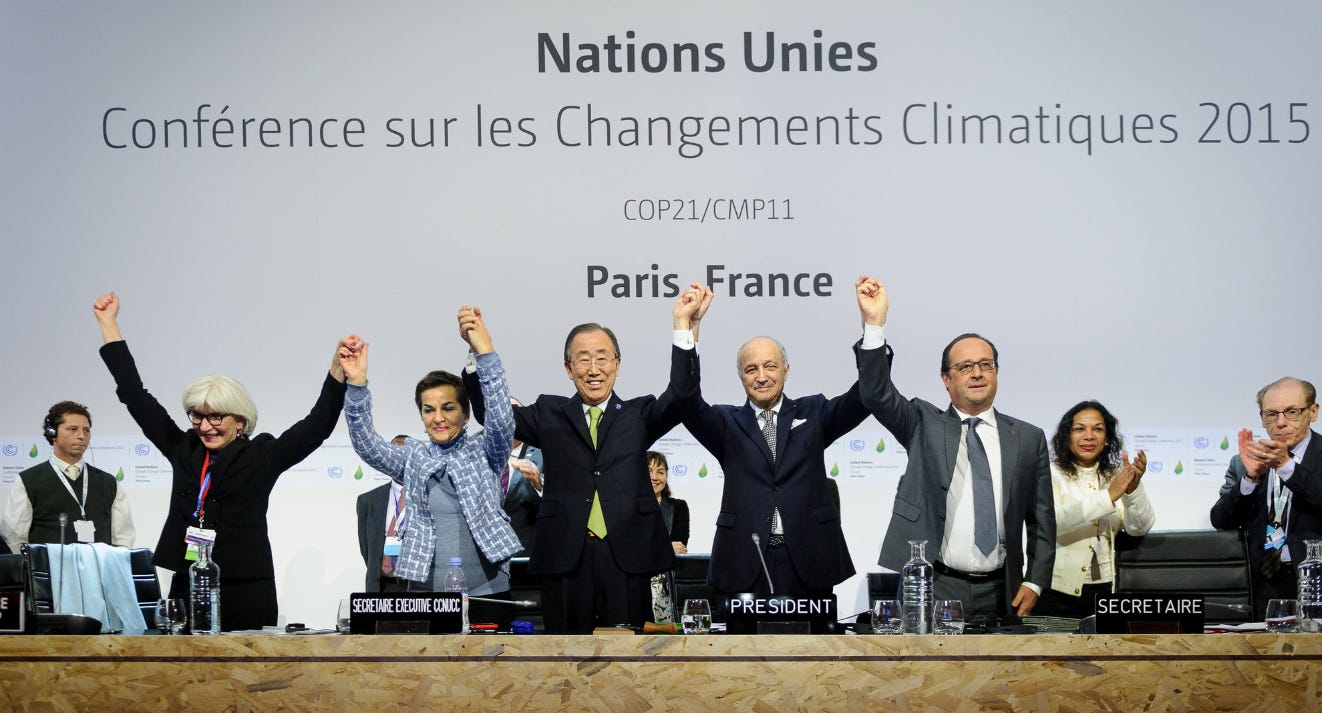
After Kyoto I and II, we got the Paris Agreement 10 years ago. It was called a paradigm shift: a non-binding ambitious treaty. It was an oxymoron, to be honest.
It can be argued that the agreement does not impose any significant, binding substantive obligations on the parties. Yet, regarding the final goal, it sets the objective of limiting the global average temperature increase to well below 2°C or even 1.5°C in a context where we have no idea what coupling to global temperatures CO2 actually has. This means that, collectively, it obliges the ratifying states to the technically impossible, while the agreement does not bind them as individual countries at all.
Does this gap between ambition and obligation pose a problem? Will this paradoxical starting point produce results? And on what terms?
Many observers have called this combination of a tough target on the one hand and non-binding commitments on the other a form of self-deception. Is it any more binding than wishing everyone a Merry Christmas and a Happy New Year? So, why did all the stakeholders celebrate? Especially, why did the environmental NGOs celebrate and even shed tears of joy? Normally, after COP meetings, they publish press releases criticising the lack of ambition.
The Kyoto framework, being a single, massive, binding and integrated deal, was simply too unrealistic for countries with very different interests and capabilities. This time, stakeholders wanted to avoid the US Senate becoming an obstacle to ratification: a binding treaty would have required that.
It has been very clear for a long time that the EU climate strategy, based on the Kyoto framework, did not attract the major emitters, who favour multiple strategies and different climate clubs.
I return to my question about environmental NGOs. Why did they celebrate after Paris? By failing to close the gap between ambition and obligation, the Paris Agreement created a serious problem for governments, leaving a void to be filled by non-governmental actors. Here I quote a Dutch professor of international environmental liability law, Dr Lucas Bergkamp:
The ambition-obligation disparity creates a large arena for climate activism at international and national levels, effectuating a transfer of power… that is inconsistent with the fundamental principles of constitutional government. If the collective efforts appear to fall short of achieving the Paris Agreement’s objectives, the judiciary is likely to be dragged into climate policymaking.
In other words, here comes more ‘lawfare’; as indeed it has, usually riding on the spurious concept of superordinate an ‘international law’ of ‘human rights’. Great Britain is a world leader in such ‘lawfare’ under its present government of human rights lawyers, as witness the bizarre surrender of sovereignty over the Chagos Islands.
Thus, the Paris Agreement paves the way for the new international ‘climate governance’ movement. Its implicit reliance on political activism by the climate movement and the related non-hierarchical governance by courts constitute a threat to constitutional government, the rule of law and representative democracy. It risks an unconstitutional usurpation of power by activist groups and unelected and unaccountable judges that could undermine legislative power and the role of positive law in deciding legal disputes. This risk of subversion is not well understood by politicians and governments.
Europe’s position
What about Europe? We are still largely alone in our climate efforts. We never achieved a global deal. Our unilateral and expensive climate measures cannot truly be considered ‘climate’ politics. They can be described as the decarbonisation of production or the outsourcing of jobs or emissions, but despite the best intentions, the EU strategy has so far not tackled the global problem on a global scale.
The EU commits to a Net Zero target by 2050, while countries like Russia and China are bound by practically nothing. Compare and contrast: last year, China built a record amount of coal power while, according to European Commission estimates, the Net Zero target costs the EU €1.5 trillion annually.
I find this situation surrealistically insane. Only a special kind of stubborn orthodoxy prevents many from seeing and saying it aloud. We are starting to reinvest in deterrence and defence across Europe. At the same time, we are undergoing a drastic unilateral disarmament in the economic sphere in the name of ‘climate leadership’. This happens in two ways. First, China gains an economic competitive advantage for its products in the global market. Second, because of our energy policy, we in the EU have become increasingly dependent specifically on Chinese technology, much like Germany became dependent on Russian energy with its Energiewende. What is the sense in that, please?
Dr Eija-Riitta Korhola was an MEP from 1999-2014. She served as Chairman of the European Parliament Environment Committee, in which capacity she attended most of the COPs. She was also a member of the Hartwell Group.

I really liked your quote “Moreover, by focusing mainly on carbon dioxide, other serious environmental problems have been neglected. It could be much more effective to pursue reasonable and necessary political measures: decarbonisation, pollution prevention, combating poverty and biodiversity loss, afforestation, energy savings, clean energy and adaptation. Merely fixating on binding ceilings can lead to self-delusion, interpreting emission reductions resulting from economic recession as a genuine achievement.” These climate zealots have made the world a worse place, and squandering trillions of dollars on their climate fiction have starved the world of the resources needed to solve real problems like tuberculosis and malaria. A pox on all their houses!
Thank you, wonderful to read about your experience. You have covered so many of the key points, logically, eloquently and efficiently. As a UK power engineer, who studied and trained in the 1970s, I feel frustrated that it has taken a quarter of a century to reach your conclusions. So much time, money and effort has been wasted in the pursuit of Net Zero. In the 1990s/early noughties I like many other power engineers supported a transition to nuclear generation away from coal (not to mention clean burn technologies for coal such as fluidised bed trials, which were never fully explored). However, hysterical environmental evangelists turned public opinion against nuclear power. Gas was seen as the path of least resistance (and cheaper) although not necessarily the best long term solution, but nevertheless politically expedient in the short term. What a complete and utter waste of livelihoods, resource and careers.