

In her UnHerd column last week, Kathleen Stock writes from a “horrifically well-insulated sweatbox”, the fan beside her registering 29°C while the air outside hits 33. Every day is the same: clear blue, suffocatingly hot, uncannily still. The parks are brown, gardens turning to dust. Stressed trees drop huge boughs. At night, foxes prowl, thirstily searching for water. Brambles appear far too early; the pond at the end of the road is silting up. She feels discombobulated – sweaty, exhausted, her mind as vacant as the cloudless sky.
This opening of her UnHerd essay, ‘Why I’ve got the hots for localism’, is an existential register of fatigue, rendered through direct observation and an aesthetic sensibility rather than charts or organised empirical data. Ms Stock has absorbed the idea of a “new kind of summer” as lived experience. The cider-apple harvest is failing, harebells and wasps are disappearing, parts of the New Forest are blackened, elderly neighbours wilt in oven-like flats and local farmers watch stunted wheat and barley. She asks how we feel about this “new normal” and answers with sadness and “discombobulation” that require no grand theoretical defence – much as grief for people or pets needs none.
Dr Stock OBE, a gender-critical feminist and philosopher, is right about the larger strategic point that follows. Whatever the causes and consequences of global warming, a small country like Britain cannot do anything about it alone. Provisional UK territorial greenhouse-gas emissions for 2025 stand at 367 MtCO₂e, less than 1% of the global total according to the Department for Energy Security and Net Zero. Any meaningful reduction is swamped by emissions growth in China, India and other large developing economies. The coordination and free-rider problems among major emitters in any proposed global deal are near-impossible. Gathering the world’s nations at the UN annual climate summits – the next one, COP31, to be held in Antalya, Türkiye, from November 9th to 20th 2026 – has made little difference to global emissions over the past three decades.
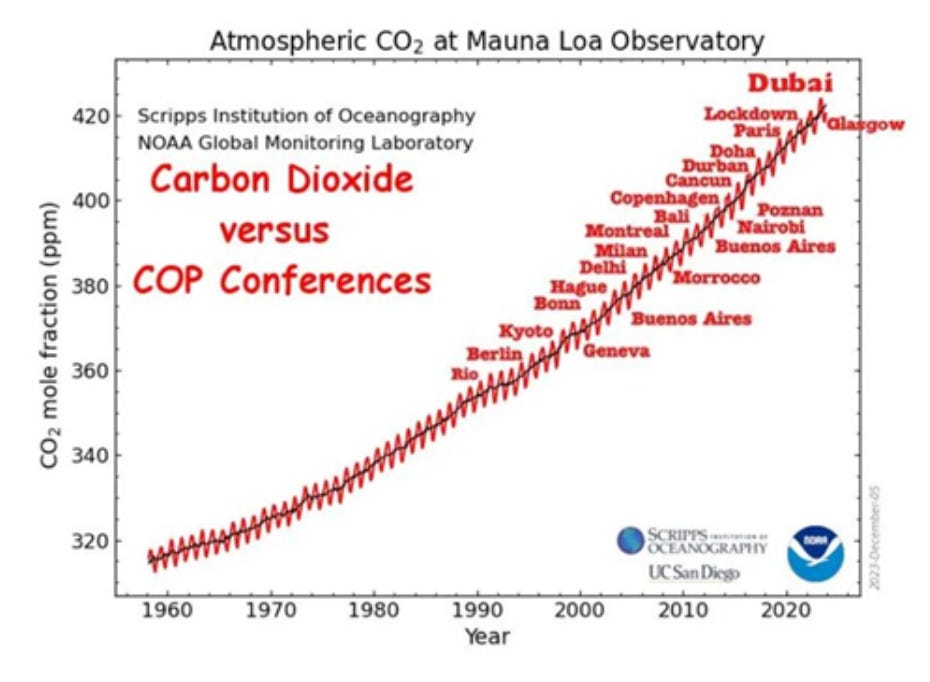
Instead of clashing endlessly over the global warming narrative, she proposes detaching the local from the global. Chasing impossible global solutions hampers useful consensus-building on urgent local and regional problems to save vanishing landscapes and help the elderly in oven-like flats, manage failing harvests and buckling rails and form practical adaptation plans “without any grand theory about carbon dioxide.”
An unprecedented hot summer, raging wildfires, failing agriculture: not by the numbers
Start with the weather itself. Stock treats the current summer as a novel meteorological regime – “the new kind of summer”, a heat so unfamiliar that “no one can remember what rain feels like”. The parks are brown, trees drop boughs, foxes search for water. Yet British summers have been hot and dry before, and worse. The 1976 heatwave and drought produced 16 consecutive days above 30°C at Heathrow, a peak of 35.9°C at Cheltenham and a drought so severe that a Cabinet minister was appointed specifically to manage it; some parts of southern England received under 55% of average rainfall over more than a year. The 1995 drought is now regarded by meteorologists as drier still. Neither event required elevated atmospheric CO₂ to be explained; both were driven by persistent blocking high-pressure systems, the same phenomenon operating today. The insistence that 2026 is meteorologically unprecedented functions less as observation than as mood music for the argument that follows. Note that the UK Met Office itself, relying on junk weather stations and purveying “homogenised” – read massaged – temperature trends, has lost credibility as a reliable organisation, as my colleague Paul Homewood has documented rigorously over the years.
The same selective framing appears in Stock’s treatment of local crises. She notes a nearby train derailment that observers speculate was caused by heat-buckled rails. Stock’s catalogue of local issues includes early brambles, a silting pond, New Forest fires, a failing cider-apple harvest, disappearing harebells and wasps and stunted wheat and barley. Some of these can cause real hardships. But the causal story she tells is incomplete, and conveniently so. The “heat buckling” of rail tracks is being investigated by rail officials but, until it is confirmed, the likely culprits are poor maintenance of tracks and other infrastructure.

