

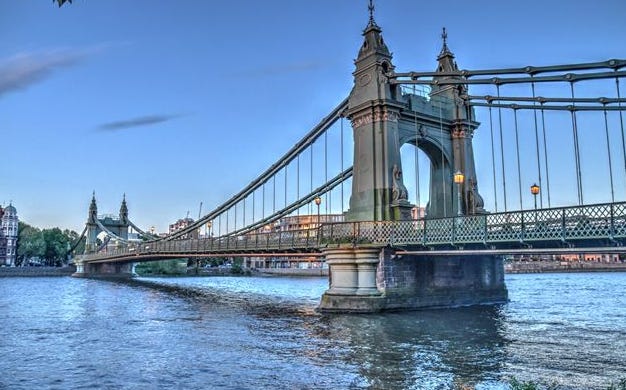
Something of a row has broken out about charitable organisations deviating from their nominal purpose. According to a Times report by Juliet Samuel, charities that were seemingly founded to maintain London’s deteriorating bridges have instead been making substantial grants to Left-wing causes. Barrister Barbara Rich, however, has answered this criticism, pointing out that the law does not constrain charities in the way that critics imagine it should, and that the consequences of making it so might not be desirable. But pulling back from the detail of this debate reveals a much more intriguing picture about the state of Britain’s infrastructure and politics.
The controversy begins with the fact that some of London’s oldest crossings are decrepit. Hammersmith Bridge has been closed to vehicles since 2019 after defects were found in its structure. Albert Bridge has been closed since February this year for the same reason. London Bridge is closed to traffic for 12 hours a day for opaque reasons, seemingly related to Covid and climate change. These closures have caused traffic chaos in neighbouring areas in a very large city divided by a wide river, both north and south sides of which are very badly served by way of crossings. And things are even worse to the east. Critics ask why it is so difficult to maintain infrastructure, and even more difficult to build new capacity.
As a former East Londoner, and then as an economic refugee (priced out of London and moved to Kent), I have sympathies for these criticisms. Getting from East London to the south by car was very often a chore that would take the better part of the day, as if a cross-country journey, not a trip of less than 10 miles. Coming back from Kent to East London, or to the east of England, I’d find that occasional restrictions or closures of the Dartford tunnel or adjacent Queen Elizabeth II M25 crossings would send traffic between Essex and Kent into East London. These problems, in the most densely-populated parts of the country, force reflection on the question of whether Britain is in any sense ‘developed’ at all.
One of the fetters on the provision of adequate roads is of course the green agenda. Although the Silvertown Tunnel in East London was built in relatively short order and completed in 2025, plans for a Lower Thames Crossing to link Tilbury in Essex with Gravesend in Kent faced legal challenges from Green Blob funded climate and transport campaigners. These legal challenges used the government’s commitments to the Paris Agreement and emissions reduction policies to prove that plans were unlawful. Meanwhile, further inland, the new East London crossing imposed on East Londoners (who are already subject to charges for congestion and pollution) tolls of up to £4.20 each way for a car, which the Mayor believed would “control the numbers using the tunnel and stop an increase in congestion and pollution”, according to the BBC.

