

You have sat too long for any good you have been doing lately.
Depart, I say, and let us have done with you.
In the name of God, go!
Cromwell to the Rump Parliament April 1653
Last week, there was an Opposition Day on Tuesday March 24th and the Conservatives took the opportunity to force a vote on the UK oil and gas industry. Their motion called on the Government to remove the Energy Profits Levy, end the ban on new oil and gas licences and approve the Rosebank and Jackdaw fields to increase secure domestic energy supply.
Parliament decided to put Net Zero above the national interest and the motion was voted down by 297 votes to 108. Not a single Labour, Liberal Democrat, Reform, Restore Britain or SNP MP voted in favour of the motion. Time to explore why this was a catastrophic error and tantamount to treason.
Catalyst for the Oil and Gas Motion
The UK’s energy policy has been a disaster for at least two decades, but the catalyst for the Tories to lay this motion was the disruption caused to global oil and gas supply caused by the war in Iran.
As a reminder, in peaceful times, about 20% of the world’s oil supply transits through the Strait of Hormuz. Since the beginning of the war, traffic through the Strait has plunged by 95%. This disruption to supply has caused energy prices to rise significantly, see Figure 1 (data from Trading View).
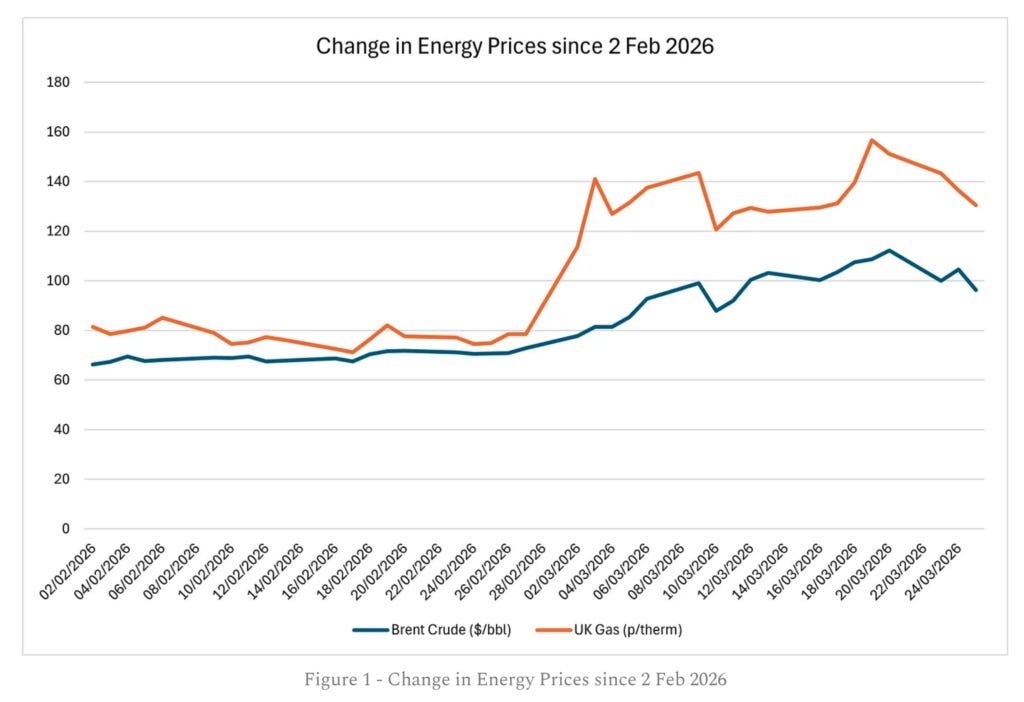
Using the start of February as a baseline, Brent crude prices are up 45% to $96 per barrel on 25 March and UK gas prices are up over 60% to 130p/therm although both prices have dropped a little from their highs.
Impact of War in Middle East
Supply of oil and gas is likely to remain constrained and prices elevated for some time, even if there is a peace deal because so much infrastructure has been damaged. For instance, Qatar’s Ras Laffan Liquified Natural Gas (LNG) plant has been hit causing extensive damage that has knocked out 17% of Qatar’s LNG export capacity and force majeure has been declared on some export contracts. Repairs will take 3-5 years to complete. Bahrain has declared force majeure after its Sitra oil refinery was attacked and Iraq has cut output from its southern oil fields. Other oil and gas facilities have been hit in Saudi Arabia, Kuwait and UAE.
The Gulf region is a major global hub for nitrogen-based fertilisers. Qatar has halted production of urea and exports of have been disrupted due to the closure of the Strait of Hormuz which could lead to a global food crisis. Exports of Helium, critical for semi-conductor manufacture have also been hit. The supply of petrochemicals like polyethylene and polypropylene has been hit which will have downstream impacts on the global plastics industry. The Gulf also accounts nearly a quarter of global sulphur supplies. Sulphur is also used to make sulphuric acid, a critical chemical in making phosphate fertiliser and in refining critical metals like copper, nickel, cobalt and uranium. Aluminium production has also been disrupted, particularly in Bahrain and Qatar, where Norsk Hydro has declared for majeure.
The International Energy Agency (IEA) has warned of the largest supply disruption in the history of the global oil market. Sky News has warned the UK is facing the biggest economic hit from the Iran war of any major country. Some impact is already being felt as China has banned export of fuels like petrol, diesel and aviation spirit, while the CEO of Shell has warned of fuel shortages in Europe as soon as next month.
UK Vulnerability
The UK is vulnerable to events in the Middle East because our industry has been systematically degraded over several decades by misguided governments. We no longer make ammonia, used in downstream products like nitrate fertiliser. Jim Ratcliffe has warned that our chemical and petrochemicals industries are on their knees because of high energy prices and carbon taxes. The UK’s aluminium production has fallen from over 300,000 tonnes in the early 2000’s to less than 50,000 tonnes.
Of course UK oil and gas production is down too, forcing us to rely more on imports.
Labour Government Response
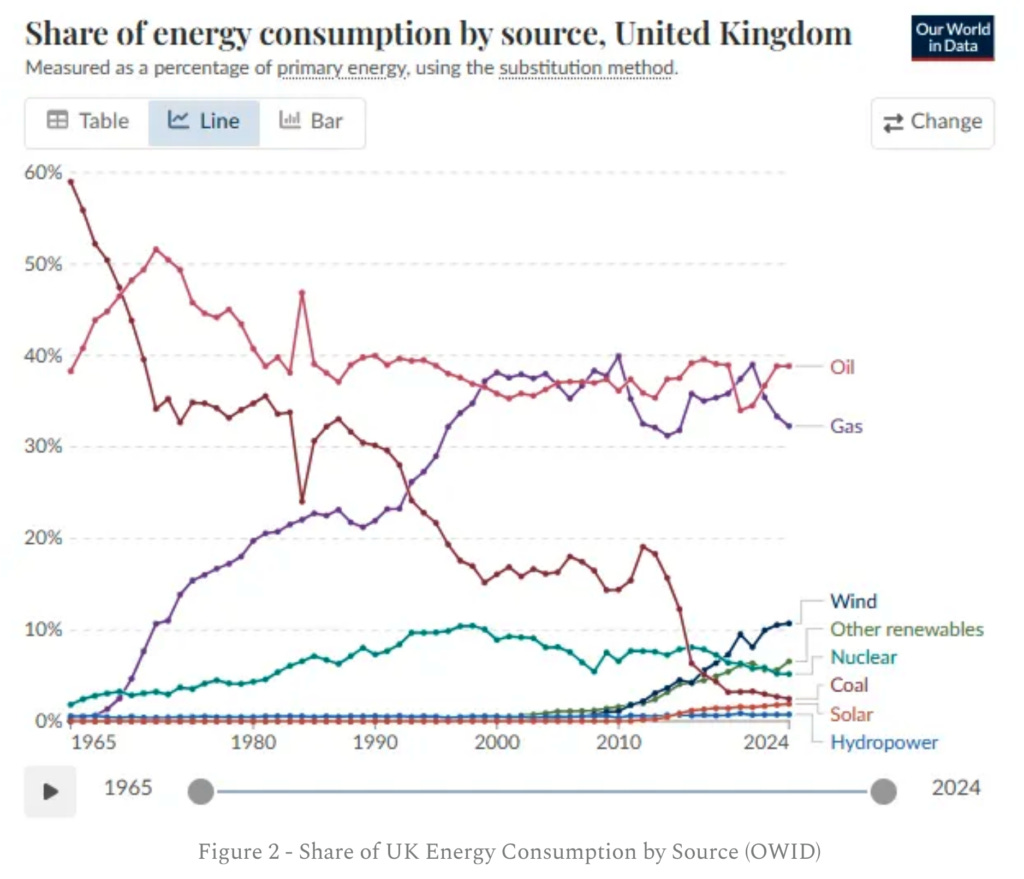
Given that coal, oil and gas provide nearly three quarters of the UK’s energy (see Figure 2), we might hope that the Government would react decisively to secure energy supplies in the face of such an energy supply shock.
But the actual response has been feeble. To protect consumers, there is a new fuel price checking website, called the Cheaper Fuel Finder to combat price gouging. Energy minister Michael Shanks has announced the plug-in solar panels will be available in supermarkets and new homes will be forced to have solar panels and heat pumps installed. This might be termed the chocolate teapot response.
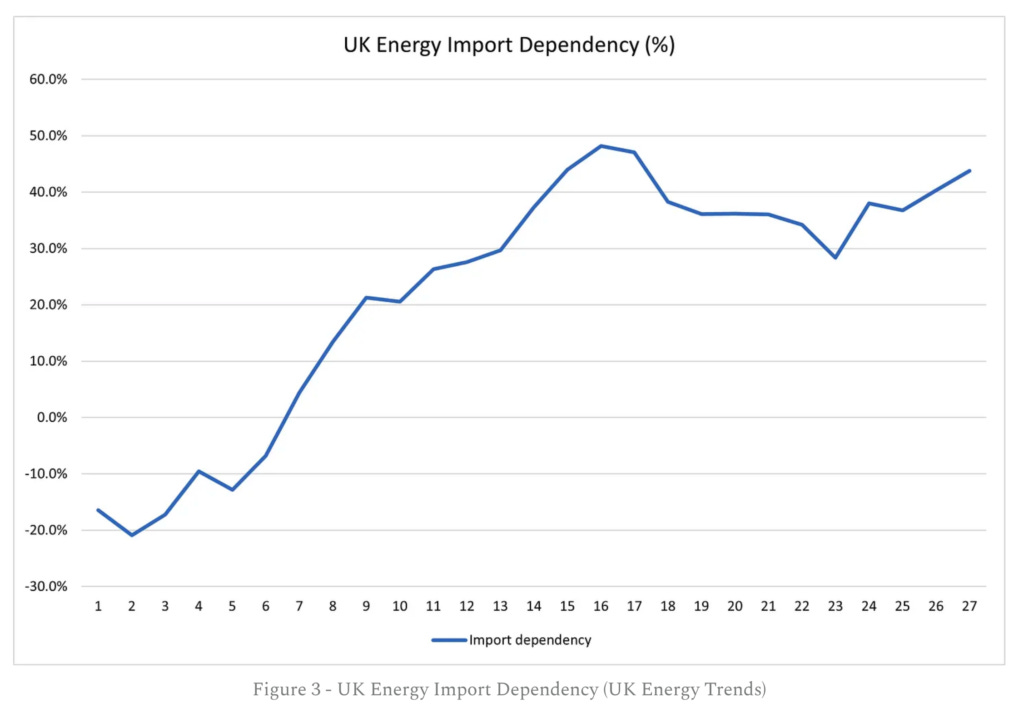
Despite the biggest ever oil supply shock and rising energy import dependency (see Figure 3, from Energy Trends Table 1.3), the Government has not made any commitments to increase domestic hydrocarbon supply.
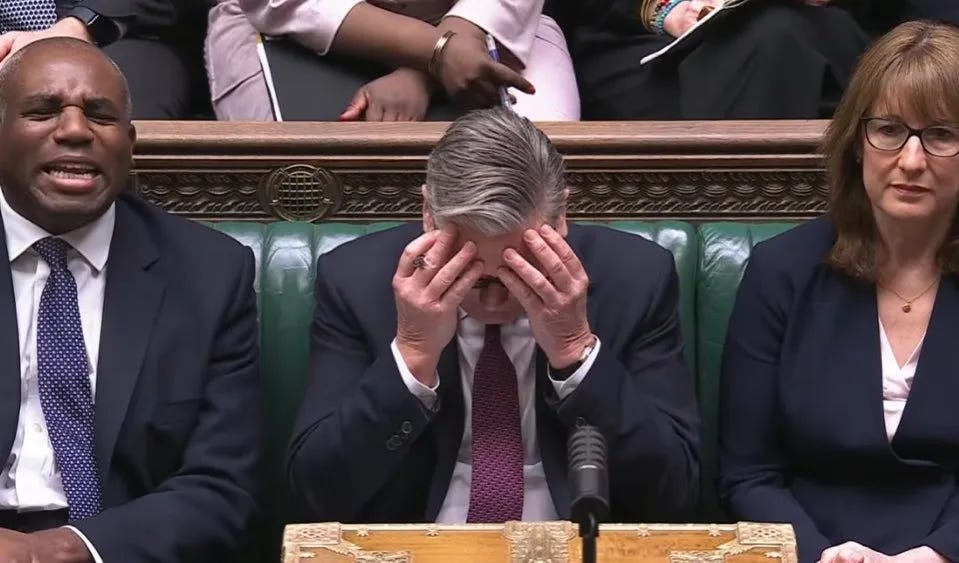
At Prime Minister’s questions, Keir Starmer steadfastly refused to overrule Ed Miliband and fast track Jackdaw and Rosebank into production.
The Government’s lack of action flies in the face of the Tony Blair Institute, RenewableUK, Offshore Energies UK, Greg Jackson and even backbench Labour MP Henry Tufnell who have all called for more drilling in the North Sea.
Benefits of North Sea Oil and Gas
There are many stories circulating effectively saying that the North Sea is not worth bothering with (see Figure 4) because it is a mature basin in decline.
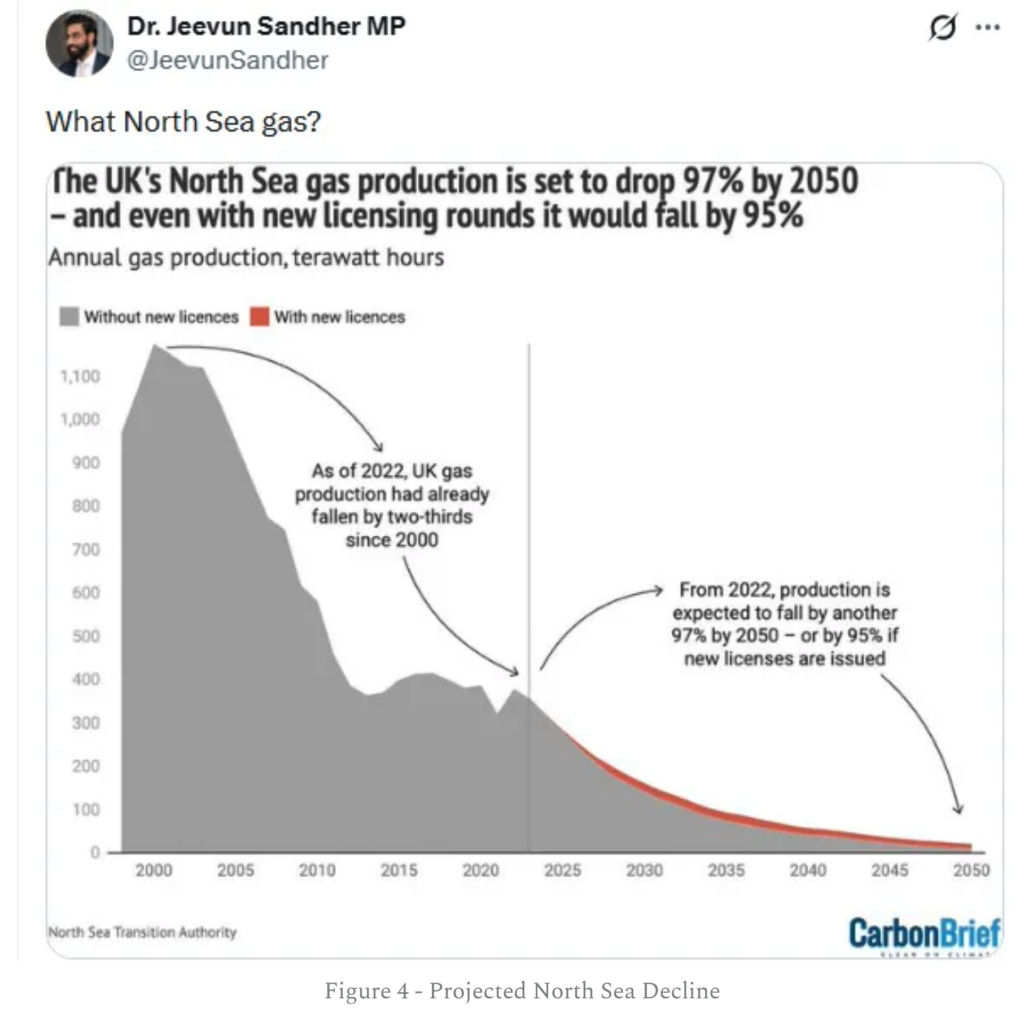
However, the gas production forecasts from the North Sea Transition Authority (NSTA) assume the current tax and regulatory regime that is discouraging investment remains in place. It is hardly surprising that production falls steeply when no new exploration drilling is allowed. Incidentally, part of NSTA’s mission is to “accelerate the move to net zero” so their pessimistic stance is unsurprising. Ed Conway from Sky has been effective in showing that if we move to a more benign environment production would fall much more slowly (see Figure 5).
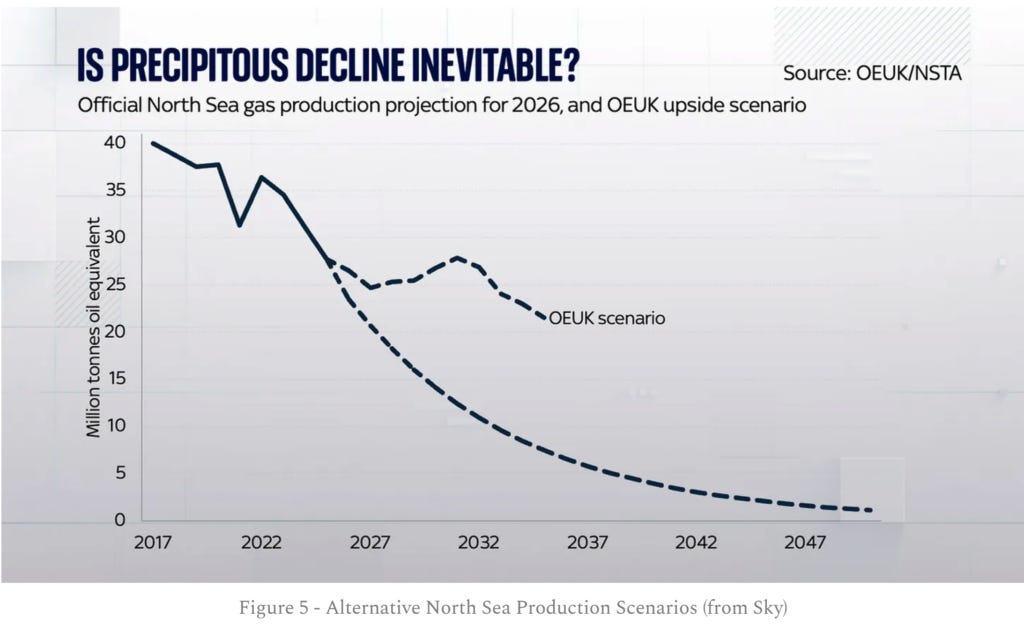
This new scenario uses data from Offshore Energies UK (OEUK) that assumes a more benign tax and regulatory regime, but does not include potential gas production from onshore fracking. OEUK has also produced analysis showing oil and gas reserves and resources could almost triple from their low case to a risked 7.5 billion barrels of oil equivalent (26.6bn boe, unrisked) with a major shift in regulations and taxes.
More domestic oil and gas production will deliver well paid jobs and tax revenue for the Exchequer. Lower tax rates will likely deliver a higher overall tax take. Domestic production will improve energy security through less reliance on imports and improve the trade deficit. Increased gas production will also likely reduce prices because it will displace expensive LNG imports. Ironically, domestic production will also lead to lower emissions of greenhouse gases because the energy intensive processes of cooling, liquefying and shipping LNG will be avoided.
Policy Response
In the light of the damage being caused by Net Zero and the disruption in the Middle East, a more rational policy response would include abolishing the windfall tax on UK oil and gas production because the marginal tax rate of 78% is discouraging investment. Capital allowances should also be restored. The regulations forcing developers to calculate Scope 3 emissions and electrify offshore installations should also be scrapped or reformed. Regulators like the NSTA should have their mission amended to maximise production.
The government should also end the ban on new exploration drilling and lift the moratorium on onshore fracking. Carbon taxes should be abolished to bring down electricity prices and lift the threat to our remaining oil refineries. The most expensive subsidies for renewables, like the Renewables Obligation should also be abolished to further reduce electricity prices and pave the way for tax cuts. More than half the cost of petrol at the pump come from tax, so there should fuel duty should be cut too. Many of these tax cuts could be funded by removing subsidies for EVs, carbon capture, green hydrogen and heat pumps as well as the cuts to the Renewables Obligation.
Voting Record
The vote on the Conservative motion was useful to flush out the enemies of national security and prosperity.
As might be expected, the 296 votes against the motion came from the Greens, Labour, Plaid Cymru and Labour-adjacent independents. Nearly 300 MPs voting for energy insecurity and industrial decline.
The members recording no vote told their own story. Ed Davey, the Clown of Westminster and leader of the Liberal Democrats, led his MPs to the fence where he parked his ample derriere and rallied his colleagues to follow his determined indecision. Nine SNP MPs, three of them in Aberdeen constituencies including their leader in Parliament Stephen Flynn, could not bring themselves to register a vote. Aberdeen is losing 1,000 jobs per month and these MPs could not be bothered to vote to save their city.
Fourteen Tories also registered their indifference to their own party’s motion with four of them, Karen Bradley, Aphra Brandreth, Caroline Dineage and Louie French being members of the green blob organisation, the Conservative Environment Network. At least as troubling was the refusal of Reform and Restore Britain MPs to vote for the Tory motion. Both parties are opposed to Net Zero and want to exploit our energy treasure. Refusing to vote for a motion they agree with smacks of petty infighting, not the principled leadership we need.
Interestingly, 118 Labour members abstained too, perhaps indicating that support for Ed Miliband is starting to crumble. North Sea drilling supporter Henry Tufnell also abstained, unable to bring himself to stick to his principles and vote for the Tory motion.
Of the 108 MPs voting for the motion, 98 were Tories backed up by Ulster Unionists and a few independents. This is a welcome volte face from the party that brought us Net Zero in the first place.
Conclusions
The UK is already suffering from high energy prices and deindustrialisation. The war in Iran has caused the largest oil-supply shock in history. As a result, energy prices have risen and the supply chains of many materials that are critical to modern economies have been disrupted. Labour’s response has been feeble.
The Tory motion to support more drilling in the North Sea to enhance our energy security was well-timed and has flushed out those who would rather blindly follow Net Zero ideology than act in the best interests of the country. It is almost as worrying that parties who agree with the new Tory policy of abandoning Net Zero could not bring themselves to vote for the motion.
We used to have a word for betraying your own country. In the limit, stupidity is indistinguishable from stupidity. But motives matter less than outcomes. Failing to act to secure domestic energy supplies is at best wilful negligence and at worst tantamount to treason. The end of this Parliament cannot come soon enough.
David Turver writes the Eigen Values Substack page, where this article first appeared.

I really am shocked and disappointed that Reform voted the way they did. They are the only Party that is supposed to be opposed to Nut Zero and, because of that, the only Party I would vote for.