

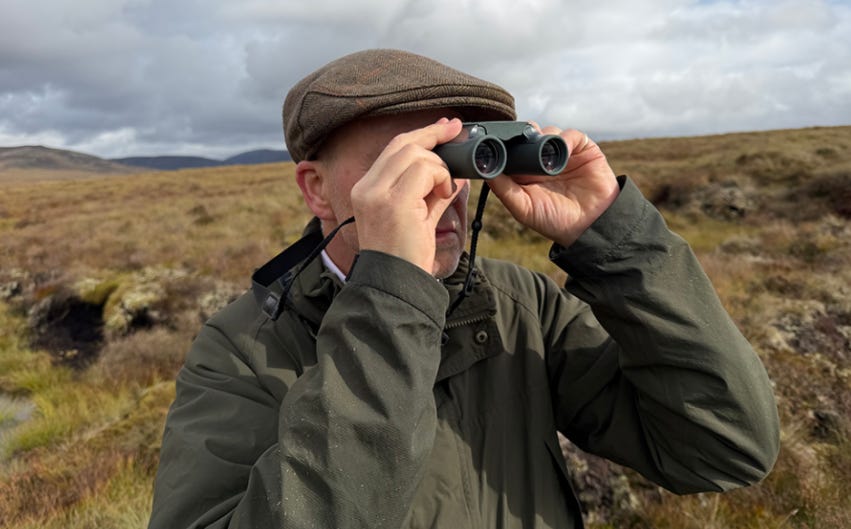
The economy of rural Scotland is under threat from a Net Zero subsidy scheme that is seeing large areas of the Highlands ‘rewilded’ and turned into peat bogs, driving out traditional pursuits like deerstalking. I wrote about the problem in my Spectator column this week after enjoying my annual visit to the Cairngorms to join in a stag hunt. Here’s an excerpt.
Some people will recoil at the thought of deriving pleasure from shooting such a majestic animal, but if they’re not killed by the ‘guests’, they’ll be shot by the professional stalkers employed by the estates or the park rangers. In 2020, the Deer Working Group, which was set up by the Scottish government, recommended that there should be a maximum of 10 red deer per square kilometre over large areas of open range, and an estimated 200,000 are culled every year – more now that the SNP Government has scrapped seasonal restrictions, making it possible to shoot stags all year round. Visitors like me account for a tiny fraction of the total, but it’s a storied tradition that has inspired some of Scotland’s finest paintings (see the Landseers in the National Gallery of Scotland in Edinburgh) and provides employment to an army of stalkers and gillies, with the trade being passed down from one generation to the next. The large sporting estates are also responsible for a lot of Highland tourism, sustaining thousands of small businesses.
But stalking is under siege and is gradually dying out. The principal cause is the lucrative carbon credit market, making it more profitable for landowners to embark on large peatland regeneration schemes at the expense of traditional Scottish sports. It’s particularly profitable because this ‘rewilding’ is paid for by the Scottish taxpayer, with Holyrood having committed £250 million to restoring 250,000 hectares of peatland by 2030. The landowners happily fill in the drainage ditches that, 60 years ago, they were paid to dig in the hope of improving the grazing. They sell the carbon credits each year to businesses that want to offset their emissions, and watch their land rise in value thanks to the carbon gold rush.
According to the stalker that took me out on Monday – a 65 year-old who was the fifth generation of his family to take it up – a neighbouring estate was sold recently for £19.5 million, triple what it’s worth as measured by how many deer and grouse are shot by paying guests each year, which used to be the way sporting estates were valued. Since the purchase, grouse shooting has been stopped altogether and stalking is being phased out, with the new owners aiming to keep the number of deer down to two per square kilometre. It’s safe to say he was unimpressed.
“There are no teachers in the schools, no nurses in the hospitals,” he said, “but the Scottish Government can find £25 million a year to fill in some ditches that will have little or no effect.” As we passed various pools of water, he scoffed at the idea that the uplands would benefit from being even wetter: “At the end of today we’ll be absolutely bloody soaking.”
One argument conservationists make is that peatland regeneration will reduce the risk of wildfires, but that is disputed by those who make their living on the land. You now need a licence to carry out a controlled burn and NatureScot is parsimonious about granting them, not wanting the carbon to be released into the atmosphere. In addition, the declining number of grouse shoots means fewer gamekeepers, so fires are less likely to be nipped in the bud. My stalker pointed out that the largest fire in the Cairngorms this year was on land that had been ‘rewilded’ by the RSPB.
Worth reading in full.
Locally we’re seeing our countryside despoiled for future generations by massive wind turbines and huge pylons built to take electricity from the NE of Scotland to England. Scotland already has sufficiency in wind and solar power and huge sums are being paid to turbine owners to switch off when it’s too windy. It’s very inefficient to transmit electricity to England. The turbines supplying England would be more efficiently located closer to the urban centres where the electricity generated is intended to be used. England has no shortage of windy places. But better still, pause any further expansion of industrial turbines and solar farms and build nuclear, using gas and oil in the mean time. It’s also becoming clear there is no national policy and process for disposing of turbines and solar panels as they reach the end of their life, which is now happening. Are we to live with defunct turbines and solar panels permanently littering our landscapes because it certainly looks like it - I can see a big wind turbine from my window which is old and no longer economical to run and hasn’t been functioning for more than 18 months and there seems to be no plan for its removal and no requirement for it to be decommissioned.