

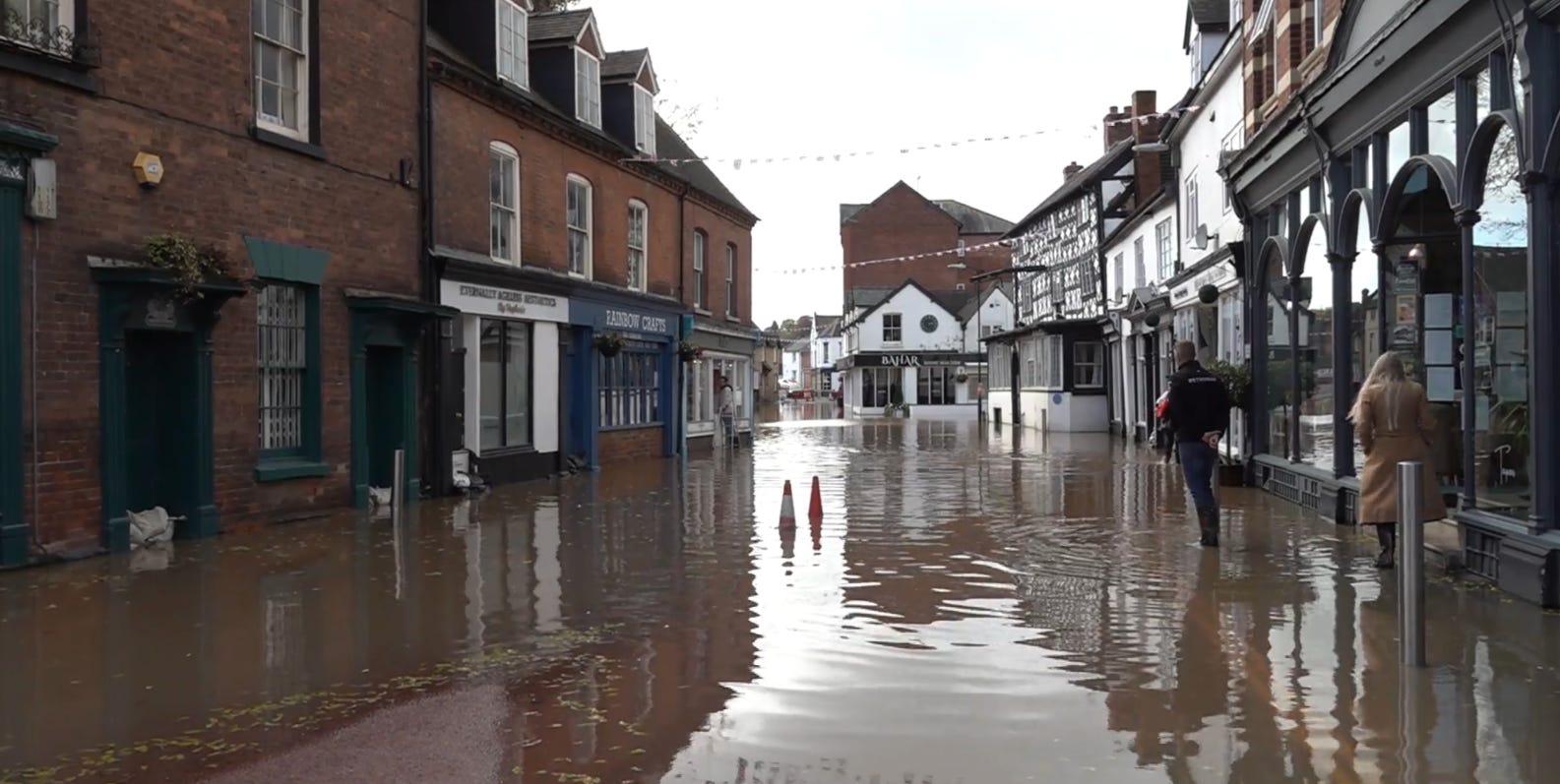
‘If it bleeds, it leads’ is the oldest rule in the newsroom. Its climate-era corollary is that if it floods, burns or sinks, it sells. Wednesday’s Telegraph ran the headline ‘Next financial crisis “to be triggered by uninsurable homes”’, warning that climate change is making British homes harder or even impossible to insure, that mortgages will become unobtainable and that properties will become unsellable. Readers are reminded that the undermining of the mortgage market drove the 2008 crash, and informed that a wave of uninsured, high-risk homes could do the same.
There is no surer way to unsettle a reader than to tell him that his home, almost always a family’s largest asset, is about to become worthless. That is precisely the point. For 15 years the climate story has been sold less as science than as a threat aimed at the reader’s own front door: your house will burn (’global warming’), your street will flood (’rising sea levels’), your foundations will crack. In May 2013 Barack Obama’s Twitter account told its 31 million followers that 97% of scientists agreed climate change was “real, man-made and dangerous”. The study behind the tweet said nothing about danger; that word was added by Obama’s team. “Real, man-made and dangerous” has nonetheless been the house style of the legacy media ever since, and the uninsurable home is simply its latest product line.
Whistleblowers, or a campaign?
The Telegraph describes its sources as senior City figures represented by “a whistleblowing organisation called Inside Track”, which has written to Ministers, the Financial Conduct Authority and the Bank of England claiming that insurers are under-pricing climate risk. The paper adds, almost in passing, that the group is backed by climate charities including the Esmée Fairbairn Foundation, one of Britain’s largest grant-makers, whose 2020 strategy explicitly targets “the causes and impacts of climate change”.
Inside Track Campaigns Ltd was incorporated in March 2025 as a company limited by guarantee whose registered business is public relations and communications. Its first accounts are not due until December, so the public cannot yet see who pays for it; its own FAQ says only that it has been funded by trusts and foundations. Nor does it deal in leaked documents, the stock-in-trade of genuine whistleblowers. Its website says plainly that it is not looking for confidential documents. It recruits anonymous senior professionals, collects their views on common industry practice, and then advises on which stakeholders should hear the message and how best to deliver it. That is a description of an advocacy campaign, as my colleague Paul Homewood describes. The template has been used before: an Inside Track group of food-industry executives issued a similar memo warning of climate risk to Britain’s food supply.
The anonymous insiders’ own words undercut the alarm. One former reinsurance executive complains that the industry does not care about climate risk more than a year ahead because it can “keep repricing cover”. That is not a scandal; it is how property insurance works. As Warren Buffett told Berkshire Hathaway shareholders in his 2015 letter, policies are written for a year and repriced annually, so a rising possibility of loss shows up promptly in premiums rather than in insolvency. An insurer that reprices every year is not quietly accumulating a 2008-style time bomb on its balance sheet.

