

According to the Lancet Countdown report, “Droughts Affected 51.8% of Global Land for at Least One Month in 2025”, and that the area affected has doubled since 2014. In my previous two articles here, I looked at the Lancet Countdown’s claims regarding the link between mortality risk and exposure to high temperatures, and the link between climate change and communicable diseases. Both headline claims, I argue, depart from observational evidence and conceal reality behind shonky statistical methods to make political points that people who are really concerned with health would not make. And in the report’s claims about droughts, we see the pattern repeated again – a once-respectable journal of medicine using its authority as political leverage.
Drought has obvious implications for human health. Water is required for drinking, sanitation and agricultural production. Droughts “are the single most destructive climate hazard to agriculture, responsible for more than 30% of global crop losses in low-income and middle-income countries, exacerbating the risk of food insecurity”, explains the Lancet. These data, of course, create a moral imperative that the world’s policymakers must respond to with urgency. The Lancet’s data explorer shows the grim detail.
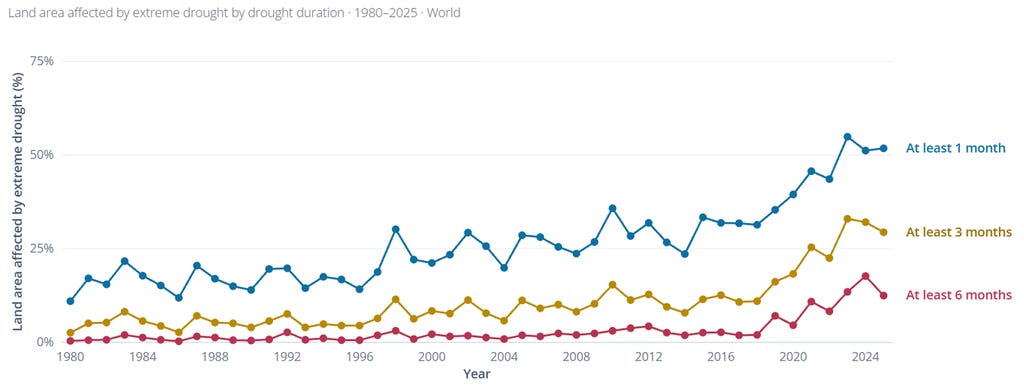
These data do indeed appear alarming. But before Daily Sceptic readers start cancelling subscriptions and joining Greenpeace, I would again urge a comparison to other sources of data and analysis. For such overviews, I tend to start with Oxford University’s Our World in Data project (much to its authors’ irritation, I would imagine).
If there has been a doubling of the land area affected by “extreme drought” lasting more than one month, and even greater increases in “extreme drought” lasting longer than three and six months then it isn’t visible in OWID’s data.

