


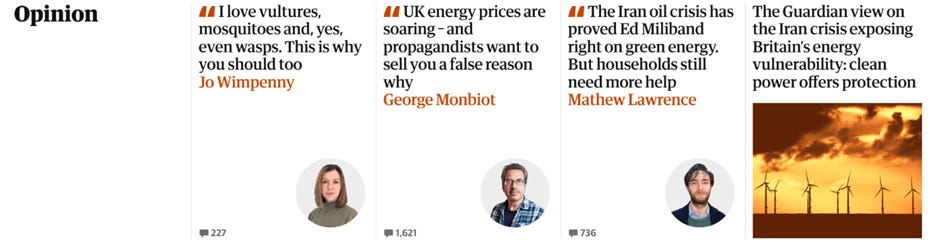
Alongside the claim that you should love mosquitos and wasps, the Guardian’s Environment Correspondents opinion section carries three attempts to turn the Iran crisis into an opportunity for the UK’s green agenda. Environmentalism is, I have long claimed, an opportunistic infection: its adherents are unable to make a case for a perfect world on its own terms, and so their argument for a radical and urgent reorganisation of society, requiring the suspension of normal politics, must capitalise on a sense of crisis to advance their agenda. And so it is that the Grauniad’s eco-hacks rush to Ed Miliband’s rescue with some tall tales.
I do not, and never will love mosquitos and wasps. I’ve never been troubled by a vulture, except figuratively: those who prey on others’ emotions by provoking alarm and fear. I’m no fonder of figurative mosquitos, either: those who suck the lifeblood of others, to enrich themselves. And wasps, too: the aggressive harassment sucking the joy out of alfresco eating and drinking. To the extent that these figurative and non-figurative things are ‘nature’, they make my point that there’s nothing in nature to offer us a model for the organisation of society. The wretched feeding off corpses and living bodies and the swarming violence – and the rigid social hierarchies of ant colonies, for that matter – suggest to me that ‘love’ for ‘nature’ of this kind is an absurdity. ‘Nature’ cannot reciprocate your ‘love’, but it will infect your infants with a deadly plasmodium.
Yes, I can, like most of us, take a trip to some awesome natural landscape and enjoy the sense of removal from the everyday nagging demands of life. But this appreciation is as much owed to the fact that I can get back in my car to my home, which is connected to a grid, to constant warmth, near countless shops, amenities, hospitals and so on, should I need any of them. Even for those who live much closer to the countryside, thousands of years of history and economic, cultural and technological development separate them from ‘nature’. Yet the religion of the Guardian is one that preaches that this has all been a catastrophic mistake.
We should understand that this is the Guardian’s ideological motivation before we take any of its subsequent claims at face value. (It should be recalled that one of the newspaper’s longstanding heroes, Paul Ehrlich, died last week.) The “Guardian view of the Iran crisis” is that Ed Miliband has “grasped” a “reality” that is beyond the understanding of his counterparts in the Conservative and Reform parties. “Green power is in effect an insurance policy against geopolitical risk,” it argues, claiming that the counter-position of increasing domestic natural gas production would not yield any benefits, chief among them Britain’s “exposure to volatile markets”. On this logic, Britain’s oil and gas wells are unable to substantially alter the volume of global supply, and will therefore be unable to alter the price paid by British consumers. “It will mainly boost oil company profits,” claims the editorial.

