

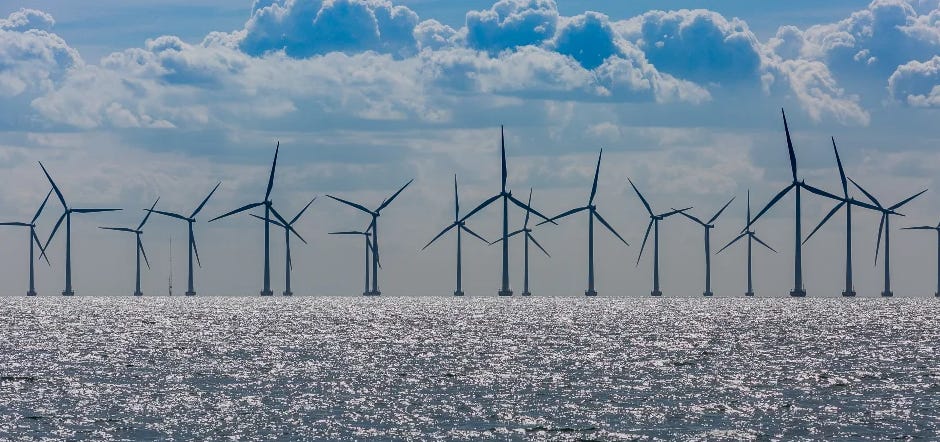
“We’re doubling down on clean power as the route to energy sovereignty and abundance,” explains Secretary of State for Energy Security and Net Zero Ed Miliband. It’s a curious timing. The opposition and Reform have now clearly established climate policy scepticism as a feature of UK politics. And that sea change is also reflected in the very different conversations heard in Davos recently, compared to the woke, green, globalist mantras of the past. Yet now “a new clean energy security pact with the EU” has been agreed at a North Sea Summit in Hamburg, which Miliband claims will “transform the North Sea into the world’s largest clean energy reservoir”. This attempt to boost the “green economy” with “100 GW of joint offshore wind projects” in international waters therefore looks more like a Grand Projet to salvage the EU and its flagship policy in the face of signs of the looming failure of both.
The pact is inaugurated by an article in Politico jointly penned by Miliband and Denmark’s Dan Jørgensen, the European Commissioner for Energy and Housing. The article treads some very familiar ground. It cites the geopolitical “uncertainty” seemingly created by Russia’s invasion of Ukraine, which “sent global gas prices soaring”. The claim is that renewable energy will create “energy security” by removing the economy from the “volatility” of “global markets”. This is Miliband’s now very boring routine – a ritual even. “Exposure to fossil fuels remains the Achilles’ heel of our energy systems,” claim the pair, citing European Commission President, Ursula von der Leyen’s belief that “as our energy dependency on fossil fuels goes down, our energy security goes up”.
We have heard it all before, and we have debunked much of it on these pages many times. But the consolidation of pure ideological rhetoric, made concrete in this new European collaboration is something else. For on von der Leyen’s terms, for example, a caveman enjoys “energy security”. You can be cold, hungry, poor, destitute, but “energy secure”. Claims that “energy security” means anything more than that in the mouths of these Eurocrats is not merely a defence of an untested claim, it is counterfactual. The story of industrial society and all of its virtues that Europe’s politicians claim to champion is the story of identifying and exploiting dense sources of energy to thereby obtain more from less. When an economy’s primary energy was wood for heat and oats for transport, society enjoyed “energy security”, but it suffered from feudal tyrants. Perhaps we can see von der Leyen’s ambitions here.
Marxists might call this phobia of hydrocarbon fuel sources some kind of commodity fetishism. On the Miliband-Jørgensen view, something simply evil lurks within the very substances themselves, which, when used as the engine of the economy, unleashed “the worst cost-of-living crisis our countries have faced in a generation”, by making us “incredibly vulnerable to international market volatility and pressure from external actors”. But if 10 countries can come together to turn the North Sea into a 100 gigawatt ocean of bird-chopping fiberglass blades, why can’t Europe come together to produce more oil and gas, to create its own market, and lower prices? Why can’t it build more gas storage to limit the shock of price volatility? Ideology has developed into a fully-fledged irrational obsession.

