

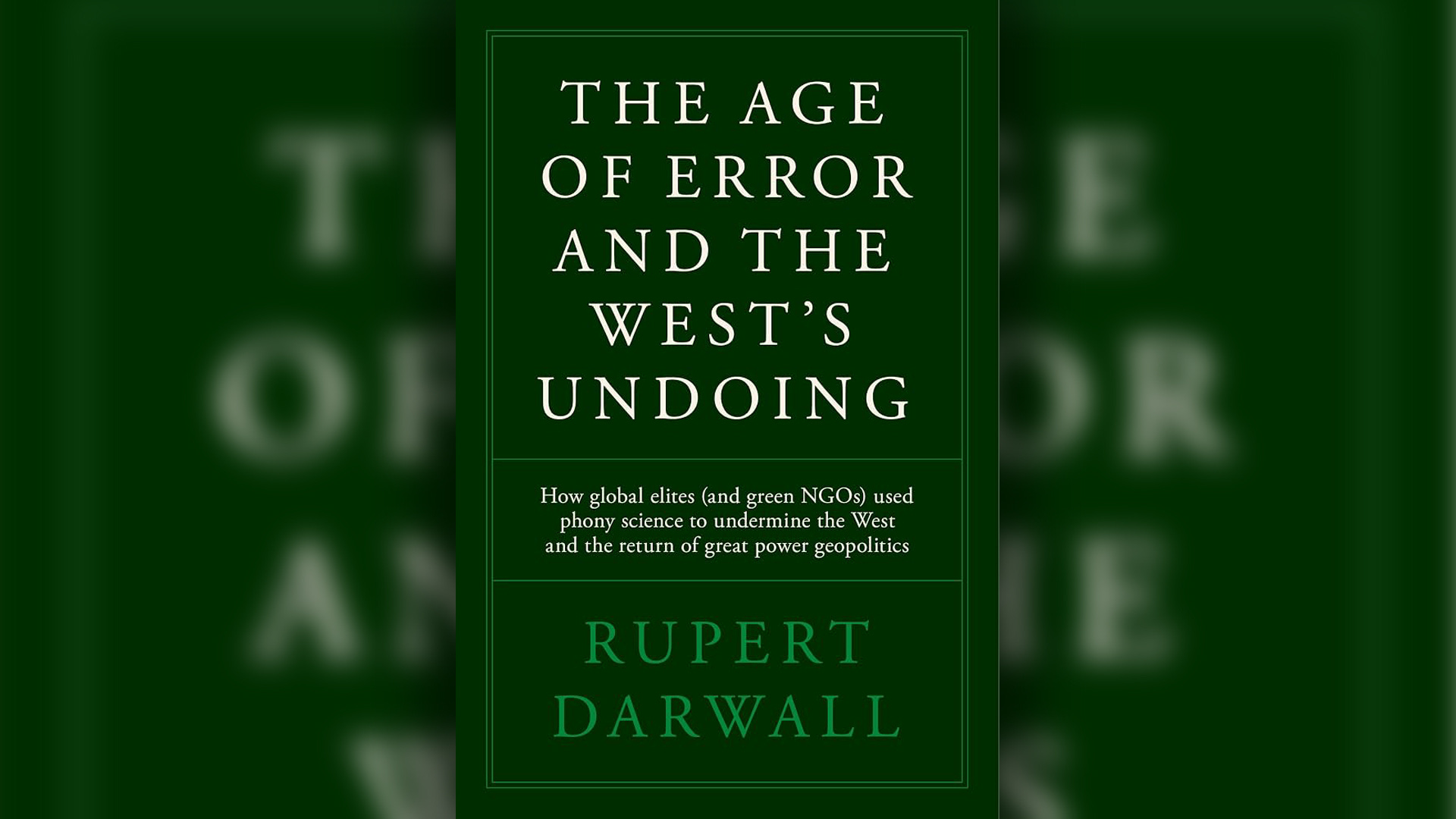
The Age of Error and The West’s Undoing by Rupert Darwall (Encounter Books, 2026)
Rupert Darwall, previously special adviser to the UK’s then-Chancellor of the Exchequer Norman Lamont and currently Senior Fellow at the National Center for Energy Analytics (NCEA), has spent the better part of two decades doing what few writers on climate policy dare to do: following the money, the meetings and the memoranda behind the West’s great green crusade. The Age of Error, newly published, is his most ambitious book (out of three) yet. It attempts nothing less than an explanation of why the West – with the significant exception of Trump’s America – chose to disarm itself economically, energetically and militarily at the very moment big-power geopolitics returned with a vengeance. The book is sweeping in its coverage of world events, learned in its focus on key issues, often brilliant in untangling the machinations that occur in the corridors of power. Yet, in one crucial respect, it is curiously conventional.
From Lehman to L’Aquila
Darwall’s age of error begins with the 2008 financial crisis. Elected politicians lost the authority to govern on their own account. Drawing on Bertrand de Jouvenel, Darwall argues that they recovered it by borrowing the prestige of experts: central bankers, climate scientists and public health officials. The result was what he calls “the co-dependency of politicians and experts with its command to ‘follow the science’”. Decisions migrated from parliaments to unelected committees (quangos in British parlance), and dissent became heresy.
The central bankers went first. Deficit financing and near-zero interest rates were supposed to restore growth; the Bank of England alone bought close to £900 billion of assets. Growth never properly resumed. What came instead were zombie firms, inflated asset prices, stalled productivity and, eventually, the inflation of 2021–22 that the monetary mandarins failed to see coming. Darwall reads this as a Keynesian conceit, the opposite of Schumpeter’s creative destruction of a vibrant capitalism. The real supply-side miracle of the period came not from Threadneedle Street or the Federal Reserve but from the shale fields of Texas and North Dakota, despite the Obama administration’s hostility to fracking.
Easy money had a further consequence. “Easy money begat ESG,” Darwall writes. Cheap capital disguised the true cost of capital-intensive wind and solar, while Wall Street embraced environmental, social and governance investing to buy itself a social licence after the crash. Mark Carney’s campaign to turn central banks into climate regulators, which I criticised at the time, and the fatal combination of central banking and ESG that followed, belong to the same story. Markets killed ESG in 2022, as Darwall wryly observes, although the regulators in the EU have not got the message, as I noted recently.
The intellectual spine of the book is the West’s abandonment of energy realism. Darwall contrasts the St Petersburg G8 of 2006 with the L’Aquila G8 summit of 2009. The 2006 G8 was the last occasion on which Western leaders spoke collectively as members of a fossil-fuelled civilisation focused on energy security. In 2009, the G8 inaugurated “an era of green Keynesianism”, promising emissions cuts of 80% or more by 2050 while claiming that green stimulus would deliver “sustainable growth”. “It was a jumble of policy incoherence,” Darwall writes. It was also a programme to replace efficient energy with inefficient energy, reversing the trajectory of progress since the industrial revolution.

