

This is the fifth in a series of 12 articles challenging climate change orthodoxy commissioned by Professor Gwythian Prins. We will be publishing the articles at a rate of one a week over the next 12 weeks (read the first article here, the second here, the third here and the fourth here). The hope is that they can be collected into a book for Sixth Formers and university students.
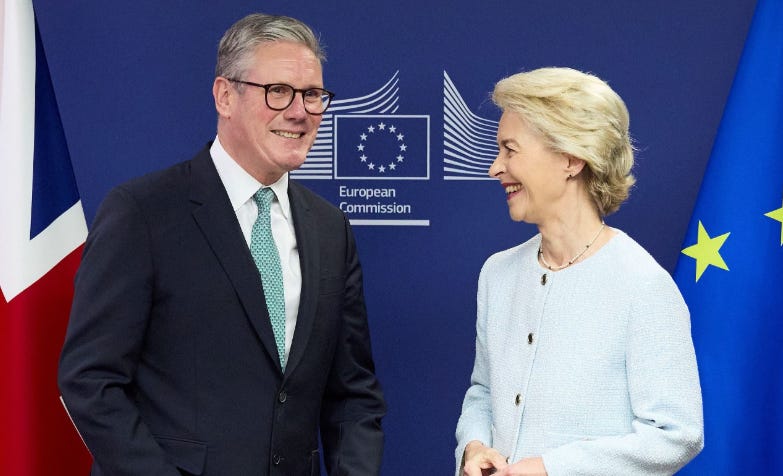
Is the UK Government seeking ‘dynamic alignment’ with the European Union to save its favourite policy agendas, like Net Zero? Despite the Common Understanding achieved in May 2025 to “respect each other’s decision-making autonomy” and despite the June 2016 referendum, some are now warning about the “quiet reversal of Brexit”. That Common Understanding requires “linking” the UK and EU’s carbon emissions trading systems, thereby aligning climate, energy and industrial policies, making them again the prerogative of the ‘rule-maker’ and Britain a ‘rule-taker’. Starmer and the other fanatical anti-Brexiteers have cargo-cult like expectations that the EU will fulfil their desires. That fervent faith may soon be dashed by irony. Starmer’s prostration before the EU and capitulation to all its vengeful punishments actually seals Net Zero’s doom, not its salvation. Let me explain. We are prisoners in double bondage.
Rather than some clandestine manoeuvring behind the public’s back, the more credible explanation for Brexit’s reversal is even more humiliating: that those now running the British state are venomously infantilised. Politicians and civil servants alike despise their own people and country and simultaneously defer to superordinate powers in the United Nations and European Union. The 2008 Climate Change Act is one of Blair’s Rings of Power: Five Acts to rule us all and in the darkness bind Britain; Acts that sacrifice the Common Law of England on the altar of ‘international law’ – a perversion of which the Attorney General for England and Wales, Richard (Baron) Hermer is High Priest.
The then Labour government believed that the planet’s first ‘legally-binding’ emissions-reduction policy would lead the world, but there’s a catch. Laws can require emissions reduction, but they cannot compel the wind to blow or the sun to shine. If the rest of the world was watching Britain’s ‘leadership’, then what they have seen since 2008 is deindustrialisation, GDP per capita stagnation and the democratic deficit widening into a traumatic repolarisation of politics.
Rather than demonstrating ‘leadership’, climate unilateralism – making laws that lawmakers have no idea how to implement – is an oath of fealty to institutions not accountable to electorates. Once the global climate apparatus was created, ‘international law’ and ‘Britain’s standing in the international community’ replaced mandates from the public. The Paris Agreement compels prohibitions and diminishes the role of the state in decision-making. This way legitimacy in Britain’s implied social contract dies.
EU Directives, often gold-plated in Westminster, required the closure of coal-fired power stations or the reduction of waste sent to landfill among a blizzard of ex cathedra regulations. These policies increased costs and reduced levels of service. Similarly, acting on the insidious precautionary principle, UN agencies set levels of various substances in the environment with zero democratic mandate and without much by way of discussion about scientific evidence. These limits in turn stoked and validated levels of hysteria among the Believers, evinced in neopuritanism such as veganism or local authorities’ war on cars. They also licensed ‘lawfare’. Through national and supranational courts any sufficiently funded NGO could force government to bend its policies; but it does so at its peril, even when, under Mark Carney’s hand, government made global financial institutions into human shields in the business of carbon governance. And there’s the rub.
In a 2012 interview on the BBC’s Hard Talk, Christopher Huhne, the then secretary of state for energy and climate change in the Conservative-Lib Dem coalition, said this: “All through human political history, you have had governments that have tried to set up particular objectives and have realised they can only go so far so fast without the rest of the world going along with them.” Citing the “bad old days of communism”, almost as Stalin himself had, Huhne concluded: “You can’t have environmentalism in one country.” His deliberate paraphrase unintentionally highlighted their common problem: what if the population doesn’t want these “particular objectives”? It’s a question that advocates of “particular objectives” rarely ask.
Environmentalism’s resonance with communism is dissonant because Stalin at least wanted factories and agriculture, whereas Greens celebrate their destruction. However, there is similarity in that radical policy agendas which, lacking popular legitimation, necessarily require top-down apparatus. Supranational institutions offer political power and cash to force or bribe alignment. But for how long can that hold? The European project’s environmentalism, though seemingly at the core of its agenda and authority, is contingent on public prioritisation of the ‘ecological crisis’. And there are clear signals across the Continent that the green king’s clothes are threadbare.
In France, carbon taxes sparked a year of violent clashes between those demanding Macron’s resignation and the police. Only the intervention of the COVID-19 episode boosted the state’s authority. French politics is left polarised by Macron’s ‘extreme centrism’. Whether or not Marine Le Pen successfully appeals her criminal conviction for embezzlement, polling suggests that a National Rally (RN) candidate will contest the Presidency on a rising wave. According to Le Monde, the RN is ready to exploit the tensions created by climate policy, and last May a vote in the National Assembly repealed the country’s “Zones à faibles émissions” – clean air zones equivalent to London’s Ulez. The decision was, according to the Times, backed by 80% of the public and by Left and Right parties alike. The Green Blob’s hitherto unshakable consensus is already shaken at its Mecca.
If France rejects extreme centrism, it will be following Rightward shifts in Italy and The Netherlands. The aggressive implementation of UN and EU nitrogen limits led directly to the Citizen Farmer Movement (BBB) and caused the repolarisation of Dutch politics. Similarly, Poland recently appointed independent conservative nationalist and defender of coal, Karol Nawrocki, as President. But it is in Germany, the industrial powerhouse, that the growing change of mood against the green agenda may be most significant.
The Energiewende, which made electricity a luxus strom, coincided with waves of immigration. Combined, both have created a sharp counter-wende in politik. A snap federal election last year saw Alternative für Deutschland’s vote share double to nearly 21%. The factors behind this change are varied, but the country’s deindustrialisation is widely cited. The thermodynamic truth of Germany’s wind turbines was revealed in the wake of Covid and Russia’s invasion of Ukraine. Germany’s status as an icon of green industrial growth was fraudulent, dependent as it was on cheap imported gas.
The fallout from this falling out is not only political. Federal Employment Agency figures show that in 2024 120,000 jobs were lost from Germany’s industrial sector. According to Welt, union representatives have called on Chancellor Friedrich Merz to suspend the Energiewende, calling promises of green growth “smoke and mirrors” and stating that: “Never before has our electricity supply been so expensive and uncertain.” Nor are the unions on this in antagonism with their bosses. Welt reports steel giant Arcelor Mittal refusing a 1.3 million Euros bung of subsidies offered by the government for hydrogen-based steel production because it would be uneconomic.
Europe’s political shifts mirror changes in American politics. The USA had been a signatory to the Paris Climate Agreement for barely a year when, in June 2017, Trump explained that that he would “put no other consideration before the wellbeing of American citizens”, and that “the United States will cease all implementation of the non-binding Paris Accord and the draconian financial and economic burdens the agreement imposes on our country”. In anticipation of Trump’s speech, the FT’s Pilita Clark revealed that “China and the EU have forged a green alliance to combat climate change and counteract any retreat from international action by Donald Trump”. This pivot to the east was a “a stark realignment of forces”, which saw the Rose Garden speech coincide with an EU-China summit. “The alliance struck by the EU and China is a concrete expression of international frustration with Mr Trump,” said the adamantly pro-EU and pro-climate Clark. But who benefits?
In interesting symmetry, between 2017 and 2023, China’s CO2 emissions increased by nearly a fifth to just under 12 billion tonnes, while the EU 27’s emissions fell by the same proportion. Meanwhile, the USA’s CO2 emissions fell spontaneously by 6% while drill baby drilling.
From the high point of the Paris Accord in the Obama years, many Left-leaning Establishment and elite preoccupations have been knifed. But the global Blob refused to accept rebuff and sought to use state power to reverse the reversals, ignoring one of the great laws of politics: the more that power has been used, the more it has waned. Blobbish intransigence has summoned up countervailing forces. Europe has discovered that its flagship green agenda, which it wanted to impose on the world, has instead made it impotent in the face of its energy-abundant, industrial powerhouse enemies to the east, on which it remains dependent.
Facing her own crisis of legitimacy, and ahead of a no-confidence vote, Ursula von der Leyen, at an EU Parliament plenary on EU-China relations, all but admitted that, rather than creating opportunities for European manufacturers, her ‘Green Deal’ had undermined them. Blaming China’s “subsidised overcapacity” for trade deficits, the EU President promised to “build a more meaningful partnership with China”. But China aggressively subsidises manufacturing for geostrategic reasons, allowing it to dump on and dominate other markets. The naïve EU and YooKay instead subsidise green self-harm.
European and YooKay governments in thrall to the catastrophist cultists chose to create and sustain comparative disadvantage, putting emissions-reduction targets before consideration of the consequences for domestic industries, employment and consumers. Surely they knew that subsidising domestic green energy production meant subsidising the purchase of goods manufactured in China, using coal? We know that they knew, because they were complaining about it in the 2000s, but did nothing about it, except to impose tariffs, thereby increasing the cost to consumers, while their destruction of Europe’s coal-fired power stations continued. Expressing this ideological myopia, oxymoronic von der Leyen opined that “Beijing is at once a staunch competitor in the clean tech race, and a vital partner for global decarbonisation”.
No. China is not a competitor. There is no race. There is only China. It is not decarbonising. And its advantages were created in very large part by climate policy which now creates tension within European countries, and between the EU and its members.
I don’t claim that the rise in populist, nationalist and largely conservative movements across the continent and the West that have been summoned up are either stable or committed to an ‘anti-climate’ agenda. But I do claim that such electoral signals in turn make intergovernmental organisations an increasingly unsustainable basis for climate politics. The EU President came to power on an extremely weak mandate, in the wake of the Grand Coalition’s collapse, and her presidency, not unlike Macron’s, has been marked by the continued Rightward and populist shift in European parliamentary arithmetic.
Similarly, Labour won the 2024 election with a massive Parliamentary majority, but with its joint third worst share of the electorate’s support since 1918, including its losses. Despite the most humiliating victory in British electoral history, the Government has pressed ahead with a doomed rhetoric: false promises of ‘lower bills’ and ‘green jobs’ in the face of deindustrialisation, job losses, economic stagnation and rising prices. Polls show that this deafness has at last summoned up in Reform an actual opposition to the climate agenda, to give voters a choice. The Government’s problems thereby mirror the crises in the EU, to which hapless, blinkered Starmer now turns, hoping to ease his dire domestic predicament.
Yet in their obsession to cancel Brexit by following ‘dynamic alignment’, Starmer and his party fail to see that the already collapsing European green policy agenda will take YooKay Net Zero with it, likely sooner than would be the case if the UK tried to maintain climate unilateralism. Starmer leads a zombie party in which Miliband is immensely popular. They will not allow him to dilute climate ‘ambition’. Labour’s living dead want to stumble back into the collapsing EU where they will be hoist with their own petard. What delicious irony indeed in these topsy-turvy times.

When is someone in the commentariat - either SM or MSM going to state the open secret that the globalist corporate communists - that the likes of Starmer (and the unelected hag vdL) work for - are deliberately impoverishing the Western world.
FOR DECADES, THEY HAVE BEEN METHODICALLY WORKING TOWARDS THE DESTRUCTION OF THE WEST………
Most Western leaders are puppets and have been instructed to destroy economies, religion, culture, societies and indeed to whole history of the Christian West.
When are you going to publish a thesis on this?