

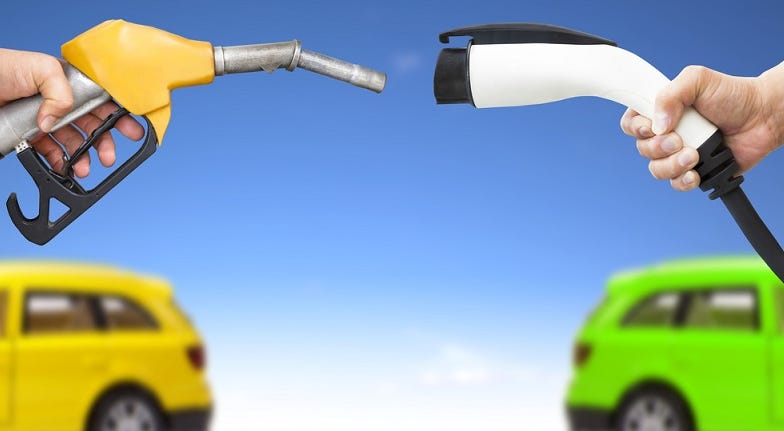
This is the 12th in a series of 13 articles challenging climate change orthodoxy commissioned by Professor Gwythian Prins. We will be publishing the articles at a rate of one a week (read the first article here, the second here, the third here, the fourth here, the fifth here, the sixth here, the seventh here, the eighth here, the ninth here, the 10th here and the 11th here). The hope is that they can be collected into a book for Sixth Formers and university students.
UK Net Zero policy aims at balancing the production and removal of greenhouse gases like carbon dioxide (CO2), methane and nitrous oxide by 2050. The primary greenhouse gas from transport is CO2 produced by burning fuels containing carbon such as petrol and diesel in conventional internal combustion vehicles. The entire Vehicle Excise Duty regime pivots on this single metric. Current Government transport policy is aimed at reducing CO2 emissions to help meet Net Zero targets. In addition, Government documents also mention as objectives reducing local pollution from transport, improving connectivity across Britain, growing the economy by enhancing the transport network and increasing the global impact of the UK to boost influence and maximise trade. However, these other objectives are not clearly prioritised, the costs and challenges of implementation are not specified and flagrant contradictions between these different aims are simply ignored.
The scale of the challenge of ‘decarbonising’ transport is very large. Transport accounts for 26% of total UK emissions, which is 0.27% of total global emissions. As a rough guide from Government statistics, the major contributing sectors to transport emissions are road transport (70%), aviation (20%) and marine (8%). In Great Britain, there are around 42 million registered road vehicles – 34 million cars, five million vans and 0.8 million heavy goods vehicles and buses. Of these vehicles, as of March 2025 only 1.5 million were pure battery electric vehicles. Cars and vans account for about half while heavy goods vehicles and buses account for 15% of total transport CO2.
In 2024, 28 billion litres of diesel and 18 billion litres of petrol were used on British roads. Alternative fuels like biofuels cannot fully replace such large volumes and have significant performance and environmental downsides. Being forced by regulations to ‘cut’ pure fuel with bio-ethanol adversely affects fuel power density and also allows algal growth in storage tanks. It perishes seals and can block pipes and filters unless powerful biocides are routinely added to stored fuel, as farmers are now obliged to do to protect their tractors. Growing crops for fuel is also an opportunity-cost against growing food. In short, imposing ‘bio-fuels’ is a functionally pointless and potentially dangerous vicious circle. If air pollution is actually the concern, running ICE (Internal Combustion Engines) on LPG is a much superior solution: super-clean with zero tail-pipe particulate. But empirically there seems to be a sly conspiracy by the regulatory bureaucrats to kill the LPG fuelling network because it competes with EVs – though these are inferior in efficiency and create more environmental harms.
The most common alternative technology for transport is electrification using batteries. Fuel cell vehicles running on hydrogen are very far away from practical implementation at scale. There are different degrees of electrification. Only pure battery electric vehicles do not have a petrol or diesel (internal combustion) engine, and all the motive energy comes from the electricity grid and is stored in the battery. A plug-in hybrid electric vehicle has a small battery which allows a limited range on stored electricity in the battery but also an internal combustion engine which will power the vehicle if the battery charge runs out. ‘Self-charging’ hybrid electric vehicles like the Toyota Prius get all their energy from their petrol engine, while partial electrification with a small battery enables the fuel energy to be used more efficiently. They also recover energy regeneratively that is normally lost on braking. This technology can reduce fuel consumption and hence CO2 emissions by up to 25%, particularly in stop-start city driving.
Realistically only cars and vans can be run fully on batteries. It is not practical to have battery powered long-range heavy goods vehicles or buses because of the large battery size needed. Aviation and shipping also cannot be run only on batteries. For instance, for a mid-range jet like the Airbus A320, a lithium-ion battery with the same energy content as the fuel it carries would weigh 19 times the maximum take-off weight of the plane. So, most of transport will still be powered by internal combustion engines running on petroleum-based liquid fuels for decades to come. If in the future all cars and vans are forced to run on batteries, the battery capacity needed will have to increase by around 30 times compared to now. However, this would account for only about half of the U.K. emissions from transport or 0.14% of total global emissions. Massive disruption for risible gain.
The most visible central Government policy is the intention to ban the sale of new internal combustion engines from 2035. In addition, there are many anti-car local policies such as low emissions zones and low traffic neighbourhoods.
However, battery electric vehicles do not offer any significant benefit in terms of CO2 unless their use and manufacture are with energy that is CO2-free. If natural gas or coal is used to produce electricity, CO2 emissions from electricity production will be high. Even if wind, solar and nuclear provide a large share of the electricity, the extra electricity demand from electric vehicles has to be met with marginal (backup) electricity generation which is always available and can quickly respond to changing demand. In the UK it will be from natural gas and produce more CO2 emissions than the average for the renewable electricity grid.
Battery manufacture needs much more process energy and produces more emissions compared to the manufacture of internal combustion engines. A recent estimate for battery manufacture from China, where over 70% of the batteries are made, is an additional 125 kg CO2 per kWh of battery capacity. So, a Nissan Leaf, with a 40 kWh battery will start with a deficit of five tonnes of CO2 and would need to drive many thousands of miles on CO2-free electricity before it can have any benefit over an equivalent conventional vehicle in terms of CO2. In the UK, a small pure electric vehicle might be better than an equivalent conventional car for CO2 by about 30% over its lifetime but its emissions will not be zero. Bigger vehicles with bigger batteries will show much less lifetime benefit, if any. Furthermore, given that battery EV service life is much shorter than that of a well-made ICE vehicle (eight years as against 20 or more) the life-time EROEI (Energy Return on Energy Invested) favours the well-maintained long-lived ICE vehicle, especially running on LPG.
On top of this, the impacts on human health, on water and high eco-toxicity associated with mining of metals needed for batteries are very significant. The net health impacts for EVs are estimated to be three to five times worse than for conventional ICE vehicles. These health and environmental impacts of battery electric vehicles are currently exported to where the mining takes place and materials are processed (e.g. the Democratic Republic of Congo, Chile, China) where environmental controls are lax and child and slave labour are also of concern. The bigger the battery, the worse the impact. Mining also requires moving large quantities of earth and rock – on average 500 times the weight of the battery. Thus a 40 kWh battery, which weighs around 300 kg could require roughly 150 tons of rock and earth moved. The footprint of oil production to power ICE vehicles is very much lower.
Local air quality is impacted by emissions of particulates, nitrogen oxides, unburned hydrocarbons and carbon monoxide from petrol and diesel exhausts. These emission levels are zero for pure battery EV and near zero and for the most modern conventional vehicles with particulate filters, especially running on LPG, the most eco-friendly fuel which the eco-lobby seems to seek to drive out of the market. Other sources such as tyre-wear then become much more important for particulate levels; and these will be greater for pure battery electric vehicles because they weigh 25-30% more than comparable conventional vehicles because of the weight of the battery.
These environmental issues, which are currently ignored, will inevitably come to the fore as the number of battery electric cars increases. The true impact of competing technologies should be assessed on a life-cycle basis, honestly accounting for manufacturing, in-use and end of life emissions. The environmental benefits of battery electric vehicles will depend on the battery size, on how it is made and how the electricity to fill it is generated and will not be zero.
The infrastructure and material requirements for battery EVs are very large. Convenient public charging points need to be built for around 10 million cars which must park on the street. Suppose, by 2030, of all the electric vehicles, there will be a million cars which want to charge at the time of peak electricity demand – in the evening after people return from work. If allowed at the 7kW Level 1 charging rate, this will require an additional seven gigawatts (GW) of electric power which needs to be CO2-free. This is equivalent to over two new nuclear power plants of 3 GW – impossible to build over such a short period. Battery charging is inconvenient – it can take many hours depending on the rate of charging, compared to a few minutes required to fuel a conventional car.
It will become steadily more difficult to source critical materials like lithium salts, copper and cobalt needed for battery manufacture if the demand is going to increase to the level required to run all cars and vans only on batteries. China has set out to corner many of these markets. This materials crunch will be worse if there is also increasing demand for grid-scale storage batteries to cover the intermittency of wind and solar. The scope for recycling old batteries to recover critical materials is very limited given the resins, complexity and weight of the batteries.
Then there is increasing evidence of spontaneous anaerobic fires in batteries which are extremely difficult to extinguish. As the number of electric vehicles grows and charging rates increase, this problem will also become more prominent. All the issues discussed above will be more difficult to ignore as the demand for batteries increases.
The current cost of an electric vehicle is significantly higher and there is increasing evidence that the depreciation rate is also higher compared to an equivalent conventional car. As battery materials increase in price in response to increasing demand, battery prices are unlikely to come down as fast as they have done in the past. As the number of electric vehicles increases, government subsidies and tax and other benefits to promote them will become unaffordable. Fuel taxes contribute around £40 billion to the exchequer. At least a part of this will have to be recovered by taxing electric cars. Some calculations show that the total cost of ownership is lower for electric cars. Such calculations assume that the cost of electricity, in relation to fuel costs for conventional vehicles remains low. In any case, individual buyers are likely to base their buying decision on up-front costs and the utility and convenience such as the availability of charging infrastructure and time needed to charge. All evidence is that in an open market battery EVs are turkeys – so fanatics like Ed Miliband respond by rigging the markets, as I have explained.
Western, particularly European strengths are in advanced high-tech ICE cars. Great Britain has a strong research and development reputation in the automotive sector. China recognised this and focused on ‘new energy vehicles’ and has now mostly cornered the supply chain needed for electric vehicles and builds them on a coal-fired grid. Western auto manufacturers will also not be able to compete with China on costs of electric vehicles. If transport in Britain were to focus only on battery EVs as current policies seek to coerce, the automotive industry will be killed under any kind of free trade. Furthermore, if consumers do not buy new electric cars because of up-front cost, faster depreciation, charging anxiety and inconvenience but still the sale of new internal combustion engines is banned, the British auto industry will be destroyed even without Chinese intervention. As professor Kelly also asks, on what planet does that make sense?
‘Green’ policies require enormous investments in infrastructure and even if all British cars and vans are replaced by pure battery EV – a 30-fold increase compared to now – and ignoring lifetime emissions, this would reduce global emissions by less than 0.14%. There are various points of conflict with other Government objectives. Private transport will become unaffordable except for the rich – and for the nomenklatura. Other anti-car policies will reduce connectivity and impact economic growth. Leadership in the automotive sector will be ceded to China. British trade and influence will wane.
All technologies relevant to transport including manufacture and different fuels need to be honestly assessed over their full life EROEI (energy returned on energy invested) cycle, sensibly deployed and continuously improved. However, in a rigged market, research and development into further improving internal combustion engines will stop even though most transport will still be relying on that technology for decades to come. The British auto industry will be sacrificed on the altar of the green cult but will yield negligible reduction in global emissions; and in conflict with our authoritarian enemies, in the land of Net Zero, the man in the diesel tank is king. No wonder Mercedes and VW are defying the EV target mandate and Land Rover is following suit. Don’t Ministers know that setting production targets in the former USSR didn’t end well? Maybe they don’t. Worse. Maybe they do.
Professor Gautam Kalghatgi is a fellow of the Royal Academy of Engineering, the Institute of Mechanical Engineers and the Society of Automotive Engineers. He has been a visiting professor at Oxford University and Imperial College London and is Chairman of the Academic Advisory Board of the Global Warming Policy Foundation.
"If air pollution is actually the concern, running ICE (Internal Combustion Engines) on LPG is a much superior solution: super-clean with zero tail-pipe particulate."
Correct. This is exactly why you know this all actually has nothing to do the climate.
The agenda is to force people onto electric vehicles, not for the environment but as part of the digital control framework Politicians and Corporations want to force us into.
Look at the VW Group. They're making massive redundancies cuts to their product lines, and are offering China to build their Chinese EVs. This isn't giving the consumer that they want, this is corporations trying to ram their Globalist agenda down our throats.
Digital IDs, CBDC's, AI Surveillance, none of these are conspiracy theories anymore. They're literally what the corrupt Globalist regime are trying to force people to accept. Nobody asked for any of this. Nobody voted for this. It's time everyone pushed back and said no.
I think the answer is follow the money. ..Anytime something is pushed at us for our own good follows this rule. If EVs are that fantastic we would buy .. 😈