

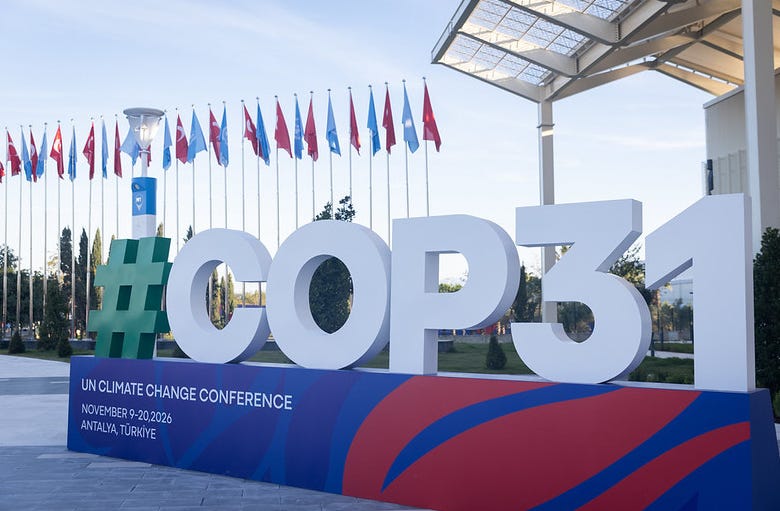
No climate meeting is complete without a call for censorship. I am not that bothered about climate science. The fraud, the scam, the lies, the hoax, the bullshit – call it whatever you want – is in climate politics. Climate politics is how we can know, for certain, that climate change is bullshit, even if it’s real. Each year for 31 years, member countries of the UN Framework Convention on Climate Change (UNFCCC) has held a Conference of Parties (COP) meeting to find ways to address the problem of a warming planet. In earlier COP meetings, this meant trying to bind every country in the world to progressive emissions-reduction targets. But as these meetings have continued, the scope of what – and who – the UNFCCC intends to bind has expanded. And now it is much more criticism than CO2 that is the target of climate politics. And that’s how we can know that it’s not about saving the planet.
At COP31 this week, the United Nations Educational, Scientific and Cultural Organisation’s (UNESCO) “Global Initiative for Information Integrity on Climate Change” launched its Charter for Climate Information Integrity in Advertising. The 32-page charter was authored by Climate Action Against Disinformation (CAAD) and the Conscious Advertising Network (CAN), and states that its purpose is “Supporting the commitments of the Belém Declaration on Information Integrity on Climate Change”. I wrote about the creation of the Global Initiative’s “Declaration on Information Integrity” last year. And now we see how, gradually, “initiatives” that are placed at the top of the annual agenda one year develop slowly over the following years.
It is only coincidence that, over the course of the three decades of COP meetings, technology has changed such that terrestrial and satellite broadcasting are all but obsolete. The first COP was held in Berlin, Germany, in 1995 – which is more or less the year in which domestic, dial-up internet became a thing. Though ADSL connections were available, broadband internet took a while longer – into the 2000s. And then, of course, there came smartphones and social media. These developments changed the nature of what had previously been confined to expensive print and broadcast media, at least creating the possibility of democratic alternatives to the mainstream.
But though technology made it possible, independent production can still be expensive. Social media outlets were quick to realise this limitation, and so the likes of YouTube began offering a share of advertising revenue with content creators in 2007. Twitter, under the ownership of Elon Musk, followed in 2023. Meanwhile, as mainstream news organisations such as the BBC turned their back on journalism and public debate in issues such as climate, to use instead their reach and power to enforce Establishment preoccupations, independent media rushed to fill the gap, which widened substantially during and following the excesses of lockdowns. (And here we are!) Now, independent media can draw audiences that broadcasters struggle to achieve with vastly larger budgets.

