

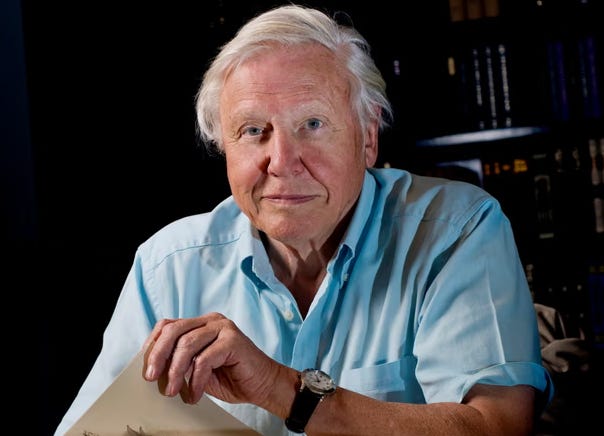
David Attenborough was celebrated last week as the nation’s beloved natural history broadcaster celebrated his 100th birthday. His was the voice and sometimes face of the BBC’s indubitably world-class nature productions – epics, most of which are technical masterpieces, worthy of celebration. And Attenborough’s peerless narrative explained the workings of the world’s flora and fauna to generations of children. But then it all went wrong.
There is no doubting Attenborough’s talents. As a grammar school boy deeply committed to his subject, he won a scholarship to study natural sciences at Cambridge shortly after the end of WWII. And as a handsome man with archetypal Received Pronunciation and a cool, calm and gentle demeanour, he was a perfect fit for the postwar BBC in its glory days. Over the next decades, Attenborough shone, not just in front of the camera, but also far behind it. In 1965, he became the controller of BBC 2, which had been created the year before. From there, Attenborough commissioned Sir Kenneth Clark’s 1969 series Civilisation and Jacob Bronowski’s The Ascent of Man, which was broadcast in 1973. Thus Attenborough can rightfully be credited for epics not just about the natural world but also the human world.
This much has been stated by those who have nothing but praise for the man. And if you want more of it, I recommend Allison Pearson’s biography of the “national treasure” in the Telegraph. And this is where I part company with those who, like Pearson, let the man off the hook for his political activism. “It is his profound belief in conservation,” states Pearson, “his fear that mankind is recklessly despoiling and plundering the riches of our planet, destroying the delicate balance of nature, that causes him to speak out.”
It would be unfair to single out the man without putting him in context. He is a BBC man. And, just as the BBC is the instrument of the British Establishment, he is an Establishment man. As awesome as the man might have been, it is Establishment institutions that make such men: grammar school, Oxbridge, the BBC. And over the years, institutions of the British Establishment were colonised by environmental ideology. At issue in this institutional decline is not the right of any “speaking out” but a catastrophic failure to hear criticism. It’s not enough to have a genuine conviction that we are “destroying the delicate balance of nature”; merely broadcasting one’s thoughts can lead to a separation from the intended audience, and worse from there.

