

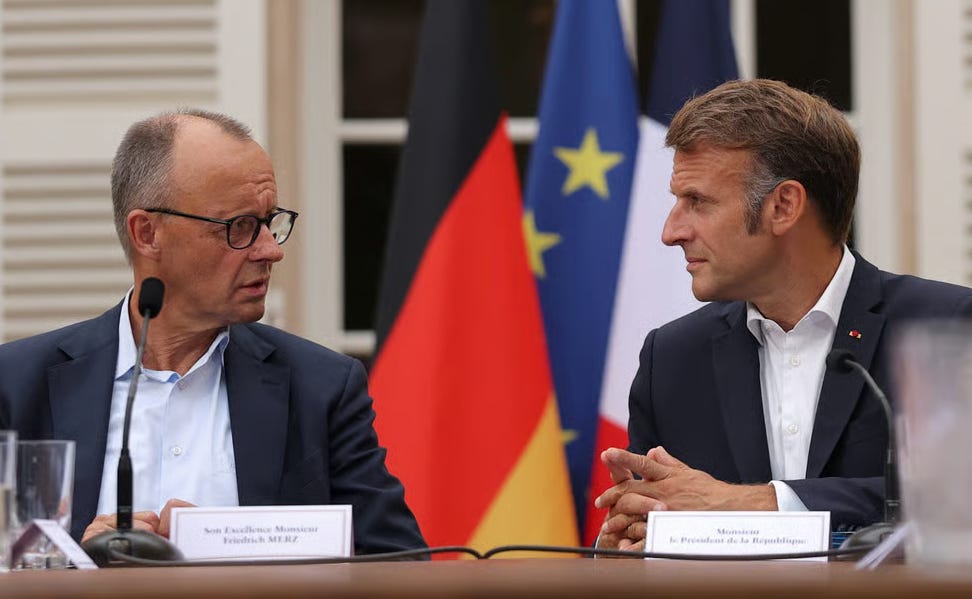
On Friday, a press release from the German Government announced a deal that had been struck with France to push for reform of the EU’s looming 2035 combustion car ban. “We are driven by a clear ambition,” tweeted President Macron, “to successfully transform our automotive industry while upholding our climate goals and our production in Europe.” Yet the relaxation sought by the Governments of the countries that are home to the continent’s two largest manufacturers is yet another vivid demonstration of the fact that the “clear ambition” driving the agreement, far from being “clear”, is a messy contradiction – and it’s not the only contradiction of European politics that is brewing into traumatic fault lines across the continent.
A revision of the EU’s ban on new petrol and diesel-powered vehicles has been on the cards since 2025, when, following pressure from manufacturers and EU member states’ governments, the European Commission scheduled a revision. According to Reuters at the time, the auto sector was “divided” by the plans to dilute the ban. But that was an act of green journalistic spin – manifestly, it was the ban that had divided. Moreover, despite seeking many opinions from the wider sector, the only manufacturer Reuters found to speak against the revision, alongside green lobbyists, was Volvo. “Volvo Cars has built a complete EV portfolio in less than 10 years and is ready to go full electric with a bridge of long-range hybrids,” said the Chinese-owned Sweden-based manufacturer, whose share price has fallen from a high of 90 SEK in 2022 to just 14 SEK today – an 84% fall. “If we can do it, others can as well.” Maybe it’s not that simple.
A similar crisis is playing out in Britain. The snivelling wretches that rule the country had implemented a phased ban on the sale of internal combustion vehicles in the form of progressive sales mandates, initially aiming for a complete ban on new sales by 2030. But in 2023, as the green agenda’s structural failures were becoming obvious, Rishi Sunak deferred the final leg to 2035. The new Labour government in 2024, whose climate brief was held by Ed Miliband, re-reversed the ban, putting it back to 2030 for fully-ICE cars, and for hybrids to be banned by 2035. But earlier this year, likely in response to the EU’s policy crisis, the Guardian reported that ‘Keir Starmer [is] ready to overrule Ed Miliband’ and “water down 2030 EV sales targets after industry and union pressure”. A consultation to “shape [the] pathway to reach zero emission driving by 2035” was opened in August and closes this week. “The UK is reviewing targets to ensure they remain pro-business and grounded in the real world,” claimed the press release. If only.
But since that consultation opened, the crisis has deepened. The FT reports that there is now a distinct fissure between departments. “The business department is keen to cut the mandate as much as possible,” says the paper, whereas “the Department for Energy Security and Net Zero (DESNZ) is pushing back as it tries to keep Britain on track with its climate targets.” Citing an anonymous source, “The DBIS position is basically ‘kill the mandate’,” claims the article.

