

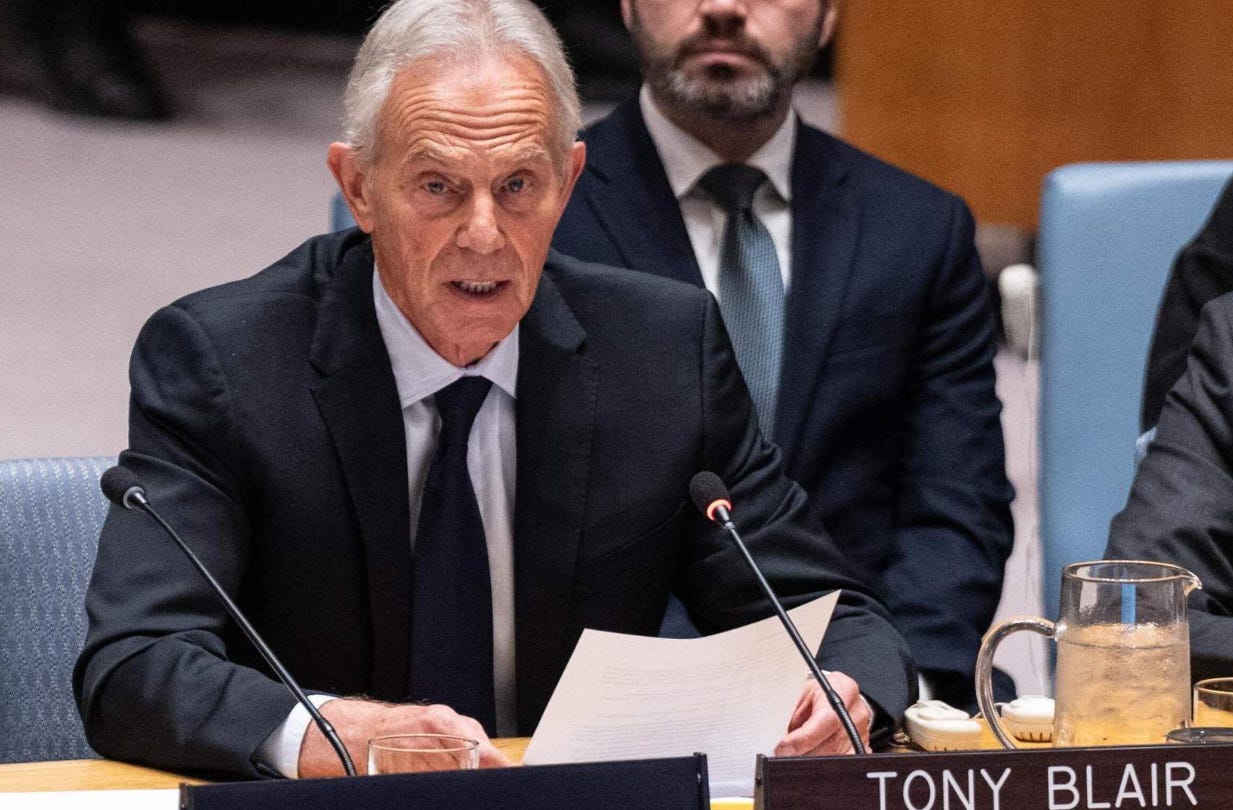
Any justification for Ed Miliband’s Net Zero climate policy, whether real or imaginary, has vanished with the official abandonment by the IPCC of the scariest concentration scenario RCP8.5. Even Tony Blair can now perceive that the pursuit of Net Zero is unwarranted and harmful to Britain.
It’s now 20 years since the publication of the ‘Stern Review on the Economics of Climate Change‘ in 2006: a review commissioned by Gordon Brown, then Chancellor of the Exchequer, in a Labour government led by Prime Minister Tony Blair. This review began the UK-drive towards the crazy carbon-phobic policies which are helping to impoverish the nation, aided by unrealistic scenarios. There is some irony that Blair is now calling for the abandonment of Net Zero: when the Review was published he warned about the disaster that would come from inaction. It was his government that helped to pave the way for the excessive climate policies we have today, and scaring people was a tool of risk management, as Lord Giddens noted in the Lords March 1st 2005.
The Stern Review claimed that the risk from global warming was such that there was imminent danger to international standards of living. But in reality, the review made totally unrealistic claims in its assessment of warming and economic impacts. It brazenly asserted that there was more than a 50% risk of global temperatures rising by 5°C by the end of the century. Given that scenario, the cost of inaction would be 5% of global GDP per annum. The review called for nations to spend between 1% and 2% of GDP as a matter of urgency to reduce carbon dioxide emission by 80%. It was effectively a call for economic self-flagellation. The scary scenario outlined by Stern’s review was based on the ‘Special Report on Emissions Scenarios’ (SRES) strong A2 pathway, which morphed into the RCP8.5 which is familiar to us. The Representative Concentration Pathways (RCPs) were first proposed in 2007 and adopted by the IPCC’s ‘Fifth Assessment Report’ (AR5) of 2014. While RCP8.5 was an extreme and unlikely scenario, like its forerunner SRES A2 it was widely treated as the ‘business as usual’ case by climate alarmists.
Lord Nigel Lawson, former Chancellor of the Exchequer in the Thatcher government, responded critically to the Stern Review in a lecture in 2006 for the Centre for Policy Studies. This was expanded into the book An Appeal to Reason, published in 2008. Lawson pointed out the uncertainty in the IPCC modelling: the SRES A1 pathway, for example, had a spread of between 1°C and 6°C temperature rise by 2100 (2.0°C to 5.4°C for A2). Given this spread, the high temperature rise outcome must be considered a low likelihood, certainly much less than 50%.

