


This is the 13th in a series of 13 articles challenging climate change orthodoxy commissioned by Professor Gwythian Prins. We will be publishing the articles at a rate of one a week (read the first article here, the second here, the third here, the fourth here, the fifth here, the sixth here, the seventh here, the eighth here, the ninth here, the 10th here the 11th here and the 12th here). The hope is that they can be collected into a book for Sixth Formers and university students.
Intermittent ‘renewable’ (solar and wind) electricity generation is a useful but niche technology, either for off-grid users or as a small portion of on-grid generation. However, British politicians have decreed its central role in an energy transition away from the sources of energy that fuelled our transformation from a remote outpost of Europe to a rich post-industrial economy. Since most renewable generation is highly capital-intensive as well as intermittent, this can only be achieved by taking vast sums of money from electricity consumers to build generation plants and a parallel electricity grid. Maintaining two grids – one reliable, the other not so reliable – is not only vastly expensive but it introduces the risk of major failures, as the near total-blackouts in Spain and Portugal in April 2025 and in Texas in February 2021 have illustrated.
The commitment to an energy transition has been supported, until recently, by most politicians from all the main political parties. However, as explained in other articles, notably by Frank and Prins, the political and bureaucratic elite has never attempted to assess whether the policies adopted were, in any sense, value for money. In this article we will examine the tangled web of subsidies for renewable generation and ask what we are getting from the huge sums involved.
Large scale subsidies for renewable generation were first introduced under the Renewables Obligation, which commenced in 2002. This required energy suppliers to source a minimum proportion of the electricity they supplied from accredited renewable generators whose output was awarded Renewable Obligation Certificates (ROCs). The original idea was that the value of ROCs would be market-driven with a cap (the ROC buyout price) to prevent excessive costs to consumers. After lobbying by renewable generators, the rules were changed to ensure that the buyout price is effectively a floor price with the consequence that the value of a ROC has more than doubled since 2002.
A major factor prompting the introduction and extension of the Renewables Obligation was a pair of EU Directives adopted in 2001 and 2009 under which indicative targets were set for electricity generation from renewable sources. Preceding concerns about climate change, the primary consideration behind the policy was the over-wrought belief that supplies of fossil fuels would rapidly decline and their prices escalate – the ‘peak oil’ hypothesis. To the extent that this was ever true for petroleum, it is patently wrong for other fossil fuels, especially coal and natural gas.
In the early 2000s, renewable generation was not expected to make a large contribution to meeting the UK’s target to reduce CO2 emissions under the 1997 Kyoto Protocol. That would be achieved by the so-called ‘dash for gas’: the large and rapid shift from coal to gas generation which followed the privatisation of the electricity sector in 1990. Even today, the case for renewable generation is made less on grounds of reducing CO2 emissions and more on grounds of energy security together with reducing exposure to European gas prices. Hence the oddly juxtaposed functions of the Department for Energy Security and Net Zero (DESNZ). This is odd because the title is an oxymoron: the more of the latter, the less of the former, also discussed in other articles too.
The Renewables Obligation became more complicated and expensive over time as the government tried to provide differential support for a variety of emerging technologies as well as to correct what was seen as the overly generous treatment of solar and onshore wind farms. As the scale of renewable generation increased after 2010, the scheme became increasingly painful for the coalition government from 2010 to 2015 and later the Conservative government. This was not only a consequence of its costs but a result of sharply conflicting political responses.
In much of rural England, there was – and still is – strong opposition to the development of solar and onshore wind farms. In Scotland, the devolved administration saw the scheme as a way of extracting money from electricity customers in the South of England. Even then, it resisted strongly all proposals under which Scottish generators would pay a higher proportion of the costs of developing the transmission network to handle the power from Scottish wind farms. In Northern Ireland, the scheme was seen by many politicians as a disguised form of farm support.
To simplify – and reduce – financial support for renewable generation as well as to shift the focus towards offshore wind, in 2015 the Conservative government announced that new accreditations under the Renewables Obligation would cease between 2016 and 2017, though a few projects were not completed until 2018. However, accredited generators will continue to receive support for 20 years with the last ROCs being earned in 2038, so the run-off costs for the scheme will continue to be high for at least a decade.
In place of the Renewables Obligation, new support arrangements took the form of guaranteed prices, under a contractual arrangement known as Contracts for Differences (CfDs). Apart from an initial round of projects awarded contracts at pre-determined prices, CfD contracts are awarded via a series of auction rounds, held initially at two-year intervals but now annually. Over time the contractual details and auctions have become increasingly complex as the government has sought to cap the total subsidies offered while increasing the amount of generating capacity contracted.
The financial model that has underpinned subsidies for large offshore wind farms has come under increasing stress during the 2020s. In 2023, the government received no CfD bids for offshore wind projects, though it had wanted to procure up to 8 GW of capacity. Bidders believed that the maximum guaranteed price was too low. The outcome was similar for an offshore auction in Germany in 2025.
Finally, in August 2025 Ørsted, the largest offshore operator in the UK, announced what is effectively a huge bailout by the Danish Government – its majority shareholder. The stated reason was the need to fund a large offshore wind farm in the US, but the offtake price for that wind farm is significantly higher than guaranteed prices for recent UK projects. If Ørsted is unable to finance a 900 MW wind farm in the US, there is little prospect of it raising the money that would be required to fulfil current plans for European offshore wind development, unless subsidies are greatly increased.
Some European countries, notably Germany, have learned that increasing the share of intermittent renewable generation – primarily solar and wind power - in total generation has a detrimental effect on the functioning of electricity markets. In 2025 the wholesale market price in Germany was negative for 570 hours in the year. During these periods, wind and solar generators are paying electricity consumers to use power rather than switching off generation. They can do this because they receive subsidies which outweigh the losses that they make on market transactions.
For some economists negative pricing is a sign that prices are working, encouraging consumers to switch consumption to periods when solar and wind generation is abundant. That logic might be sound if final consumption of electricity responded in any significant way to hourly price variations. However, evidence suggests that such responses are negligible. Negative prices are the perverse consequences of subsidies that encourage intermittent generators to supply electricity to the grid even when and where it has no market or social value.
The GB market is following the German pattern. In 2021 standard market index price was negative for 36 hours in the year, whereas in both 2024 and 2025 the market index price was negative for more than 240 hours per year. The breakdown in the operation of the wholesale market is accelerating and the proportion of hours in the year with surplus generation. The frequency of negative market prices is likely to exceed 10% in 2030.
In parallel with this change, the GB market has become heavily dependent on imports of power from France and other continental countries. Annual net imports to the GB market have risen steeply: from 1% to 16% of final demand. In 2024 the GB market was a net importer of power in 91% of hours. From being occasional, imports via interconnectors have become fundamental to meet GB electricity demand. The dependence on imports is likely to increase rather than decline up to 2030. Hence, in addition to the volatility of prices caused by domestic renewable generation, the GB market will be heavily exposed to price volatility in France and Germany caused by the variability in solar and wind generation in countries from Spain to Sweden.
DESNZ argues that large investment in intermittent renewable generation up to 2030 will reduce the GB market’s exposure to gas prices. This claim is at odds with our analysis, which implies that some gas generation will be required for about 50% of hours in 2030 and more than 8 GW of gas generation for 27% of hours. Even for periods when the required level of gas generation is very low or zero, all the policy will have achieved is to substitute dependence on French and German market prices for gas prices. In all this there is an obvious – and rising – risk to security of supply: the opposite of the claimed objective.
Over two decades from 2005 to 2025, the UK has provided subsidies of £274 billion (at 2025 prices) to support electricity generation from ‘renewable’ sources. These subsidies can be split between direct and indirect subsidies.
Direct subsidies are payments to generators including the buyout value of ROCs, payments under CfD contracts, constraint payments (to not generate at times of glut) and guaranteed prices paid to micro and small generators.
Indirect subsidies include (a) levies and other costs like the Climate Change Levy and emission permits imposed on non-renewable generators that raise the revenues earned by renewable generators, and (b) the increase in system costs: balancing the grid’s stability, capacity payments to ensure the availability of reliable sources of backup generation and transmission charges caused by the increasing volume of renewable generation.
2004 is used as the baseline for our calculations of the impact of renewable subsidies to exclude pre-existing renewable generators, in particular hydro plants built before 2000. (Details of how the subsidies for renewable generation were calculated and the data sources used are available on Renewable Energy Foundation’s website or on Prof Hughes’s Cloud Wisdom Substack. With minor exceptions the estimates are based on official and regulatory statistics published by ONS, OBR, Ofgem, DESNZ, Elexon and similar sources.) The annual level of subsidies at 2025 prices – calculated relative to 2004 costs – increased from £0.2 billion in 2005 to £24.8 billion in 2023 with a small reduction to £22.6 billion in 2025. That sum will continue to grow rapidly to fund the current Government’s Clean Power 2030 plan. In 2024 the cost of subsidies for renewable generation amounted to more than 60% of the UK’s spending on defence (£37.5 billion in 2024-25). On current plans, the cost of renewable subsidies will substantially exceed the UK’s defence spending in 2030. Do the public realise this? Do they believe that the benefits of promoting renewable energy exceed the value of spending on defence and the UK’s security?
The largest component of these subsidies in 2025 was the Renewables Obligation followed by the cost of emission permits. Other costs including capacity payments and balancing and transmission costs caused by the growth in intermittent renewable generation were small in the past but have grown rapidly in the last five years and will become even more important in future.
The total output of all kinds of renewable generation has grown from 16 TWh in 2005 to 152 TWh in 2025. The share of renewable generation in total final demand for electricity has increased from 5% to 55%. Intermittent renewables accounted for 70% of total renewable generation in 2025 with onshore and offshore wind accounting for 57% of total renewable generation.
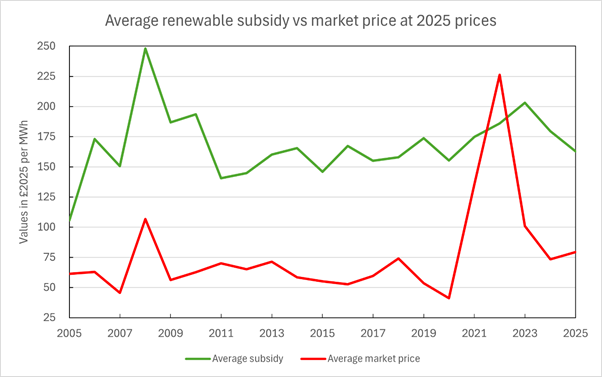
The figure shows how the average subsidy per MWh of renewable generation at 2025 prices has changed over the last two decades alongside the wholesale market price for electricity. The subsidy level has a sharp spike in 2008 and a gradual upward trend from 2011 onwards with a smaller spike in 2023. The median subsidy was £165 per MWh at 2025 prices. In contrast, the market price has stayed within a range from £50 to £80 per MWh with brief spikes in 2008 and 2021-23. The median ratio of the subsidy to the market prices was 2.35.
Taken at face value these estimates mean that over the last two decades electricity users have typically paid, either directly or indirectly, over £3.35 including levies and charges to cover subsidies for every £1 spent on the wholesale cost of electricity. However, the true situation is substantially worse than this figure suggests. One of the major indirect subsidies for renewable generation – the Emission Trading System (ETS), introduced first in 2008 as an EU policy but continued since the UK left the UK – pushes up the wholesale market price of electricity by a significant amount in almost every period.
Without the ETS the average market price would have been about 10% lower from 2008 to 2014, and then 21% lower on average over the period from 2015 to 2018. Since 2019 the average reduction if the ETS was eliminated would have been 30%. For example, in 2025 the average market price was £79 per MWh. We estimate that this would have been £55 per MWh if the ETS had not existed.
Thus, in 2025, for every £1 that electricity users would have paid at market prices without the ETS, they paid £3.90 when the impact of all subsidies for renewable generation is considered. The distortion to the efficient operation of the electricity market in the UK is very large. Yet, how many policymakers admit this reality? Even if promoting renewable generation is a worthy goal, can we really justify this level of distortion in the prices that we pay for a crucial element of modern life and economic activity?
The amount of renewable generation has increased more than four times since 2011, but the average subsidy per MWh at 2025 prices has increased from £143 per MWh in 2011-12 to £171 in 2024-25. This is clearly inconsistent with the frequent claim that renewable generation is getting cheaper and will protect customers from volatile market prices. Not only are direct subsidies high, but indirect subsidies, reflecting the wider system costs of the shift to renewable generation, have been increasing rapidly and will continue to do so up to 2030.
We have calculated the contribution of renewable generation to reducing the UK’s aggregate level of CO2 emissions by assuming that gas plants would have been used to meet electricity demand had renewable generation not been available. The cautious approach is to assume that the emissions per additional MWh of gas generation would be close to the average emissions coefficient in each year. Official statistics put this at 0.403 tCO2 per MWh in 2005 falling to 0.375 tCO2 per MWh in 2024. On that basis, renewable generation reduced emissions by 0.9 million tCO2 (MtCO2) in 2005 and this reduction rose to 51.6 MtCO2 in 2024.
Those figures overstate the contribution of renewables to reducing CO2 emissions by a significant margin. Without the subsidies for renewable generation, first, the fleet of gas plants would have been operated more efficiently (many fewer starts and stops), and second, older gas plants would have been replaced by new plants that typically have 15% to 20% lower emissions per MWh of output.
Even on the conservative basis, the average subsidy at 2025 prices per tonne of CO2 (tCO2)emissions reduction was £456 per tCO2 from 2005-10, fell to £402 per tCO2 for 2011-15 and then rose to £486 per tCO2 for 2021-25. The average cost for the last five years is more than 10 times reasonable estimates of the social cost of carbon, i.e., the amount that collectively we might be willing to pay to reduce CO2 emissions. These are significantly below £50 per tCO2 at 2025 prices. Again, there is no evidence that the cost of supporting renewable energy to reduce CO2 emissions is falling.
Even by modern standards of government profligacy, support for renewable generation is a ridiculous boondoggle, lining the pockets of rent-seekers and grifters first and foremost. Its direct impact on households via electricity bills is large, but domestic consumption only accounts for 35% of total final consumption. The remainder of the cost is borne by industry, commercial and other customers. Their higher costs are passed on via higher prices for goods and services.
Over the period from 2023 to 2025 the total cost of subsidies for renewable electricity generation was £890 per household per year at 2025 prices. Of this total, £310 was included in household electricity bills. The remaining £580 was paid by businesses and public services, who had to recover the costs either via higher prices and taxes or by reducing the levels of services which they provided.
Ultimately, it is the invisible economic costs of high electricity prices on investments and innovations that do not happen that is critical for the UK’s economic future. A telling metric is that total final consumption of electricity has fallen by 22% since 2005, even though the UK’s population has grown by about 15% in 20 years. During the same period the UK’s growth in labour productivity has fallen behind that in the US by about 1.2 percentage points per year. If only a part of that is due to the discouragement of investment due to high energy costs, the economic cost may be a reduction of 10% in national income or over £250 billion per year at 2025 prices. Were these medical data, the doctor would be putting a patient with such low blood-pressure on the ‘at risk’ register.
At some point, those compelled to pay these bills will judge if they receive value for money. The facts laid out here, derived from Government and other public statistical sources, can help them to make up their minds.
There is another lesson about political and bureaucratic incentives. What was conceived as a modest – and market-driven – programme to reduce the UK’s dependence on fossil fuels has mutated into a vast and hugely expensive monster. The combination of virtue-signalling targets and lobbying has underpinned this mutation. At no point in the last two decades has any official attempt been made to assess whether the overall policy and its components are cost-effective. The reluctance to subject renewable policies to genuine scrutiny has fuelled the increasingly widespread loss of trust in the competence and honesty of politicians and the bureaucracy.
Professor Gordon Hughes was formerly professor of political economy at the University of Edinburgh, senior adviser on energy and environmental policy at the World Bank and chairman of the Water Industry Commission for Scotland. He has published many articles on the economics of renewable energy.
Dr Lee Moroney is Associate Director of the Renewable Energy Foundation and manages its data collection and analysis. She has published reports on regulatory arrangements affecting renewable generation in the UK, wind farm noise and the evolution of subsidies for renewable generation since 2000.

In any case there's a particular nonsense at the heart of the UK's emission reduction policy as defined by the 2008 Climate Change Act: it applies only to emissions emanating from within the UK. As a result, we're closing GHG emitting activities in Britain in pursuit of Net Zero (and because of high energy prices) and then importing the relevant products from countries that commonly burn coal for electricity generation – thereby increasing global emissions. Of course the same criticism applies to much of the electricity imported from Europe and to the import of the many products - such as computers, mobile phones and solar panels - that we're unable to manufacture ourselves anyway.
An excellent financial analysis of a very complex subject in easy to follow language, only lightly touching on the fatal flaw that current policy is almost certainly going to lead to cascading grid shutdowns (like Spain in April 2025) and rationing (controlled rolling blackouts) due to electricity supply shortfalls, e.g. during cold, dark midwinter Dunkelflautes when power is needed most.
It nicely skewers the vulnerability of relying on international interconnectors, a policy I suspect was largely driven by the petty motivation that the emissions associated with imports, including electricity, don’t go on the UK’s books.
The analysis doesn’t even mention batteries and the inconvenient fact that the storage capacity of the current deployment of batteries is only enough to power the grid for about 10 minutes.
The revelation that the cost of renewable subsidies will substantially exceed the UK’s defence spending in 2030 is particularly striking. Who knew?! Does Burnham?
The calculated reduction in CO2 emissions by renewable generation of 51.6 MtCO2 in 2024 is only 16% of the UK total according to OWID, so nothing to rave about: https://ourworldindata.org/grapher/annual-co2-emissions-per-country?country=GBR~OWID_WR~OWID_WRL.
As the final paragraph points out, it’s long-overdue time for the authorities in charge to give an honest, repeat honest response to analyses such as this.