

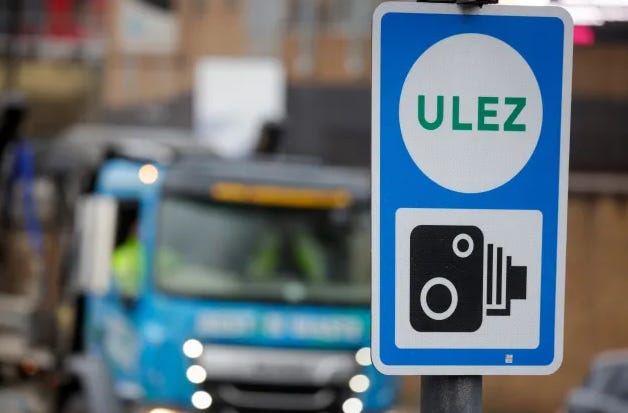
Last Friday, a retired appliance engineer named Kevin Rees was jailed for 15 years at the Old Bailey for blowing up a Ulez camera in a London street in December 2023. The judge found that the offence was motivated by terrorism; the blast damaged cars and property up to 100 metres away, including a child’s bedroom. Of course, building a bomb and detonating it on a residential street is a grave crime, and nothing below excuses it.
But it is fair to ask how a roadside charging scheme became a cause that drove one man to explosives, and why as many as 1,500 cameras are said to have been attacked in some way. Despite an FOI request for an update on how many cameras and other sensors had been attacked or removed, the authorities withheld year-by-year vandalism counts and repair costs, citing public safety and criminal investigations in February 2026.
The extension of the zone to all 32 boroughs in 2023 was imposed on millions of people who had no meaningful say in it. Labour’s loss of the Uxbridge by-election that July was widely blamed on it, and London Mayor Sir Sadiq Khan himself has acknowledged that when the original zone was launched, “all the mainstream political parties, including my own, were opposed”. What we are looking at is less a public-health measure than a moral crusade with a revenue stream.
Moving goalposts and modelled deaths
The standard defence is that Ulez and related measures (such as Low Traffic Neighbourhoods) have worked; London’s air has indeed improved. In 2024, for the first time, London recorded no breach of the UK’s legal annual limit for nitrogen dioxide, and compliance with Ulez standards has risen from 39% to 97%. One might think this the moment to declare victory. Instead the goalposts have moved. In 2021 the World Health Organisation cut its annual guideline for nitrogen dioxide from 40 to 10 micrograms per cubic metre, and for fine particulates from 10 to five, and Imperial College’s Frank Kelly has welcomed Khan’s commitment to bring London into line. But a target that recedes as one approaches it is not a target but a treadmill.

