

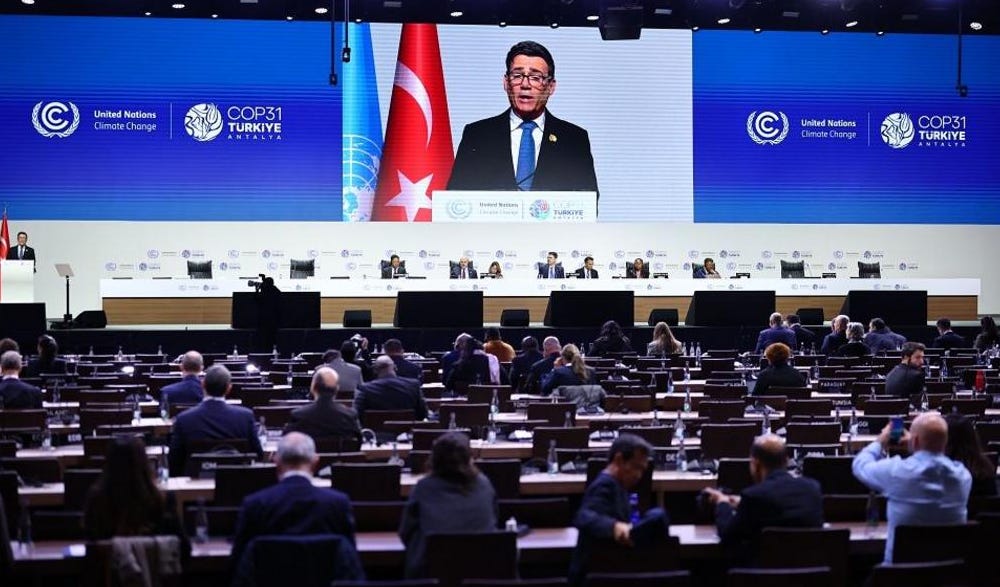
Last Thursday, Prime Minister Andy Burnham made his debut at the UN climate circus in Antalya. As the first speaker – the only G7 leader to attend the conference – he had five minutes to address a half-empty hall. He recommitted Britain to Net Zero by 2050, declared that “Britain is back” and endorsed Turkey’s pledge to raise electricity’s share of global energy demand from 21% to 35% by 2035 – “35 by 35” – promising a clean electrification road map to match. He even conceded that the “consensus we once enjoyed on science and climate has gone”.
Nine days earlier, the Telegraph reported that the very same government was backing away from the subsidies that make wind and solar power commercially possible. Energy Minister Michael Shanks told a House of Lords committee that next year’s Contracts for Difference (CfD) auction would be paused so the scheme could be reformed. Ministers imposed a moratorium on new levies and policy costs on household bills. And Chancellor John Healey said in the Budget that Labour’s priority is “first and foremost cheaper energy”, which Whitehall sources read as a demotion of the 2030 clean power targets championed by Ed Miliband – who, as Foreign Secretary, was sitting in the Antalya audience.
The same man, in the same fortnight, presents two faces. At home, a Government alarmed by voters’ bills is quietly easing off the subsidies that push those bills up. Abroad, in its folly of global climate leadership, promises to electrify everything faster than anyone else. The two goals collide. Promoting intermittent renewables at the expense of reliable fossil fuels and lowering energy costs are contradictory goals: the first raises prices, so the second requires abandoning the first. Sooner or later, Burnham will have to choose between them.
A pause is not a policy
Start with what actually happened. The headline said “halt”; the reality is a pause. Shanks said the CfD process had given investors valuable certainty, but that Ministers wanted to consider whether more significant changes were needed to make it work for consumers. This year’s auction, Allocation Round 8, is going ahead: the system operator is due to publish its notice of auction on November 19th. Ministers also acknowledged that renewable capacity is growing faster than grid upgrades, causing bottlenecks, wasted power and wind farms being paid large sums to switch off, and said a plan is being drawn up to limit future capacity in Scotland. That is a remarkable admission from a Government that, until a few weeks ago, was telling us that more wind was the route to lower bills.
“Investor certainty” is the polite phrase for the problem. A CfD guarantees a developer a fixed price for its output, and the risk is shifted onto consumers’ electricity bills, as I explained in my critique of an Oxford University report claiming renewables are cheaper than gas. Pausing next year’s auction does nothing about the contracts already signed, which will keep drawing on billpayers for years.
The moratorium on new levies sounds like relief but freezes nothing that already exists, and it sits awkwardly beside the Government’s insistence that it still backs 95% clean electricity by 2030. Treasury Minister Dan Tomlinson has now said it is right that the system costs of all new power are considered. Quite so. They are precisely the costs that levelised-cost (LCOE) comparisons leave out, and which make the ‘cheap renewables’ story a fairy tale. The Treasury’s other favoured trick, moving costs from bills to general taxation, is a shell game: last year’s Budget took about £150 a year off household bills according to the government, but the bill did not vanish; it moved from the meter to the payslip.
Paying to switch off the wind
Much of Britain’s wind power is generated in Scotland, where transmission capacity is constrained in delivering power south to where the demand is. When the wind blows, the system operator pays wind farms to switch off and pays gas plants in the south to switch on. Octopus Energy – hardly an enemy of renewables – calculates that Britain had by early October already passed last year’s entire £1.47 billion bill for doing so. The system operator forecasts £3.2 billion in the year to July 2027, and the Government itself has warned that the figure could reach £10 billion by 2030.
These are the system costs that the renewables lobby never puts in its glossy tables. Modo Energy puts transmission constraint costs at £1.9 billion in 2024-25, 71% of all balancing costs, up from 44% two years earlier, and on course for £4-8 billion a year by 2030 without major intervention. As with the CfDs, the bill is recovered from consumers. The UK’s electricity crisis is not the product of a poorly designed market; it is the product of Net Zero, which pushes weather-dependent generation into a grid built for dispatchable power.
Meanwhile the bills themselves are not behaving as promised. Ofgem’s cap rose to £1,723 in October, a three-year high, and Cornwall Insight forecasts a further 9% rise in January. Burnham himself told the Commons on September 1st that UK household energy bills are “the highest in Europe”. Full Fact found that, in 2024, UK industrial electricity prices were also the highest among International Energy Agency members with available figures. ‘Electrify everything’ means loading more demand onto the most expensive commodity in the developed world, down wires that cannot carry it.
Antalya: a performance for an empty house
The summit Burnham flew into has all but given up on its signature promises. Oil-producing Arab states renewed their opposition to fossil fuel transition roadmaps as the conference opened; Brazil’s roadmap is voluntary, and a binding fossil fuel agreement is reported to be unlikely. Regarding money, which makes the world go around, the EU’s own climate commissioner, Wopke Hoekstra, said fresh demands for new climate finance commitments were “dead in the water“. The opening plenary then adopted a finance work programme demanded by developing countries over EU objections, while the push to make the tripling of adaptation finance a separate agenda item was dropped. In effect, the cupboard is bare.
The US again sent no delegation. Burnham spent just over an hour at the venue, a planned meeting with Brazil’s President Lula was cancelled, and he flew on to Dublin. In the audience sat Ed Miliband, who now holds the UK’s seat as Governor of the World Bank (as one of 189 Governors) and who intends to push that institution back towards the climate agenda it has spent a year retreating from, in a collision course with Washington. Perhaps Burnham read the American midterms as proof that the climate hydra lives. After the Democratic sweep, that the UN green hydra has seemingly been given a second life. But the American voters who delivered it were punishing high energy prices not demanding more climate virtue.
Then there is the arithmetic of the speech itself. The 21% that Burnham wants lifted to 35% is electricity’s share of total global final energy consumption. The remaining 79% is direct burning of fossil fuels or their use as feedstock – in transport, industrial heat, agriculture, shipping, aviation and petrochemicals. Raising that share by roughly two-thirds in nine years, with grids that already pay to throw wind power away, is merely a virtue-signalling slogan.
Burnham also declared climate a national security issue and named Dame Madeleine Alessandri as the UK’s special representative for climate security. Yet the security crisis the world actually lived through this year was not a warming one; it was the closure of the Strait of Hormuz, which showed that the the world still runs on fossil fuels. A Government serious about energy security would be asking how to secure supplies of the fuels behind the 79% of final energy that is not electricity instead of appointing yet another envoy.
Pleasing no one
Nor does Burnham’s two-step please the faithful. Green Party leader Zack Polanski and Friends of the Earth’s Asad Rehman questioned Burnham’s climate credibility after the speech. The greens point to the approval of the Jackdaw gas field, a pending decision on Rosebank and possible cuts to the electric vehicle sales target. They think he has sold out; sceptics can see he has not changed course. In April, Miliband was vowing to double down on Net Zero in the face of the Hormuz shock, accusing opponents of “nonsense and lies”. Burnham’s Government now quietly retreats while repeating the vows.
And the Prime Minister’s answer to the cost of private-sector energy is the one thing certain to make it worse: GB Grid, announced at the Labour conference in September as a publicly owned company to take on private energy operators, being not much more than a reheated Fabianism. A man cutting subsidies to private wind developers while proposing state ownership of the grid leaves the cost of intermittency, in the end, with the taxpayer.
Make a choice
It is not that the Government has lost its nerve, it is just that it has never found its conviction. It cannot maintain the fiction that renewables lower costs, because ordinary people can see in their own bills that green policies raise prices. So it tries to do both: keeping the Net Zero and ‘electrify everything’ policies on the books while quietly extricating itself from the auctions that guarantee returns to wind developers. Such tinkering at the edges will neither lower energy prices nor achieve Net Zero or ‘35 by 35’.
At some stage Burnham will have to decide whether to continue the vast subsidy programme that promotes renewables and attempts to wean the country off natural gas for power and heating, or to discontinue it and allow some semblance of rational energy policy, in which fossil fuels play their role in giving the economy and its people affordable energy for heating, mobility and industry. A Prime Minister who admits at a COP that the consensus has gone has taken the first step. The second is to admit that the policies built upon that consensus went with it.
Until then, Burnham has two faces, and neither is looking at the electricity bill that ordinary people face.
Dr Tilak K. Doshi is the Daily Sceptic’s Energy Editor. He is an economist, a member of the CO2 Coalition and a former (cancelled) contributor to Forbes. Follow him on Substack and X.

It's not totally impossible to shift electricity more towards 35% and do this mainly through renewables. My position is simply this. Renewables can work cost effectively. Norway and Paraguay are proof. Solar also can play a big part in some geographies. Anywhere with long sunny days and an energy demand at that point (e.g for aircon) might well find solar can lower costs.
The problem is places like ours, the UK. We have no real hydro to speak off, solar is literally useless at the time ww need energy most and wind is getting very pricey even at LCOE level. Plus we have sunk cost in a grid that depends on firm power.
I have never for the life of me understood why our dumb politicians think it's a one size fits all. Some place can do 100% renewable (Paraguay), some can probably manage to integrate 15-20% (us).