

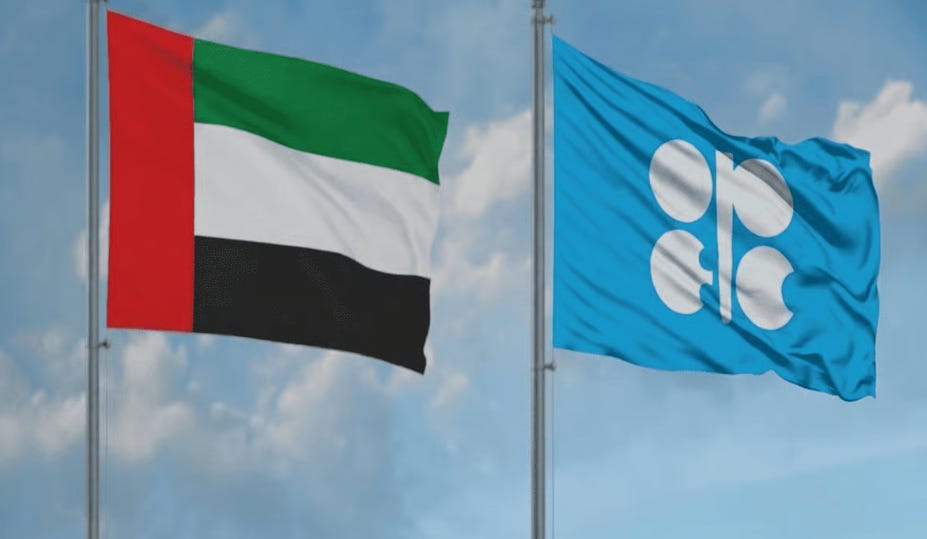
The United Arab Emirates’ announcement on Tuesday that it will leave OPEC and OPEC+ effective May 1st sent shockwaves through the energy world. As the cartel’s third-largest oil producer, with a production capacity approaching five million barrels per day and ambitions to push higher, the UAE was no peripheral player. Abu Dhabi joined OPEC back in 1967 — before the UAE federation existed in its modern form — and the unified UAE carried that legacy for nearly six decades.
The exit decision was framed by Emirati officials as a “policy-driven evolution” in pursuit of “long-term strategic and economic vision”. Within hours, a familiar trope emerged among media commentators: the UAE, fearing the inexorable global march towards Net Zero, is racing to avoid ‘stranded assets’. Oil will be left in the ground, you see, because electric vehicles in China and Europe’s Green Deal will soon render the black stuff obsolete.
Watch out for stranded assets!
The stranded assets narrative is the climate alarmists’ weapon of choice. In behavioural economics, the tenet of loss aversion suggests that the fear of a tangible loss is far more effective than hope for putative gains in shaping actions. For over two decades, climate activists and financial pundits have argued that fossil fuels — coal mines, oil and gas fields, pipelines, refineries — would soon suffer the fate of the buggy whip on the eve of the automobile age. The energy transition, they insisted, would ‘strand’ trillions of dollars in hydrocarbon assets as the world turns away from carbon-intensive fuels.
Climate activists have long claimed that technological progress in energy efficiency and renewable energy technologies combined with climate policies pursued by governments around the world will lead to substantial falls in demand for fossil fuels. A Financial Times column in 2020, for instance, claimed that the pursuit of climate change policies would “evaporate” a third of the current value of the big oil and gas companies. If countries met their Paris Agreement commitments and kept to the “no more than 2°C above pre-industrial levels” target, 50% of all coal, oil and gas resources would be “stranded” and, by definition, have zero value. If the stricter 1.5°C maximum is aimed for, then 80% of the world’s fossil fuels would be stranded.

