

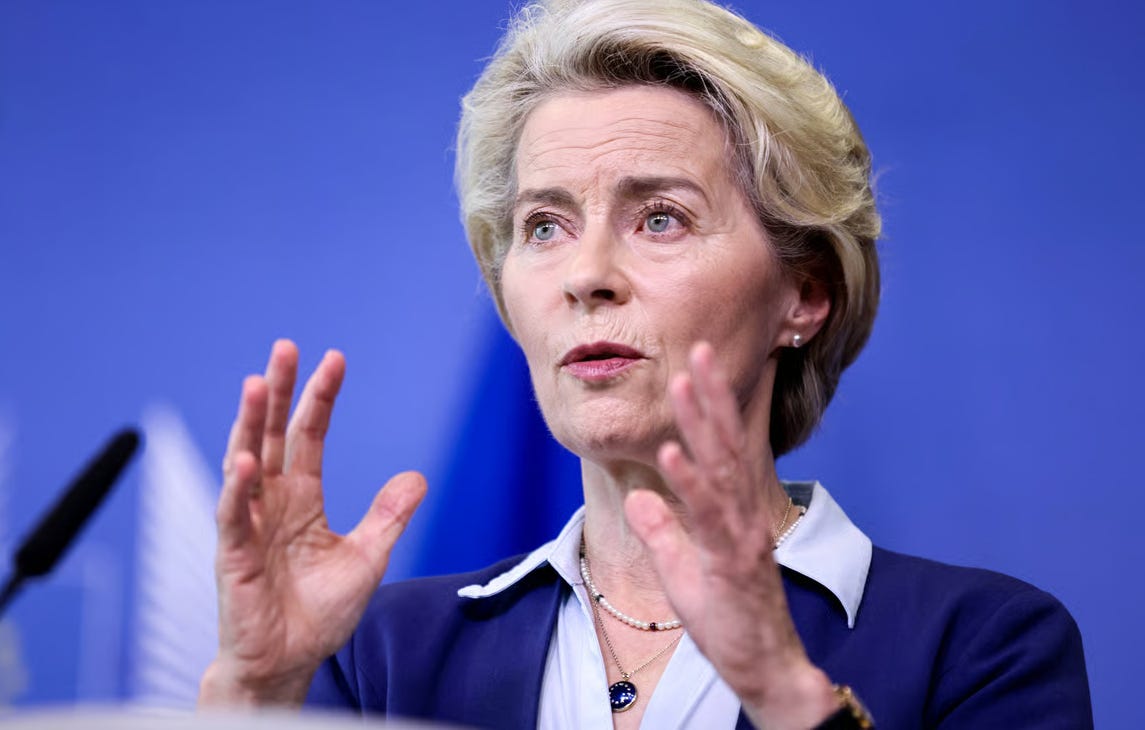
We have discussed previously on these pages, Ed Miliband’s proclamation of Britain’s “golden age of nuclear”. This week, Miliband’s atomic chorus was joined by none other than European Commission President Ursula von der Leyen. In a speech to the Nuclear Energy Summit in Paris, the leader of the conflicted Commission of the collapsing Union announced that “Europe needs homegrown, low-carbon energy sources”, and that “nuclear and renewables together have a key role to play”.
There has never been a meaningful proposal for “nuclear and renewables” for precisely the reason von der Leyen states: “Nuclear energy is available around the clock, providing electricity all year.” Europe’s and its member states’ energy policies were driven by fantasies of 100% renewables. And what would be the point of building intermittent generation capacity alongside 24/7 capacity, which is furthermore not well-suited to ramping its output up and down? Moreover, the green ideology that was absorbed into Europe’s political architecture was overtly hostile, not only to nuclear energy, which it claimed was too risky, but to all abundant and cheap energy – i.e., solutions that didn’t require immiseration. It was in response to the possibility of ‘clean’ nuclear power providing cheap energy that the green movement’s godfather, Paul Ehrlich claimed it would be like “giving an idiot child a machine gun”.
There are no straight lines in this history, however. In his critical history of the environmental movement, Green Tyranny: Exposing the Totalitarian Roots of the Climate Industrial Complex, Rupert Darwall explains that Sweden sought to establish the climate change narrative both domestically and on the global political agenda to advance its own plans for nuclear energy as far back as the mid 1970s – before climate change was really a ‘thing’. But, to cut a long (and very worthwhile) story short, a very different attitude to industrial development congealed in Germany, which says Nein Danke to Atomkraft. Despite its industrial prowess, “German culture harbours an irrational, nihilistic reaction against industrialisation”, says Darwall. Renewables seemingly reconcile this deep contradiction.
Europe, for the most part, is not an oil and gas producer, explains von der Leyen. Consequently, dependence on imports puts the EU “at a structural disadvantage to other regions”. True. But what the President forgets is that it was the EU that, in the 2000s, opened its doors to the Green Blob.

