

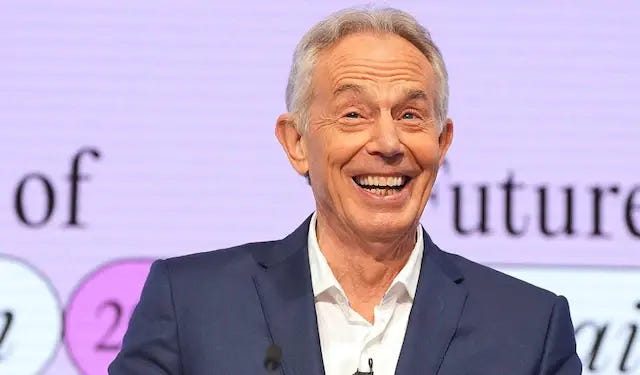
I have previously written here about six reports from the Tony Blair Institute for Global Change (TBI), each of which has taken an increasingly critical stance towards Ed Miliband’s interpretation of Net Zero – namely his “Clean Power 2030” agenda. Blair’s reports have made a few ripples, indicating a weakening of what had been a rock-solid consensus position on the Left-of-centre, mirroring the Conservatives’ Net Zero epiphanies. Now, rather than tasking his wonks, the former Prime Minister has set out his objections in his own words – nearly 6,000 of them in a broader ramble about the direction of the party he once led to three election victories. And those words, far more forceful than those of his minions, have attracted much more attention, with Blair going as far in interviews about his essay as calling Ed Miliband’s agenda a “quixotic fantasy”, but resisting the implication that Miliband is thus a “quixotic fantasist”.
Whether or not Blair will move the Government from its fantasy, this latest intervention does undermine the foundations of the policy agenda. It is an unfortunate fact of British politics that it takes a figure like Blair to effectively authorise the expression of Net Zero scepticism, even though the stark arithmetic facts of the climate agenda’s inevitable doom have been obvious from the outset. Resistance to basic arithmetic was fuelled by the Green Blob’s dominance over British politics, and by the hollowing out of our democracy, as I shall explain below. And, as I’ve argued, Blair’s objections are not all they seem. They overstate the progress of electrification, for example, rather than industrialisation. And Blair’s epiphany comes extremely late in the day, apparently linked to his contention that the AI boom is not a bubble that is about to burst, but an industrial revolution – a hope shared by his Institute’s grantors. He also believes that climate policy and AI are central to his ultimate dream: digital ID. So before I retire from climate scepticism and give thanks to the Dark Lord, I wish to sustain the theme of my recent articles.
Climate policies are the expression of an attritional war against us. They consequently largely consist of banalities repeated ad nauseam. The war required the weaponisation of institutional prestige, followed by the rhetorical neutron bomb: who are you going to believe, some blogger or the world’s top scientific institutions? The capture of such institutions and the constant bleating of green litanies were, for a long time, not dampened by the failure of alarmist prognostications – the non-event of ‘runaway global warming’, the total lack of evidence depicting a ‘climate crisis’ and endless green energy policy and hardware failures. It’s easy – I would imagine – to regurgitate the vapid slogans of the green agenda when it’s a requirement of a six-figure salary. Debunking them comes at a net cost. The fissure that opened up on the Green Blob, which is now eroding the consensus, did not open up on ground created by climate science or policy scepticism. It is falling apart because of its own internal contradictions. And Blair epitomises them.
Let’s get straight to the heart of Blair’s political metaphysics. “The centre – properly defined – is where you put policy first and politics last”, claims Blair in his essay. According to this formulation, “you begin with the question: what is the right answer?”. And the final step of this method: “only once you have that do you engage in the political task of persuading people of it.”
This is garbage. And it is made even worse by Blair’s argument for a “radical centrism”. “Yes, Britain needs radical change,” he… um… explains… “but the difficulty (not just in Britain) is that too often the sensible people aren’t radical, and the radical people aren’t sensible.” The evidence for this claim of British politics having re-polarised – i.e., away from the centre – is Labour’s experiment with Corbynism, and the Tories with Brexit.

