


This piece by Dr Patrick Frank is the second in a series of 12 articles challenging climate change orthodoxy commissioned by Professor Gwythian Prins. We will be publishing the articles at a rate of one a week over the next 12 weeks (read the first article here). The hope is that they can be collected into a book for Sixth Formers and university students.
Since 1990, the United Nations Intergovernmental Panel on Climate Change (IPCC) has released six Assessment Reports (AR), averaging one every five years four months. The IPCC ARs contain the latest representations of climate science applied to human impacts on the terrestrial climate. Over the intervening 35 years, expressions of concern about human-produced emissions of carbon dioxide (CO2) and other so-called greenhouse gases have evolved from speculative warnings that they may change the climate for the worse to dead certainties of having done so.
IPCC certainties notwithstanding, the climate itself has shown no manifestations of a great change. As ably conveyed by the Oxford-trained physicist Ralph Alexander, extremes of climate have not increased. Like fusion power, year by year human-caused climate disaster seems to be always 20 years in the future.
A word about temperature extremes. The climate has been warming since the Little Ice Age – the 1300-1850 cold period. Widespread monitoring of air temperature did not begin until about 1850, just as the modern warming trend began. Starting with measurements from a cold period, a warming climate will necessarily produce a series of ever-new ‘record temperatures’ of no particular significance.
My own journey into this wilderness began with the IPCC third Assessment Report. The media din of accusatory polemics was exhausting. As a means of retaining sanity, I decided to discover for myself whether there was a need to worry about CO2 emissions and climate.
After two years study, I learned that climate models make huge mistakes when modelling the climate. This was a Damascus moment. Large errors meant the IPCC could not possibly know what it claimed to know.
Examining climate modelling papers with a new clarity, I saw that these modelling mistakes never conditioned the published analyses or conclusions. Claiming that climate models can resolve an effect of our CO2 emissions on the climate is rather like claiming one can use a jeweller’s loupe to resolve the outlines of an atom.
A further discovery followed: IPCC air temperature projections are simplistic. The modelled climate is made to warm passively in response to increased CO2 as though nothing else changed.
Attempts to publish this work in peer-reviewed scientific journals led to a further discovery. Namely, that climate scientists, apart from research meteorologists, are evidently untrained in determining the physical integrity of climatological data.
My reviewers showed no ability to distinguish between statistical uncertainty and physical error. Likewise, propagation of uncertainty seemed a foreign language to them. Such a shocking lack of training in how to evaluate the integrity of one’s own data is to be expected only in a naïf who had never taken even a high school physical science course. Climate modellers are apparently unprepared to evaluate the physical reliability of their own models.
As a personal aside, my impression was that some reviewers read the title, ‘Propagation of Error and the Reliability of Global Air Temperature Projections’, and merely inferred the content before writing a review. I did not realise the title would sow such confusion. In point of fact, uncertainty is propagated therein rather than physical error. They are very different. But one must read the paper to discover this. “Propagation of error” is the name by which I learned the method and I defaulted to that rendering. I should have been more explicit and titled the paper, “Propagation of Uncertainty and…”.
Publication finally came after six years, 13 journal submissions and 30 reviews. The reviewers for Frontiers in Earth Science: Atmospheres provided the knowledgeable and constructive reviews one expects in the physical sciences. I have continued to receive misconstrued criticisms which I rebut in specific detail, forming a now lengthy commentary alongside the 2019 original.
Analysis of the simplistic climate modelling approach to air temperature projections and the confounding simulation errors they made revealed that nothing can presently be known about the effect of CO2 emissions on air temperature. Climate models are far too coarse to resolve the very small impacts of increased CO2, or even to inform us whether our CO2 emissions produce a discernible effect at all. The story is summarised in the Figure.
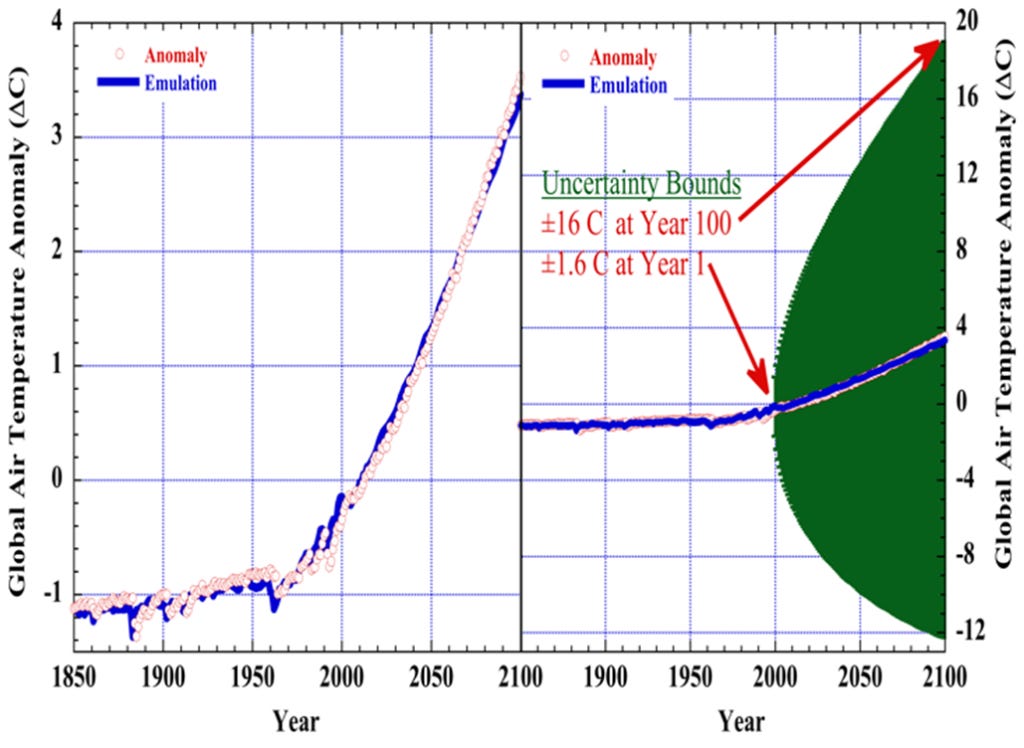
To understand the Figure, it is necessary to understand uncertainty as it is used in the physical sciences. First, uncertainty is not error. Error is the difference between a calculated result and the physically true value. Uncertainty is a measure of our ignorance concerning the physical truth-value of a result. It conveys how much confidence one should have in that result. Errors can be seen. Uncertainty is a judgement (which can often be made quantitative).
One cannot observe the air temperatures of the future. They are not knowable. Therefore, one can never know the error of an air temperature projection. This is a major impediment to judging reliability.
However, one can know the uncertainty of the projection. One gets a handle on uncertainty by calibrating the climate models by how well they reproduce the salient observables of the past climate.
Climate models are adjusted to reproduce the air temperatures of the past hundred years. However, they have considerable trouble reproducing the global cloud cover of the recently past climate. This deficiency is known because global cloud cover has been directly observable since 1979, the beginning of the satellite era.
Clouds are a prime controller of the heat energy of the lower atmosphere. The intensity of atmospheric heat energy determines the air temperature. If the adjusted climate models get the past air temperature right, but get the cloud cover wrong, a deep problem is revealed. Wrongly simulated cloud cover should not produce rightly simulated air temperatures. This problem is the case.
The known deficiency in reproducing global cloud cover means that when climate models simulate the future climate, the simulated future cloud cover will be wrong. How wrong, no one knows.
But if simulated future cloud cover is wrong, then the heat energy of the simulated future atmosphere will be wrong, and the projected future air temperature will be wrong. How wrong, no one knows.
It is not controversial that climate models cannot be adjusted to reproduce unknown future cloud cover. However, calibration of climate models against the past climate reveals how wrongly they simulate past cloud cover. We thus know how wrongly they simulate atmospheric heat energy. This, in turn, bears on how poorly climate models are likely able to simulate future air temperature.
Suppose you are using a climate model in a super computer to simulate the future of climate and air temperature. You enter everything you know about the present climate, and then add an estimate for how levels of atmospheric CO2 might change in the future. You hit ‘return’ and off it goes.
Initially, within the computer, the simulated future climate will be similar to the present climate, because the initial change in CO2 is small. Atmospheric heat energy and global cloud cover will not have yet changed much. But with the step-by-step simulation, computed CO2 increases (say), and global cloud cover, atmospheric heat energy and thus projected air temperatures are all simulated incorrectly. How incorrectly, we don’t know.
If CO2 increased the same way in the physically real world as in the computed world, the physically real climate would respond in whatever way the climate responds. But with each new simulation step, our knowledge of the difference between the simulated future climate and the analogous physically real future climate, diminishes.
With every step that simulates cloud cover, heat energy and air temperature all wrongly we have less and less knowledge of this difference. We know there is a difference. How different, we don’t know.
But we can calculate our level of ignorance because calibration of the climate model told us how wrong each simulation step is likely to be. Not how wrong it is, just how wrong it is likely to be.
This is the meaning of the spread of uncertainty around the projection in the figure after 2000. Our ignorance of how far removed the simulated future air temperature is from the physically true but unknown future air temperature has increased with each step of the simulation.
By 2100, the uncertainty is so wide (our ignorance is so great) that the projected future air temperature conveys no physical knowledge at all. In point of fact, none of the projected future air temperatures convey any real information. The projection has no reliability at all.
This ignorance provides an explanation for how it is we’ve gotten into such a mess over climate.
Reiterating the result of this study: climate model air temperature projections have no predictive value. Nor have they any prescriptive value. Projections of future air temperature are physically meaningless. They literally reveal nothing whatever about the level of future air temperature. Not for next year, not for 2050, not for 2100, nor for any other future year.
Since publishing on the physical vacuity attending the climate modelling of future air temperature, I have further investigated and published upon the reliability of the historical air temperature record, and the relation of temperature and CO2 across the 66 million years of the Cenozoic.
There is insufficient space to discuss these works. However, the story remains the same.
The accuracy of measured historical air temperatures is impacted by the local environment. Insufficient wind speed or intensity of direct and reflected sunlight put significant errors into the measured air temperature of even perfectly good, naturally ventilated temperature sensors.
These errors, of unknown size or sign, are permanent in the historical record. They are not reduced by increasing the number of measurements. Those compiling the historical air temperature record do not take these inaccuracies into account and seem to care nothing for instrumental field calibration. Other problems also abound.
The historical and neglected inaccuracies infest past measurements and are forever cryptic. They cannot be accounted or removed from the record. The conclusion stemming therefrom is that neither the rate nor the magnitude of atmospheric warming since 1850 is knowable.
Lastly, over the prior 66 million years, nearly the entire level of atmospheric CO2 can be explained by the temperature of the upper ocean – the part that is in direct communication with the atmosphere. Evidently, for the past 66 million years, atmospheric CO2 was not a driver of climate warmth. Rather, the warmth of the climate drove the level of atmospheric CO2.
The inevitable conclusion is that neither the IPCC nor climate modellers, nor the Royal Society or the US National Academies, nor any government agency or environmental NGO, can possibly know what it asserts about the impact of human CO2 emissions on global air temperature.
At this juncture, what we do know for a certainty is that all the repetition about the ‘settled science’ of CO2 – let alone anthropogenic CO2 – as an unequivocal primary driver of climate change with harmful effect does not make it true. The same deep uncertainty surrounds catastrophic climate change. The truth remains enveloped in clouds of uncertainty which the models simply cannot pierce.
Dr Patrick Frank is a research physical methods experimental chemist, now Scientific Staff Emeritus of the SLAC National Accelerator Laboratory, Stanford University, USA.

Thank-you. I've read your post about CO2 and warming, and agree with you.
The whole CO2-warming argument rests on the assumption that nothing else changes - that CO2 is the only actor.
The assumption is nonsense, and the entire scare rests on climate models that produce physically meaningless air temperature projections.
the betrayal of integrity among the scientific societies, including the APS and the National Academy, is outrageous and worse than shameful.
Great article, thanks.
One thing that gets overlooked is that all these inaccuracies are easily corrected by applying hubris to the inputs!